![[Re]Group: A Playbook for Turbulent Times](https://substackcdn.com/image/fetch/$s_!PUHU!,w_120,h_120,c_fill,f_webp,q_auto:good,fl_progressive:steep/https%3A%2F%2Fsubstack-post-media.s3.amazonaws.com%2Fpublic%2Fimages%2Ff2fb4256-d509-4e61-827b-2ee678efbba9_256x256.png)
![[Re]Group: A Playbook for Turbulent Times](https://substackcdn.com/image/fetch/$s_!OvcZ!,e_trim:10:white/e_trim:10:transparent/h_182,c_limit,f_auto,q_auto:good,fl_progressive:steep/https%3A%2F%2Fsubstack-post-media.s3.amazonaws.com%2Fpublic%2Fimages%2Fa2653539-a634-4ef5-9aab-bc4a7546ebc9_1344x500.png)
![[Re]Group's avatar](https://substackcdn.com/image/fetch/$s_!w0DV!,w_108,h_108,c_fill,f_webp,q_auto:good,fl_progressive:steep/https%3A%2F%2Fsubstack-post-media.s3.amazonaws.com%2Fpublic%2Fimages%2F0517e9f8-af1c-41a5-b83c-2630660e4517_256x256.png)
Everything you need to know about the candidates, Security Council straw polls, debates and public appearances, and the process to get the UN’s top job (Last updated: September 14, 2026).
At a Glance
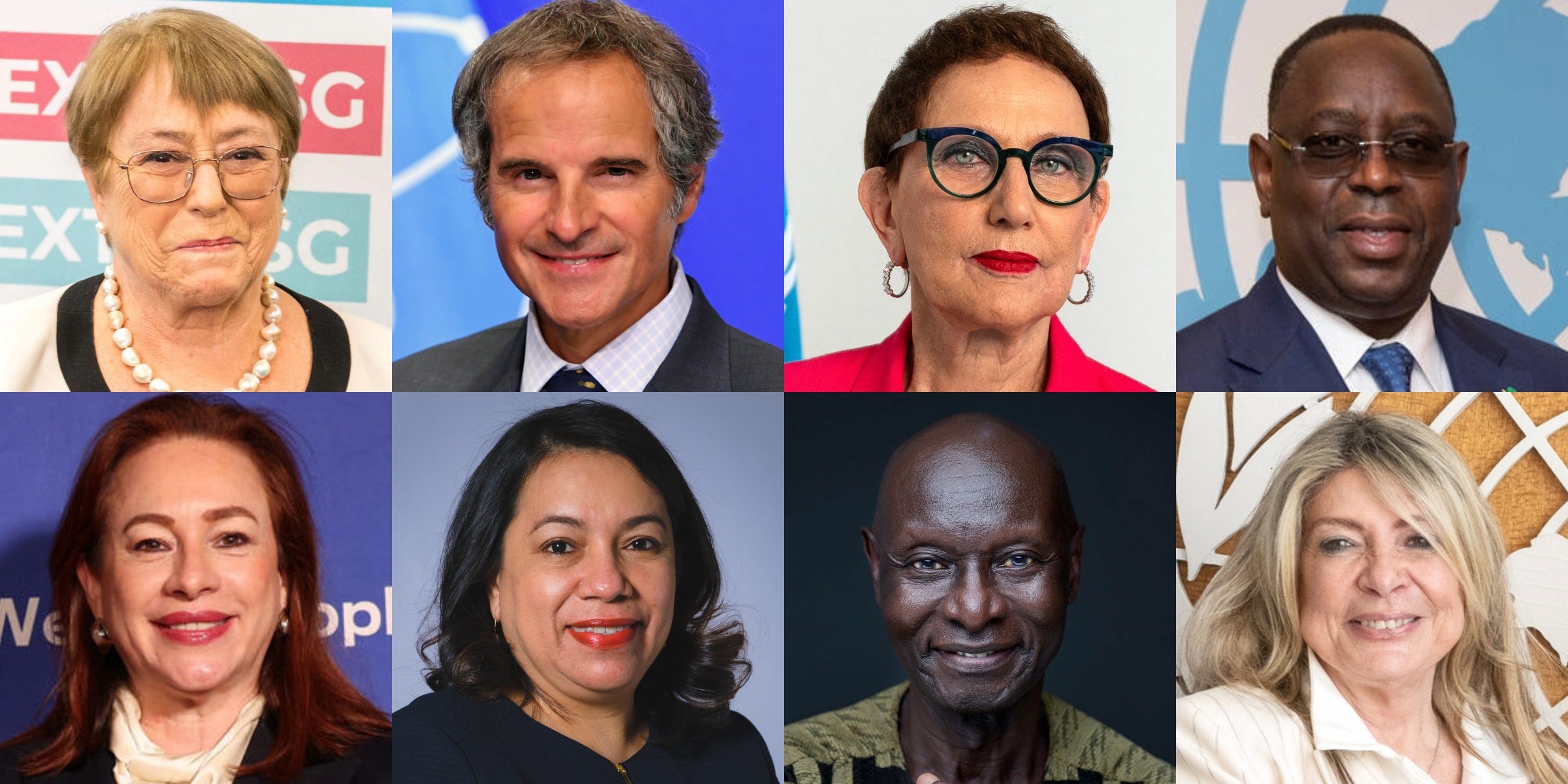
👤 Active Candidates (8): Ivonne A-Baki (Ecuador; nominated by Tonga), Michelle Bachelet (Chile; nominated by Brazil and Mexico), María Fernanda Espinosa (Ecuador; nominated by Antigua & Barbuda), Rafael Grossi (Argentina), Rebeca Grynspan (Costa Rica), Olara Otunnu (Uganda), Carolyn Rodrigues Birkett (Guyana), Macky Sall (Senegal; nominated by Burundi and Senegal)
⚙️ Current Phase: Interactive Dialogue with any other candidates who might emerge; continued public campaigning by candidates; secret ballots in the UN Security Council to winnow down candidates and see if there is a front-runner
🗳️ Next Milestone: Next UNSC straw poll (Sept 18). See the results from the first two straw polls below.
What to Watch For
With two rounds of straw polls completed, no consensus candidate has emerged. The next straw poll is planned for September 18, and history suggests that the shift to color-coded ballots will also likely happen in late September or early October.
All eight candidates have also now completed their Interactive Dialogues in front of all the membership, and the President of the General Assembly will likely encourage any other candidates who may emerge in the coming weeks to have their Dialogue as soon as possible.
During UNGA 81, watch for how the candidates show up and which priorities they throw their weight behind.
Jump to:
Milestones • The Field • Straw Polls and Vetoes • The Politics • Reading and Resources

📅 Milestones
August – September 2026: Subsequent Straw Poll Rounds — Security Council holds subsequent rounds of straw polls under the presidency of France (September). Expect color-coded ballots (distinguishing P5 veto-holders from the E10) during these rounds, likely later in the process (late September or early October).
September 22–28, 2026: UNGA High-Level Week — World leaders gather in New York. A window for bilateral meetings and any “dark horse” candidate entries.
October 2026: Formal UNSC Recommendation — The Security Council aims to adopt a resolution recommending a single candidate to the General Assembly. However, this could be delayed until late in the year (Kofi Annan did not make it out of the Security Council until December 13, 1996).
October-December 2026: Transition — The 193 Member States will vote in the General Assembly (historically by acclamation) to appoint the 10th Secretary-General, allowing for a planned three-month transition period.
January 1, 2027: Term Begins — The new Secretary-General officially takes office.
👤 The Field
Legal basis:
UN Charter Article 97 — “Appointed by the General Assembly upon the recommendation of the Security Council.” Modalities: GA Resolution 79/327 (pp. 6–8, 2025) sets timelines, eligibility, withdrawal rules, and ethics for campaigning.
Key rules:
Candidates can be nominated by any Member State, individually or jointly (no requirement to be nominated by their own country) at any point until the next Secretary-General is selected and appointed.
Member States can withdraw nominations; only one candidate at a time.
Requirements: CV, vision statement, campaign finance disclosure. Candidates holding UN roles should suspend them or consider doing so.
Active Candidates
Withdrawn Candidates
📊 Reading the Field
With the first Security Council straw poll having taken place on July 30 (leaked results here, and our analysis here) and the second round on August 21 (leaked results here), both candidates and analysts now turn to making sense of each vote. Experienced watchers of the selection process suggest that zeroing in on "discourage" votes (the higher the number, the lesser the chances) is key. For those in the lead, figuring out where the “discourage” came from will be essential. As for what results mean for late entries, some analysts say that a strong late entry only works if the front-runner has genuinely stalled.
1. A Compact Field (For Now)
With eight candidates, the 2026 field is slim compared to the 2016 race, when 13 contenders were in the frame. However, because there is no official deadline for nominations, candidates can theoretically enter right up until the Security Council votes to recommend a single name.
2. Geographic Matters (Until It Doesn’t)
By the informal regional rotation system, it is traditionally the turn of the Latin American and Caribbean countries, which account for five of the eight active candidates (with the remaining two coming from Africa). Notably absent is the Eastern European Group (EEG) — the only UN regional group that has never produced a Secretary-General (and was passed over in 2016). (See the official list of UN Regional Groups for background.)
3. The Pressure for a Female Secretary-General
All nine Secretaries-General have been men. General Assembly Resolution 79/327 urged Member States to “strongly consider” female candidates. With five women among the eight active candidates, the Security Council will face public scrutiny if it passes them over in favor of a 10th male Secretary-General.
4. The Nomination Game
Member States are ignoring the traditional convention that a country only nominates its own national. Burundi nominated former Senegalese President Macky Sall, who was later also endorsed by Senegal. Antigua and Barbuda (GRULAC) nominated Ecuador’s María Fernanda Espinosa. Tonga nominated Ecuadorian diplomat Ivonne A-Baki. Multiple nominations protect candidates from withdrawals, keeping Michelle Bachelet in the race when Chile withdrew its sponsorship on March 25.
🎙️ The Public Campaign and Debates
Before the race moved behind the closed doors of the Security Council, candidates spent months on the public campaign trail. Between April and July, they presented vision statements at the General Assembly’s Interactive Dialogues, participated in independent hustings across London, Geneva, and Jeju, and faced off in a televised UN Town Hall in New York.
📖 Full Debate Archive
For event recaps, video recordings, full transcripts, and news coverage from every public forum, check out our companion piece:

⚙️ How Straw Polls and Vetoes Work
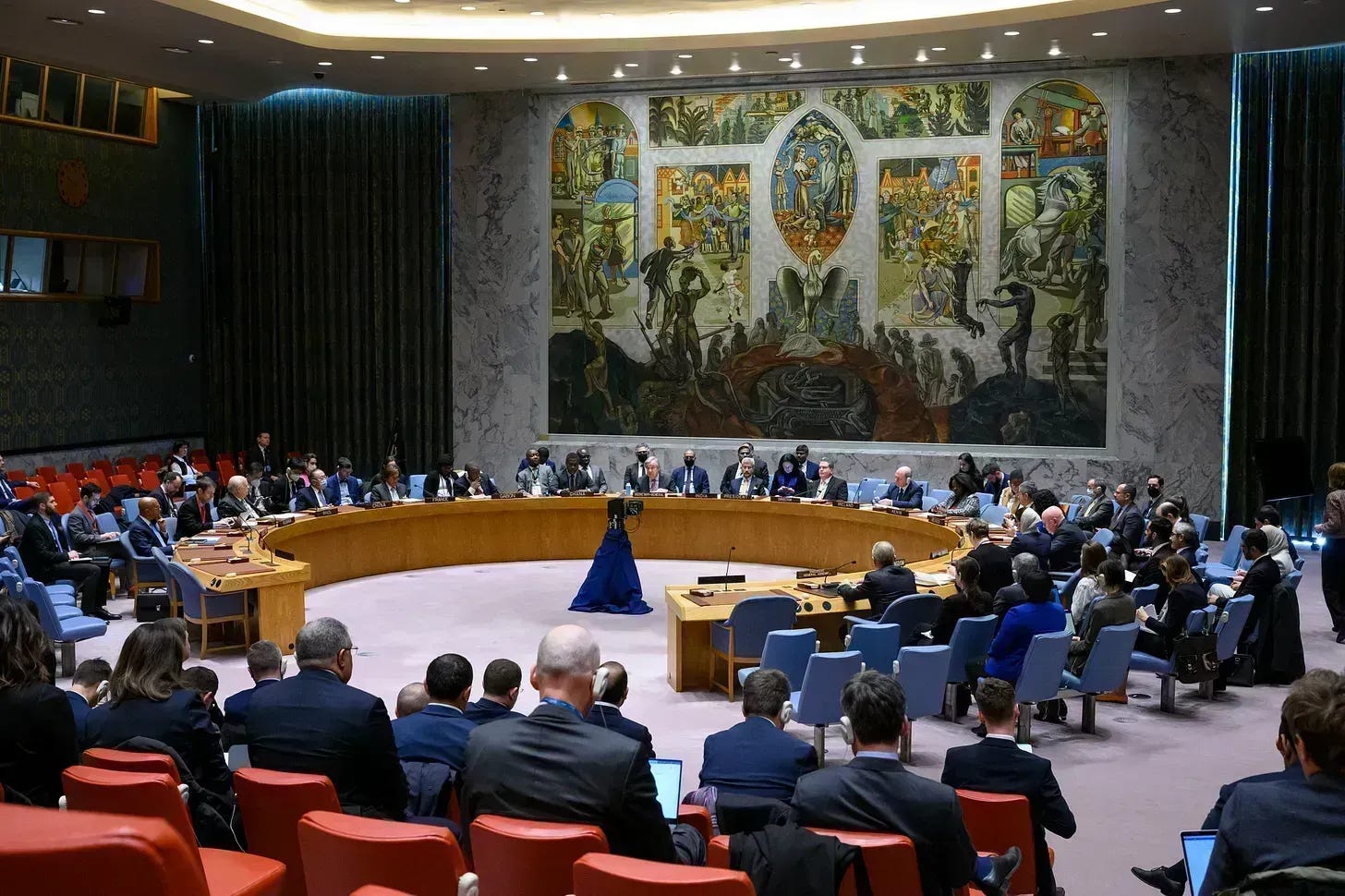
While the General Assembly hosts public debates, the power to select the Secretary-General rests firmly with the 15 members of the UN Security Council. A P5 veto is decisive; broad support across the E10 and regional groups is critical.
To filter the field without triggering formal vetoes too early, the Council relies on a series of informal, secret votes known as straw polls.
📖 Deep Dive on Straw Poll History
Discover how Ugandan Ambassador and now SG candidate Olara Otunnu invented secret straw polls during the 1981 deadlock in our full guide:

1. The Early Rounds (Standard Ballots)
Starting in late July under the Presidency of the Democratic Republic of the Congo, the 15 Council members cast secret ballots for each candidate. Members can select one of three choices:
Encourage
Discourage
No Opinion
While these ballots are strictly confidential in theory, the totals leak to the press within minutes, but mystery remains on how each country has voted. The initial rounds serve as a war of attrition to test candidate momentum and pressure underperforming “tailenders” to withdraw.
First Round of Straw Polls
We now have the Security Council’s first views on candidates in the race for UN Secretary-General.
On July 30, the 15 members cast their first secret straw polls. No consensus candidate emerged, but for the first time a woman, Rebeca Grynspan (Costa Rica), is leading the first straw poll. Watch if the candidates with too many “discourage” votes choose to drop out. Read our analysis of results here.
2. The Late Rounds (Color-Coded Ballots)
As the field narrows (typically in August or September), the Council switches to color-coded ballots to reveal where the permanent members stand. The E10 vote on white paper, while the P5 vote on red paper.
A single “Discourage” vote on a red ballot signals an insurmountable P5 veto. Usually, P5 countries push for colored ballots to be used as early as possible, while the E10 fight to keep the playing field level.
3. The Winning Threshold
To secure a formal recommendation from the Security Council to the General Assembly, a candidate must achieve two things:
Secure at least nine “Encourage” votes out of 15.
Receive zero red “Discourage” votes from the P5.
The Security Council’s recommendation is likely to specify a five-year term (”for a term of office from January 1, 2027 to December 31, 2031”), although some have argued for a single seven-year term.
At that point, it is over to the General Assembly to approve the candidate, by acclamation (usually) or by secret ballot (Rule 141).
4. The Transition
After the Secretary-General–designate is sworn in before the General Assembly, we will see the first senior hires (Deputy Secretary-General, Chef de Cabinet, key Under-Secretary-General posts). Expect them to reflect priorities, regional balance, and any horsetrading during the selection process.
The 10th Secretary-General’s first day in office is on January 1, 2027. Look out for their inaugural priorities speech later that month.
📰 Weekly Analysis
For updates on P5 tactics, dark horse rumors, and race dynamics, subscribe to receive [Re]Group Weekly.
🏛️ The Politics
While we all focus on what candidates say in public, what matters most is what they say to the key players in the Security Council, and what the major powers are signaling to each other.
The race also does not happen in a vacuum, and global events could easily start to reshape the negotiations.
1. The Key Decision-Makers
The P5 (The Veto Holders): China, France, Russia, the United Kingdom, and the United States hold most leverage. Any one of them can sink a candidacy with a single red ballot.
The E10 (The Elected Members): The ten elected members vote but cannot veto. However, their collective support is mathematically essential for a candidate to reach the nine-vote minimum threshold. The current E10 roster features Bahrain, Colombia, the Democratic Republic of the Congo, Denmark, Greece, Latvia, Liberia, Pakistan, Panama, and Somalia.
2. The Power of the Presidency
The Security Council President is a monthly rotating chair who holds significant influence over the frequency, timing, and rules of the straw polls.
July (Democratic Republic of the Congo): Oversaw the first standard ballot round.
August (Denmark) & September (France): Under the presidency of Denmark, the second straw poll took place in late August, and probably more rounds will be held ahead of UNGA in September. History suggests that France will oversee the shift to color-coded ballots.
October (Greece): The preferred window for the Council to resolve the contest and finalize its recommendation to the General Assembly.
November (Latvia) and December (Liberia): The deadlock zone. If the Council fails to resolve a veto standoff by October, all bets will be off in November and December.
January (Portugal): Five new elected members join the Council in January, including Portugal, which takes the Presidency. Don’t discount the nightmare scenario where no new Secretary-General is in office as the new year starts (because insiders haven’t and they’re already creating contingency plans).
3. External Events to Watch
The late stages of this race collide with international events that could shift strategic priorities if the selection runs late into the year, or may shape the Secretary-General-elect’s transition plans:
September 12–13: BRICS Summit (India) — A major gathering of the Global South, pulling the focus of P5 members Russia and China right before the UNGA.
September 22–28: UNGA High-Level Week (New York) — The ultimate diplomatic mixer where backdoor deals are made.
October 4 (and Oct. 25 runoff): Brazilian General Elections — A critical election for Latin America’s largest power (and co-nominator of Michelle Bachelet).
November 3: U.S. Midterm Elections — A domestic distraction for Washington if the race is not wrapped up in October as planned.
November 9–20: COP 31 Climate Summit (Türkiye) — A major multilateral test for the UN system.
November 18–19: APEC Summit (China) — Hosted in Shenzhen, this summit will demand diplomatic attention from the P5 right in the middle of the potential “deadlock zone.”
December 14–15: G20 Summit (Miami) — The final major gathering of world leaders before the new Secretary-General’s term begins on January 1.

🔍 Reading and Resources
UN Charter Articles 97-101 on the role of the Secretary-General and Secretariat
GA Resolution 79/327 on the selection process, paragraphs 38–46
Joint letter by the President of the General Assembly and President of the Security Council to Permanent Representatives on the process, inviting nominations
Security Council Report’s report on the history of the selection process, December 2025
1 for 8 Billion Ultimate Guide and Candidate Policy Profiles
Proposals for process improvements from the Accountability, Coherence, and Transparency (ACT) Group (informal group of 27 Member States)
Tracker of UN Member State support for a woman to be Secretary-General by 1 for 8 Billion, Global Network of Women Peacebuilders, and NYU Center for Global Affairs.
Abbreviations
APG — Asia-Pacific Group
E10 — Elected members of the Security Council
EEG — Eastern European Group (has never had a Secretary-General)
G77 and China — Group of originally 77 and now 134 developing countries
GRULAC — Latin America & Caribbean (rotation turn)
MS — Member State
P5 — Permanent members of the Security Council
PGA — President of the General Assembly
PR — Permanent Representative
PSC — President of the Security Council
UNSG — UN Secretary-General
UNGA — UN General Assembly
UNSC — UN Security Council
WEOG — Western European & Others Group
ICYMI
Read more about the race for the next UN Secretary-General.
