![[Re]Group: A Playbook for Turbulent Times](https://substackcdn.com/image/fetch/$s_!PUHU!,w_120,h_120,c_fill,f_webp,q_auto:good,fl_progressive:steep/https%3A%2F%2Fsubstack-post-media.s3.amazonaws.com%2Fpublic%2Fimages%2Ff2fb4256-d509-4e61-827b-2ee678efbba9_256x256.png)
![[Re]Group: A Playbook for Turbulent Times](https://substackcdn.com/image/fetch/$s_!OvcZ!,e_trim:10:white/e_trim:10:transparent/h_182,c_limit,f_auto,q_auto:good,fl_progressive:steep/https%3A%2F%2Fsubstack-post-media.s3.amazonaws.com%2Fpublic%2Fimages%2Fa2653539-a634-4ef5-9aab-bc4a7546ebc9_1344x500.png)
![[Re]Group's avatar](https://substackcdn.com/image/fetch/$s_!w0DV!,w_108,h_108,c_fill,f_webp,q_auto:good,fl_progressive:steep/https%3A%2F%2Fsubstack-post-media.s3.amazonaws.com%2Fpublic%2Fimages%2F0517e9f8-af1c-41a5-b83c-2630660e4517_256x256.png)
By Callie Sones, Diana Paz García, Bruce Jones, and Jeffrey Feltman
We are in the grips of a geopolitical furor, and most eyes are trained on events in Tehran, politics in Washington, and the imminent summit between Donald Trump and Xi Jinping (if it is not postponed once again). But in New York, thoughts have turned to the election of the next Secretary-General of the United Nations.
This week, candidates participated in a sequence of webcast dialogues, primarily with Member States but also with some vetted questions from civil society organizations. The hearings come after considerable diplomatic wrangling by their official host, President of the General Assembly Annalena Baerbock (former foreign minister of the world’s fourth-largest economy, an unusually high stature holder of the role).
Seeking more engaging ways to go about the selection process, Baerbock encountered stiff resistance, primarily from the five permanent members of the UN Security Council. That they should have put sand in the gears of an issue this limited in scope is instructive. It shows the political tensions surrounding the institution, but also that the major powers believe this is a job that still matters. The P5 never had any intention of losing control of the selection process.
The dialogues arrive at a fraught juncture for multilateralism. The UN has been roundly criticized over its perceived failures in Gaza, Ukraine, and elsewhere. The analytical consensus is that the international order and the multilateral system that supports it are under significant stress, perhaps to the point of rupture.
That context does not relieve policymakers of the obligation to take seriously the question of who will lead the UN after António Guterres concludes his tenure on Dec. 31. A careful reading of the history of the institution, whatever its limitations, reveals something the current skepticism tends to obscure: The UN has at times been a crucial diplomatic off-ramp in great-power crises.
UN mediators and observers were deployed to help end the first Arab-Israeli war as early as 1948. The same year the UN Security Council was the venue for negotiations between the P3 (the United States, the UK, and France) and the Soviet Union to ease the Berlin Blockade. When North Korean troops, with Chinese and Soviet backing, invaded South Korea in 1950, it was a UN force that assembled to resist and reverse the aggression. The legacy of that action lives on today in the form of the UN Command that technically oversees the U.S. troop presence on the peninsula.
The Suez Crisis in 1956 led to mediation by Canadian diplomat Lester Pearson and the deployment of the UN’s first large-scale armed peacekeeping forces. And so on through the Katanga Crisis (1960–63) and the Yom Kippur War (1973). Famously, this includes U.S. President John F. Kennedy and Soviet Premier Nikita Khrushchev’s use of Secretary-General U Thant as a back channel during the Cuban Missile Crisis in 1962, with strong backing from Indian Prime Minister Jawaharlal Nehru and other nonaligned leaders.
The pattern did not end with the Cold War. U.S. President Bill Clinton and his French counterpart Jacques Chirac made use of UN authorization in the Balkans in 1999. The second Bush administration sought Security Council legitimation ahead of the 2003 Iraq War. In its first term and despite its institutional skepticism, even the Trump administration engaged with UN frameworks on specific issues, such as sanctions resolutions against North Korea. In his second term, even while acting unilaterally in Venezuela and Iran, President Trump has turned to the UN to authorize a gang suppression force for Haiti, alongside a new UN mission to provide that force with logistical support.
The lesson is not that the UN is invariably indispensable, but that it has been consistently available to states willing to use it. The quality of the UN’s leadership has real consequences for its availability and effectiveness.
Revisiting the structural critique
The prevailing critique of the UN holds that the institution is hidebound, insufficiently flexible, excessively bureaucratic, and structurally incapable of responding with the speed or creativity that contemporary crises demand. This critique, however compelling rhetorically, obscures more than it explains. When states have chosen to engage with the UN, they have found that it can often be deployed in ways that are more creative and consequential than a negative narrative would suggest.
We can see this flexibility across a range of diverse deployments. For instance, the UN established a commission to handle compensation claims following Iraq’s invasion of Kuwait, and deployed observers in Georgia to monitor a pre-existing regional ‘peacekeeping’ force. From 1995 to 1999, it placed a preventive force along the Macedonia-Albania border to serve as a ‘blue trip-wire’. In 1999, it authorized the Australian-led multinational force that rapidly restored order in East Timor. More recently, that adaptability has extended to a naval task force patrolling the waters off Lebanon’s coast after 2006 and a unique dual-key judicial arrangement in Guatemala from 2007 to 2019.
The moribund critique also applies to Security Council membership, which has not been revised since 1965. There is a strong normative case for expanding the Council by adding permanent or long-term members to more accurately represent today’s distribution of power. Advocates of Security Council reform, however, routinely fail to explain how adding new members would lead to fewer wars. Those States most likely to trigger the kinds of war that the UN is meant to prevent are already on the Council and already wield vetoes. And even if vetoes were magically waved away, a UN resolution does not stop aggression; only collective defense can do that.
Disaggregating the cost critique
A second line of criticism concerns the trajectory of UN costs.
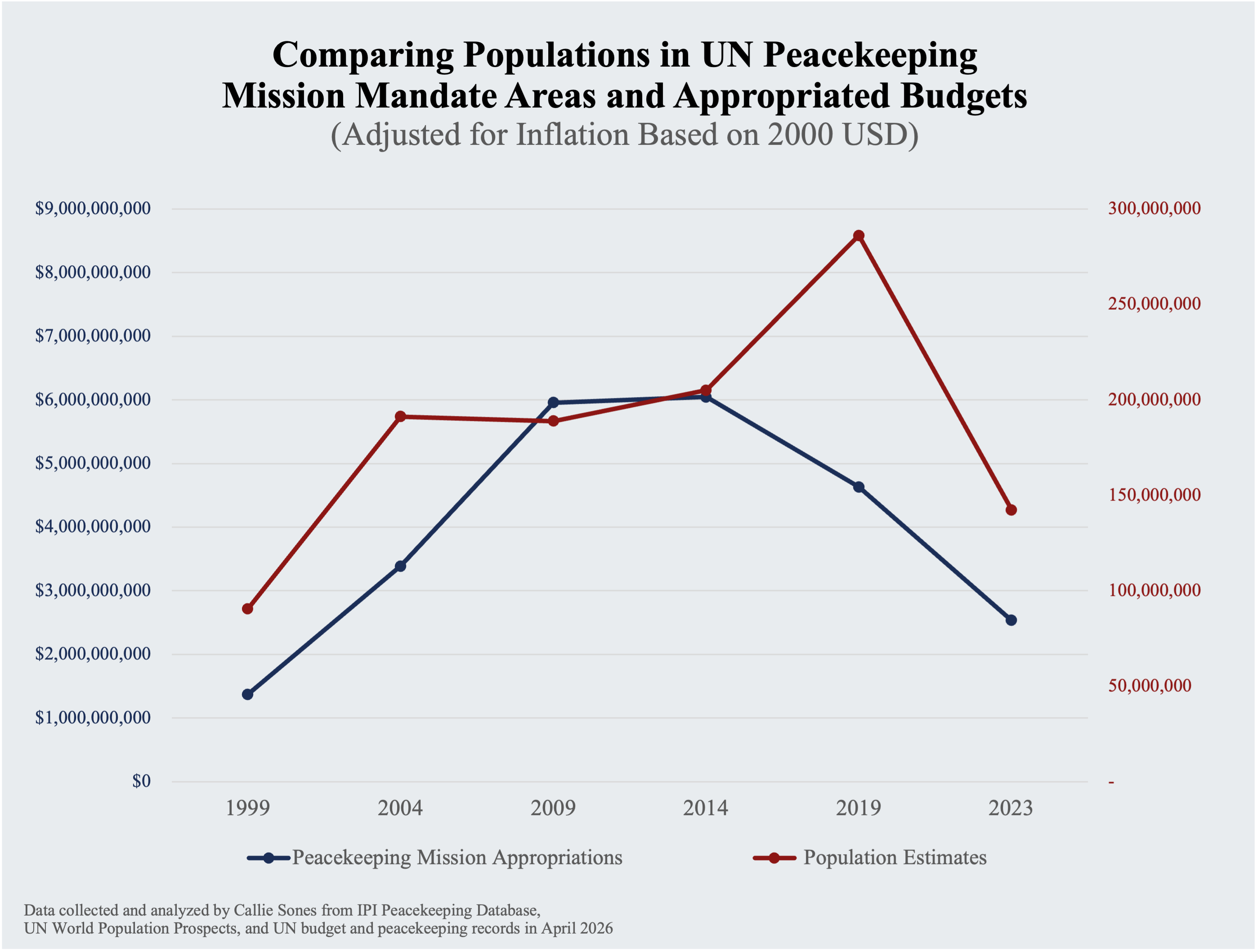
When it comes to the most expensive item in the UN’s budget, peacekeeping, we find little validity to the critique that budgets have run out of control. Many analysts skip over a basic variable: the number of people living in places where UN peacekeeping and political missions are deployed. When budgets are benchmarked against the population covered by the mission’s mandate, a correlation emerges (see figure 1). There has been some fluctuation — per capita costs grew in the mid 2000s as the UN was asked to undertake more complex multidimensional deployments — but have since fallen back to historical baselines. Overall, the more powerful trend is a simple one: The cost of peacekeeping broadly tracks population size.
In real per capita terms, protecting a civilian through UN peacekeeping today costs roughly the same as it did a quarter-century ago in 1999. Throughout this period, costs have tracked the scale of what the institution was mandated to do. That is not evidence of institutional inefficiency. It is evidence of institutional responsiveness.
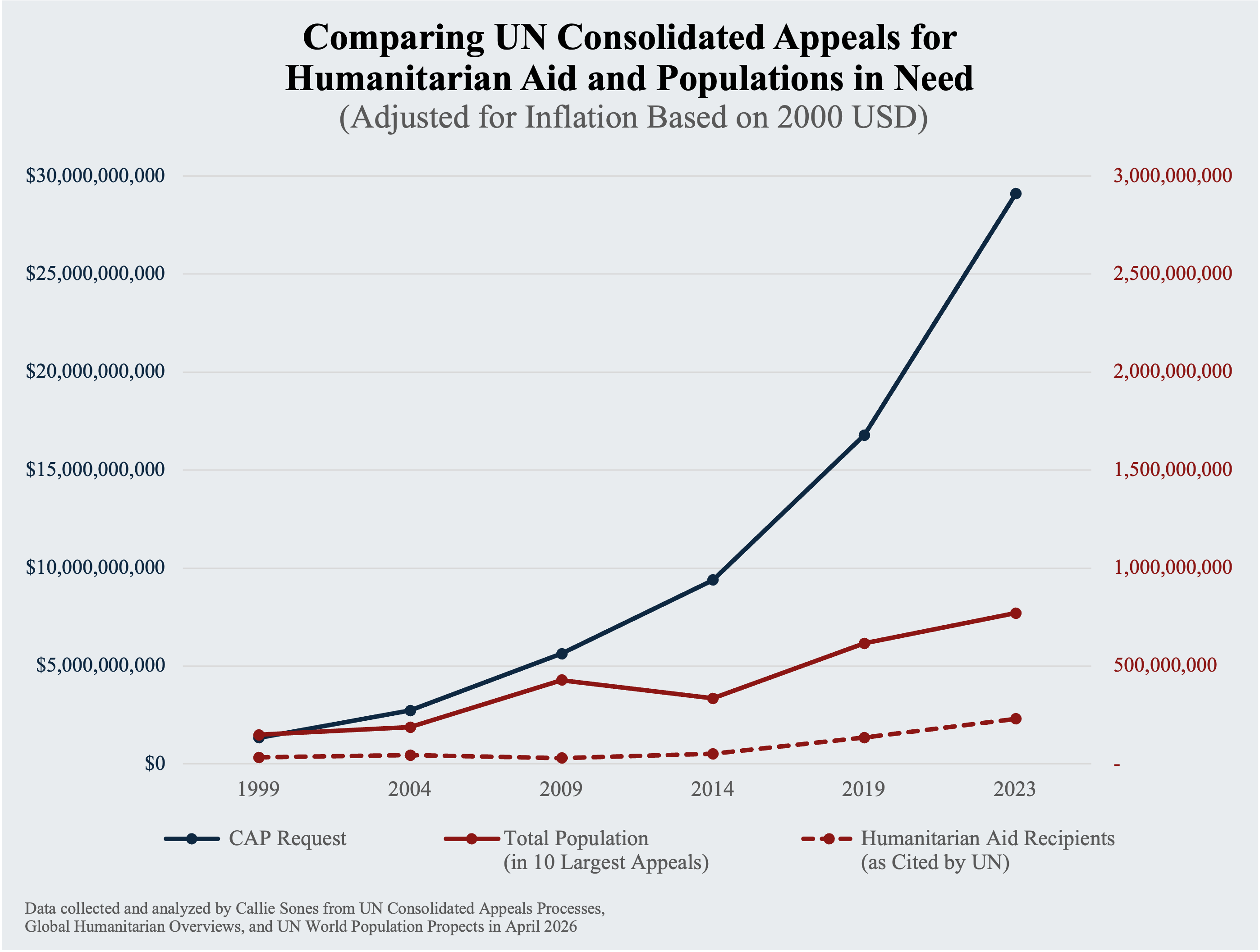
A more persuasive criticism concerns the humanitarian side of the ledger, where the population data does not clearly account for cost growth. The Trump administration has drawn considerable criticism for its deep reductions in UN humanitarian funding. It would be an error, however, to treat this as an idiosyncratic American position. Across the membership, states are reassessing their humanitarian contributions. And as the underlying data suggests, humanitarian budgets have grown at a rate disproportionate to demonstrable demand in population need and operational scope (figure 2). (This data is a snapshot; the picture is made more complicated by the reality that budget requests often go partially unfilled. That nuance doesn’t alter the overall trendline though.)
While the number of people requiring assistance has grown significantly since the turn of the century, the overall budget has grown even faster. After adjusting for inflation, the real per capita cost of humanitarian aid has roughly doubled since the early 2000s and was even higher at its peak in 2015 (figure 3).
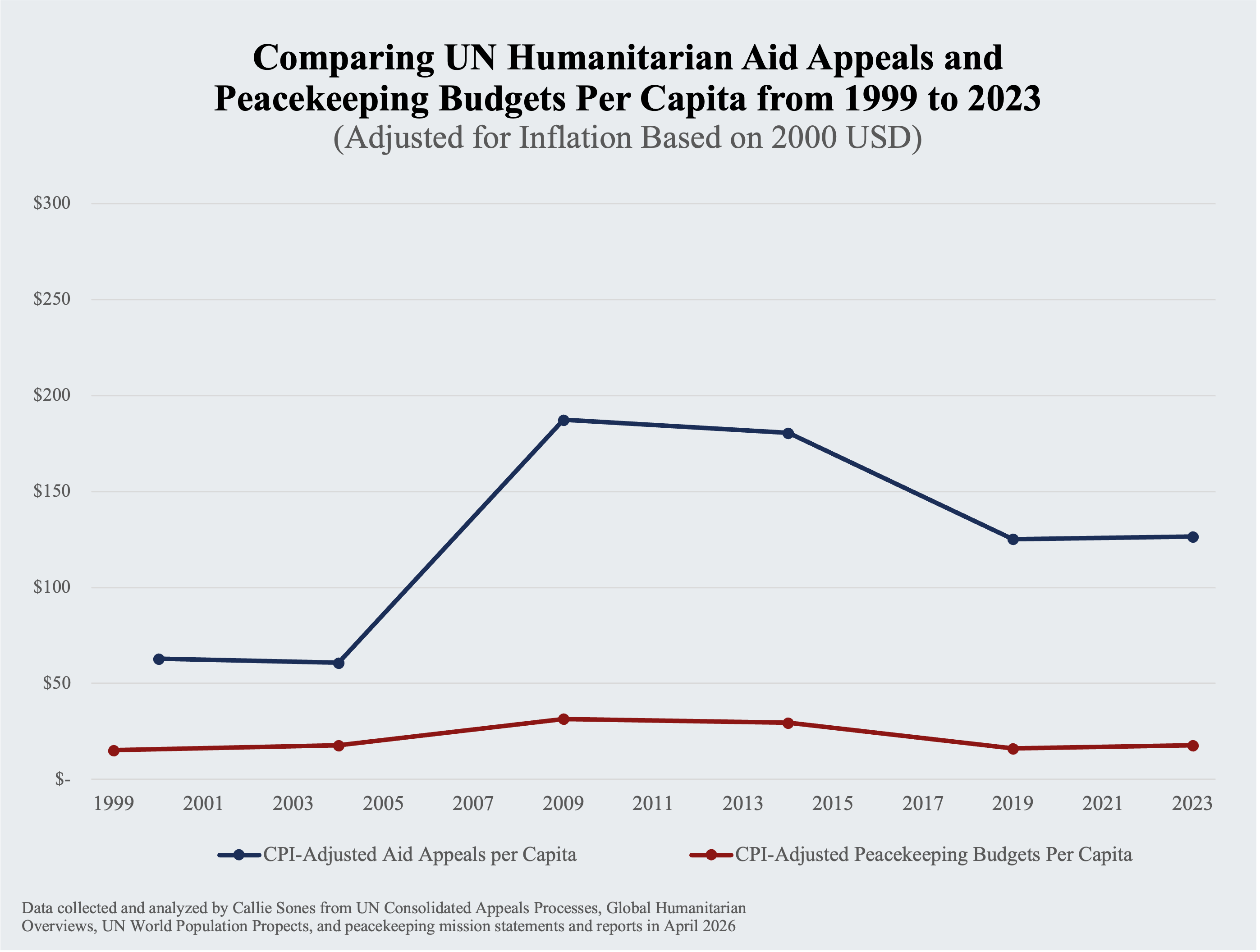
This does not suggest evidence of waste or even inefficiency, but rather reflects the widening scope of the UN’s humanitarian model. However, in the current environment, even after a recent reset that aims to “hyper-prioritize” life-saving operations, alongside deep cuts to headquarters staffing, the UN will still need to confront this structural rise in humanitarian costs.
Implications for selecting a new Secretary-General
The UN’s agenda encompasses an expansive range of issues: from climate governance to international development, from disarmament to digital regulation. But whether the UN can regain some of its lost relevance will depend less on its performance in these areas than on how it fares in its core post-war mission of mitigating conflicts.
To do so, the next leader must once again position the organization as an indispensable tool for de-escalation and crisis management. Whoever takes the helm will have a compelling story to tell on the myriad ways the UN can mitigate crises, and on the realistic costs of keeping the peace in increasingly complex settings. They will also have to get to grips with the structural rise in the cost of humanitarian operations, as funding drops but need continues to grow.
Ultimately, the candidates in New York must offer a narrative that connects the UN’s capabilities to the current geopolitical reality. Yes, they must chart a course for reform, but the real challenge is persuading a skeptical world to care about an 80-year-old institution — and to remind world powers of the ways the UN can help.
While cynics may dismiss the UN’s relevance amid major power aggression and a rapidly changing global order, history suggests a more complex picture. Limiting one of the few institutional tools we have for risk management is counterproductive. There is no advantage to a weak Secretary-General when the world desperately needs better options for crisis management. If we’re facing an all-hands-on-deck moment in world politics, let’s pick clever hands.
About the authors
Callie Sones is an International Affairs and Modern Languages Major at Georgia Institute of Technology; Diana Paz García is an International Security Analyst; Bruce Jones is a Senior Fellow at the Brookings Institution; Jeffrey Feltman is a senior fellow at the United Nations Foundation and the John C. Whitehead Visiting Fellow in International Diplomacy at Brookings.