



Welcome to the [Re]Group Weekly. Today:
From Ore and Order to AI and Arms: Why the race for critical minerals is moving from a clean energy challenge to a battle over technology and military power.
Reading List: From the “new resource curse” to the mines underwriting the AI supply chain, five things to read on the geopolitics of strategic resources.
The SG Roundup: Results from the Security Council’s eighth straw poll, as Türkiye’s Feridun Hadi Sinirlioğlu joins the race.
From the Archive: Catch up on our series of interviews exploring what awaits the 10th Secretary-General in 2027.
From Ore and Order to AI and Arms
In 2021, the International Energy Agency (IEA) argued that “the transition to clean energy means a shift from a fuel-intensive to a material-intensive system.”
Instead of burning fossil fuels, you’re harvesting electrons from sunlight, wind, or water, but you need more complex and varied minerals upfront to do that job (lithium, cobalt, nickel, copper, gallium, silicon, and rare earths). Your new electric car needs six times the minerals of the conventional one it replaced. The onshore wind turbines that power it need nine times more minerals than a gas-fired power plant of equivalent capacity.
To meet the Paris Agreement targets, the agency estimated a quadrupling of demand for critical minerals by 2040 and a sixfold increase to hit net-zero by 2050. To save the climate, you need to dig a lot of mines, in other words.
Who digs those mines — and who profits from them — is at the heart of [Re]Group’s interview with Jojo Nem Singh, founder of the Critical Raw Materials Policy Lab, which launched this week. Jojo has spent the past five years asking: “Why do some mineral-rich states turn ore into industry while others keep shipping dirt?”
At the beginning of the decade, the focus was on boosting supply. The IEA warned of an impending “mining gap,” with existing mines and projects unable to meet projected demand and lead times for new mines that average more than 16 years: “12 years to complete exploration and feasibility studies, and four to five years for the construction phase.”
Jojo’s research shifts the question from “How do we open more mines?” to “Who controls the midstream refining, intellectual property, and equipment needed to process the ore?” Or more pithily: “Who makes the money?”
Building domestic processing takes a mix of forceful state intervention, private sector agility, cheap energy, patient capital, and a political bargain that can restrain corruption, limit environmental damage, and navigate trade rules designed to trip developing economies up.
Prepping for the interview, I dipped into the IEA’s outlook for 2026 to see how that 2021 forecast has aged. Instead of a smooth ramp-up of production, the market has been a roller coaster, spooking investors even as scarcity intensifies and new bottlenecks hit refining and component manufacturing. And, as Jojo’s research has shown, one country — China — holds nearly three-quarters of the more than a million mining patents filed between 1990 and 2023.
According to the IEA, “2025 marked the year when the economic risks of highly concentrated supply chains materialized at scale,” as export controls on rare earths, battery tech, and minor metals put up to $6.5 trillion of downstream manufacturing at risk. The closure of the Strait of Hormuz then “provided another stark reminder of the vulnerabilities affecting mineral supply chains,” cutting off fossil fuel byproducts that are essential to the refining process.
In the interview, Jojo and I talked about how fast the ground has moved over the past decade. First, the shale boom reshaped the global order as the U.S. again became an energy giant. Then the clean energy transition accelerated, turning critical minerals into the new oil. And now, as my colleague Renata Dwan points out, the ground has shifted again, as the battle to control artificial intelligence and a new arms race trigger a fresh surge in demand for strategic minerals.
For Renata, adding demand from tech and defense onto the green transition is rewriting the politics of natural resources. When minerals were just about the green transition, rich countries could bracket them off with a range of other climate problems. Once they became the bottleneck for AI supremacy and military power, the gloves came off. Open markets have become a source of strategic vulnerability for buyers and an obstacle to resource sovereignty for producers. And that’s before you bring in the tech giants (and the billionaires who run them) who are now cutting deals directly with states to lock in mineral rights.
Where does that leave international cooperation? Four questions stand out:
If markets aren’t the answer, are overlapping mineral clubs any better? With nine rival alliances now competing to lock up supply, how do we avoid trashing global public goods, and squeezing the states and communities at the bottom of the value chain?
How do you deal with the power of private actors? When mining, energy, and AI giants outmuscle governments, and armed groups control illicit supply chains, how does state-centric diplomacy keep up?
Can universal institutions rewrite the rules? Can developing countries use the UN and other multilateral institutions to pool their leverage, or will the traditional international system play only a supporting role?
If we are inevitably heading toward a messy “ecosystem,” how do the pieces fit together? And as we asked last week, will complexity create more problems than it solves?
If you missed the interview, (also cross-posted on Critical Raw Materials), go read it and let us know what you think.

A Hole in the Ground Owned by a Liar
Reading List
I had to do a lot of reading for this week’s interview, so if you want to know more about what is a fascinating but often bewildering topic, here’s where to start. Beyond Jojo Nem Singh’s research (begin with this), the report from the Secretary-General’s panel, and other sources linked in the interview, I recommend:
Critical Minerals, Critical Decisions (UNCTAD): Offers an alternative to the IEA’s market outlook, urging mineral-rich developing nations to transform extraction into sustainable growth by aligning their fiscal, trade, and environmental policies, building local processing, and forging regional partnerships with strict community safeguards. Good advice, but as we have seen, easier said than done.
The New Resource Curse (Foreign Affairs): Rabah Arezki, Frederick van der Ploeg, and Michael L. Ross explain why the critical minerals boom may be harder for developing countries to navigate than oil. In a fractured geopolitical order where technologies move fast, demand for a mineral may evaporate before a producer finishes building an industry around it.
The Geopolitics of Critical Minerals and the AI Supply Chain (Institute for Advanced Study): Tatiana Carayannis, Naima Kane, Marie-Therese Png, and Alondra Nelson connect the race for AI supremacy to the mines that make it possible. They show how the rapid expansion of AI “is materially underwritten by extractive regimes and how Global South countries, often treated as peripheral, are in fact central to its unfolding.”
America’s Most Dangerous Dependence (Foreign Affairs): If you want to understand how the U.S. national security establishment views critical minerals, Heidi Crebo-Rediker lays out the fear that Washington’s “key military adversary” controls up to 90% of the processing capacity for materials it would need if it went to war. Pair with this EuroHub4Sino paper on how China is de-risking its supply chains.
The War Below (Ernest Scheyder): A frontline narrative of the race for lithium and copper by the veteran Reuters journalist. I have only just started this book (a recommendation from Renata), but it wins points for the quote attributed to Mark Twain: “A mine is a hole in the ground owned by a liar.”
The SG Roundup
Eighth Straw Poll
Yesterday, the Security Council held its eighth straw poll — once again with standard white ballots. Just as Lana Nusseibeh entered the race before the seventh round, Feridun Hadi Sinirlioğlu was nominated by Türkiye on Nov. 1 — days before the eighth straw poll. He will also meet with the UN General Assembly for an interactive dialogue later today.
The results show Rebeca Grynspan still in the lead with 12 “encourage” votes, followed by Rafael Grossi on nine, Carolyn Rodrigues Birkett on eight, and Nusseibeh in fourth with seven. Some now think we may see the nomination of further candidates (see Russia’s position on the pros and cons of widening the field).
Full breakdown below.
To learn more about the candidates, the straw polls, and the process, check out our cheat sheet.

From the Archive
If you enjoyed this week’s interview, it is the latest in a series exploring the future of multilateralism as the UN elects its 10th Secretary-General.
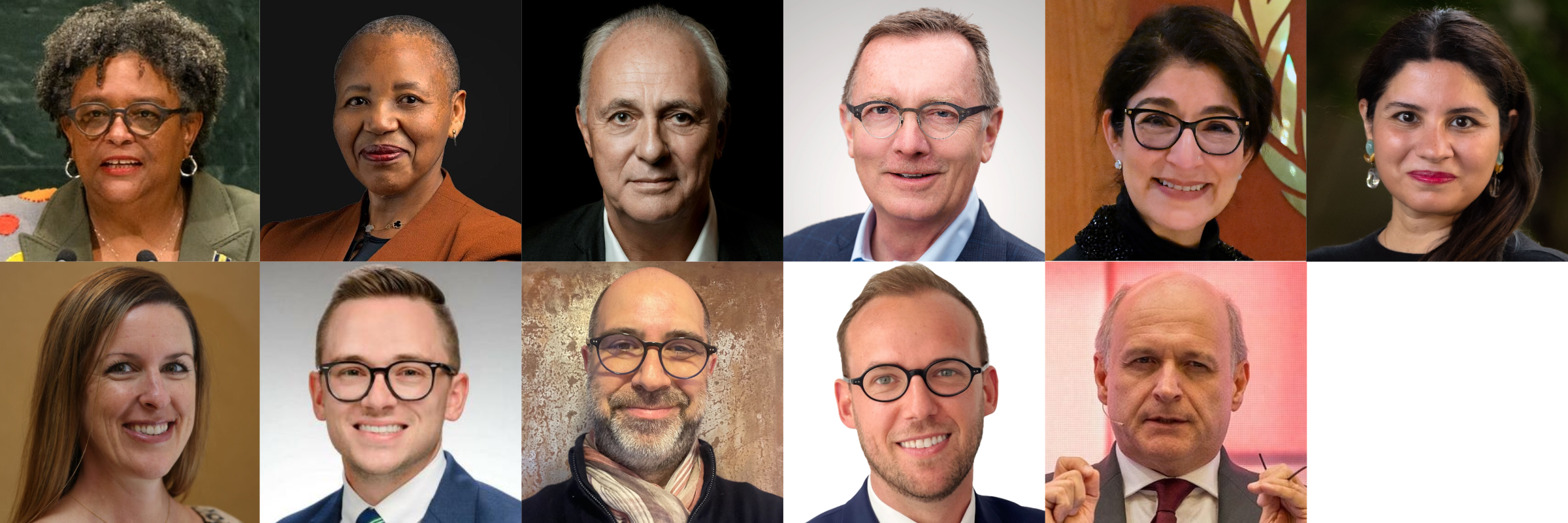
Across the year, we have heard from Barbadian Prime Minister Mia Amor Mottley, Ambassador Mathu Joyini, former UN Deputy Secretary-General Mark Malloch-Brown, and former Under-Secretary-General for Political Affairs Jeffrey Feltman on the challenges facing the UN’s new leader in 2027.
We have also spoken with UNOOSA’s Aarti Holla-Maini on space diplomacy, Nur Laiq on artificial intelligence, Allison Carnegie and Richard Clark on surviving the populist wave, Cepei’s Philipp Schönrock on reforming an “ungovernable” system, Thibault Camelli on the General Assembly, and Francesco Mancini on the rise of middle powers.


