![[Re]Group: A Playbook for Turbulent Times](https://substackcdn.com/image/fetch/$s_!PUHU!,w_120,h_120,c_fill,f_webp,q_auto:good,fl_progressive:steep/https%3A%2F%2Fsubstack-post-media.s3.amazonaws.com%2Fpublic%2Fimages%2Ff2fb4256-d509-4e61-827b-2ee678efbba9_256x256.png)
![[Re]Group: A Playbook for Turbulent Times](https://substackcdn.com/image/fetch/$s_!OvcZ!,e_trim:10:white/e_trim:10:transparent/h_182,c_limit,f_auto,q_auto:good,fl_progressive:steep/https%3A%2F%2Fsubstack-post-media.s3.amazonaws.com%2Fpublic%2Fimages%2Fa2653539-a634-4ef5-9aab-bc4a7546ebc9_1344x500.png)
![[Re]Group's avatar](https://substackcdn.com/image/fetch/$s_!w0DV!,w_108,h_108,c_fill,f_webp,q_auto:good,fl_progressive:steep/https%3A%2F%2Fsubstack-post-media.s3.amazonaws.com%2Fpublic%2Fimages%2F0517e9f8-af1c-41a5-b83c-2630660e4517_256x256.png)
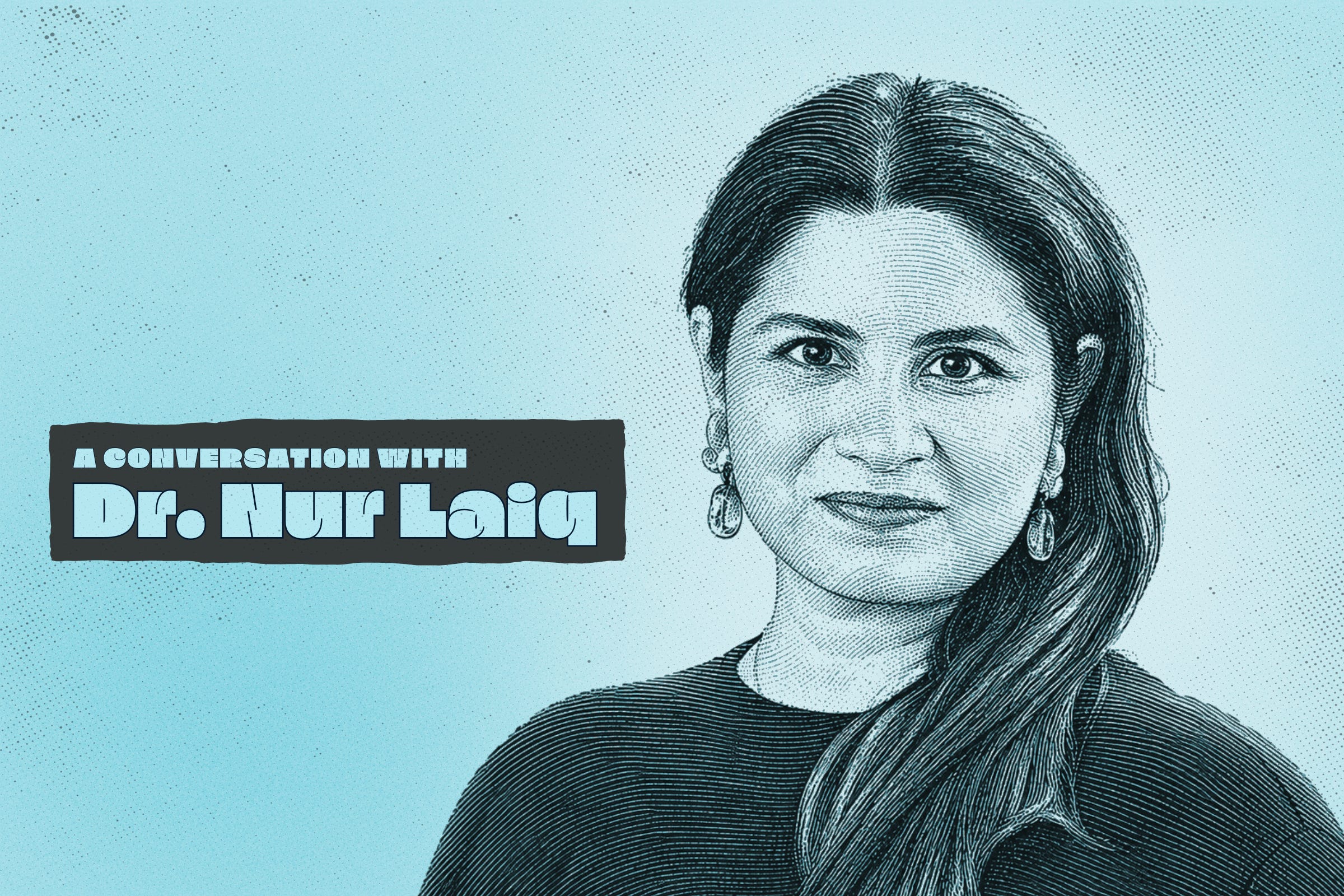
The dominant narrative in Silicon Valley is that tech companies innovate in a vacuum while slow-moving governments struggle to catch up.
Dr. Nur Laiq — who is joining the Johns Hopkins School of Advanced International Studies as a Fellow and also a Non-Resident Fellow at the Center on International Cooperation and the International Peace Institute — challenges this view.
In her analysis, public policy is not just “background noise,” but drives the tech economy. Her research examines “both continuity and disruption in the development of policies related to public goods, innovation, regulation, and geopolitics.”
Viewing the rapid advancement of artificial intelligence through this geopolitical lens, Laiq warns against the “wild west” approach to competition between global superpowers.
As she recently argued in The National Interest:
“AI competition without guardrails is creating a dangerous geopolitical race dynamic that increasingly resembles an unregulated nuclear arms buildup.”
Dr. Laiq is currently exploring this dynamic in a forthcoming book with the working title Move Fast, Break Things: The Policy Origins of Today’s AI Race.
Yet where others see inevitable fragmentation, Laiq sees an opening for the multilateral system. She argues that the UN can anchor global AI governance while leveraging the technology for sustainable development, peacebuilding, and conflict resolution.
Does the UN Have a Seat at the AI Table?

In the United Nations’ early years, Secretary-General Trygve Lie negotiated with governments to stop the nuclear arms race. But today, the code that could reshape civilization is owned by private companies.
We recently hosted Laiq on World’s Toughest Job, where she offered an optimistic take on the UN’s position to govern AI. With the inaugural Geneva dialogues now completed, we sat down with her again for a follow-up conversation to assess the actual state of play.
We focused on three challenges: whether Geneva delivered momentum or was just a talking shop, how the 10th Secretary-General can broker coalitions as the superpowers guard their tech sectors, and how the UN can promote interoperability to avoid countries being locked into an AI Cold War.
Read the [Re]Group weekly for an update on recent developments in AI governance

[Re]Group: The Geneva dialogues are over, the Scientific Panel has published its first report, and the ITU has launched its new commission. How do things stand on the UN’s push to govern AI?
Nur Laiq: Geneva achieved momentum by sharpening the conversation. It showed where convergence is actually possible — child safety, for example, emerged as a potential governance floor.
It was also notable that the Secretary-General put two other major issues on the table: human oversight of weapon systems and the environmental footprint of AI. By 2030, he said that data centers could use more electricity than all but five countries on the planet. His call for an AI Environmental Transparency Initiative — demanding companies disclose their carbon, land, and water footprints — is an important step.
Geneva exposed divergent approaches among Member States, but that is fine. Policy always requires political coalitions to get off the ground. Geneva delivered a clearer political map. The Global South, especially the G77 plus China, reiterated their support for the UN as a primary forum for global AI governance, grounding their position in sovereignty and development interests.
The next task is turning those ideas into concrete mechanisms.
[Re]Group: The Independent Scientific Panel noted that the evidence base for AI will likely come together too slowly to make policy decisions. Usually, the multilateral system has the luxury of time to gradually form a consensus. How can the UN keep up with the speed of change?
Nur: For legislators and policymakers at the UN, AI is not just a technological issue; it is a question of power, of equity, sovereignty, safety, who profits, who regulates, and who gets a say. The technology is moving fast, but we have been managing power for millennia. That gives us a foundation to act.
The first decision for the next Secretary-General is whether they are willing to spend political capital on AI. If so, it must be treated as a priority for the first 100 days.
A new Secretary-General must arrive with a clear framing: AI governance is a core planning issue for the next decade of multilateralism. We need to build an accountability machine — common standards, public disclosures, and public registries — rather than just hosting broad conversations about principles.
The strategic question then becomes how the Secretary-General and the UN system can use their convening power, procurement leverage, and moral authority to ensure AI develops within a public interest framework, rather than being ruled entirely by concentrated private and geopolitical power.
[Re]Group: The United States wants to maintain national control, while China is promoting open source and a shared governance approach. There’s then a massive bloc of consumer countries terrified of being locked out. If you were Secretary-General expending political capital, how do you navigate that geopolitical map?
Nur: The Secretary-General’s role is not to replace state power, but to create political space for inclusion, safety, interoperability, and access. You don’t need all 193 States to agree on everything. The UN can identify overlapping interests through formal blocs and informal groups of friends.
We can bring in civil society and the private sector — there is a real constituency in Silicon Valley deeply concerned about safety, as we saw with the recent Pacing the Frontier letter signed by tech insiders.
But we will need strict transparency and conflict-of-interest rules to ensure that cooperation with the tech sector doesn’t turn into institutional capture.
[Re]Group: This looks like an accelerated version of what the climate world built. Formal negotiations provide structure and overall objectives, and offer a platform for launching alliances with capacity to deliver on priority objectives. You then build an accountability framework around the whole thing. But that is a colossal political lift. Do people in the AI space realize how hard it is to build machinery of this sort?
Nur: The climate analogy is right. That is why the open question remains whether the next Secretary-General wants to spend the political capital and secure the financial backing required to pull it off.
Looking at the candidates, it isn’t clear yet. Michelle Bachelet talks about AI through a human rights lens; Rebeca Grynspan approaches it through a development lens. Others have had less to say. There is an ongoing debate within the UN about whether to focus solely on the original Charter issues of peace and security, or to expend serious capital on AI.
The UN already has a framework for a fair AI bargain: the Sustainable Development Goals.
The Secretary-General can use the SDG machinery, national voluntary reviews, and development banks to demand that Big Tech’s models support SDG delivery and respect common standards for access and safety.
The UN can also champion “plug-and-play” standards so countries avoid getting locked into a single geopolitical bloc or a single company’s ecosystem.
The bargain must mandate local ownership. We need to share a language that empowers governments to say no to extractive arrangements, especially in procurement.
This conversation has been edited for length and clarity.


