![[Re]Group: A Playbook for Turbulent Times](https://substackcdn.com/image/fetch/$s_!PUHU!,w_120,h_120,c_fill,f_webp,q_auto:good,fl_progressive:steep/https%3A%2F%2Fsubstack-post-media.s3.amazonaws.com%2Fpublic%2Fimages%2Ff2fb4256-d509-4e61-827b-2ee678efbba9_256x256.png)
![[Re]Group: A Playbook for Turbulent Times](https://substackcdn.com/image/fetch/$s_!OvcZ!,e_trim:10:white/e_trim:10:transparent/h_182,c_limit,f_auto,q_auto:good,fl_progressive:steep/https%3A%2F%2Fsubstack-post-media.s3.amazonaws.com%2Fpublic%2Fimages%2Fa2653539-a634-4ef5-9aab-bc4a7546ebc9_1344x500.png)

AI enthusiasts imagine a heaven in which artificial intelligence accelerates the discovery of new medicines, helps farmers grow more food on less land, and gives every child access to a brilliant, patient, personalized tutor. Others fear a hell, where AI entrenches inequality, ravages the environment, and ultimately produces uncontrollable systems whose interests diverge from ours.
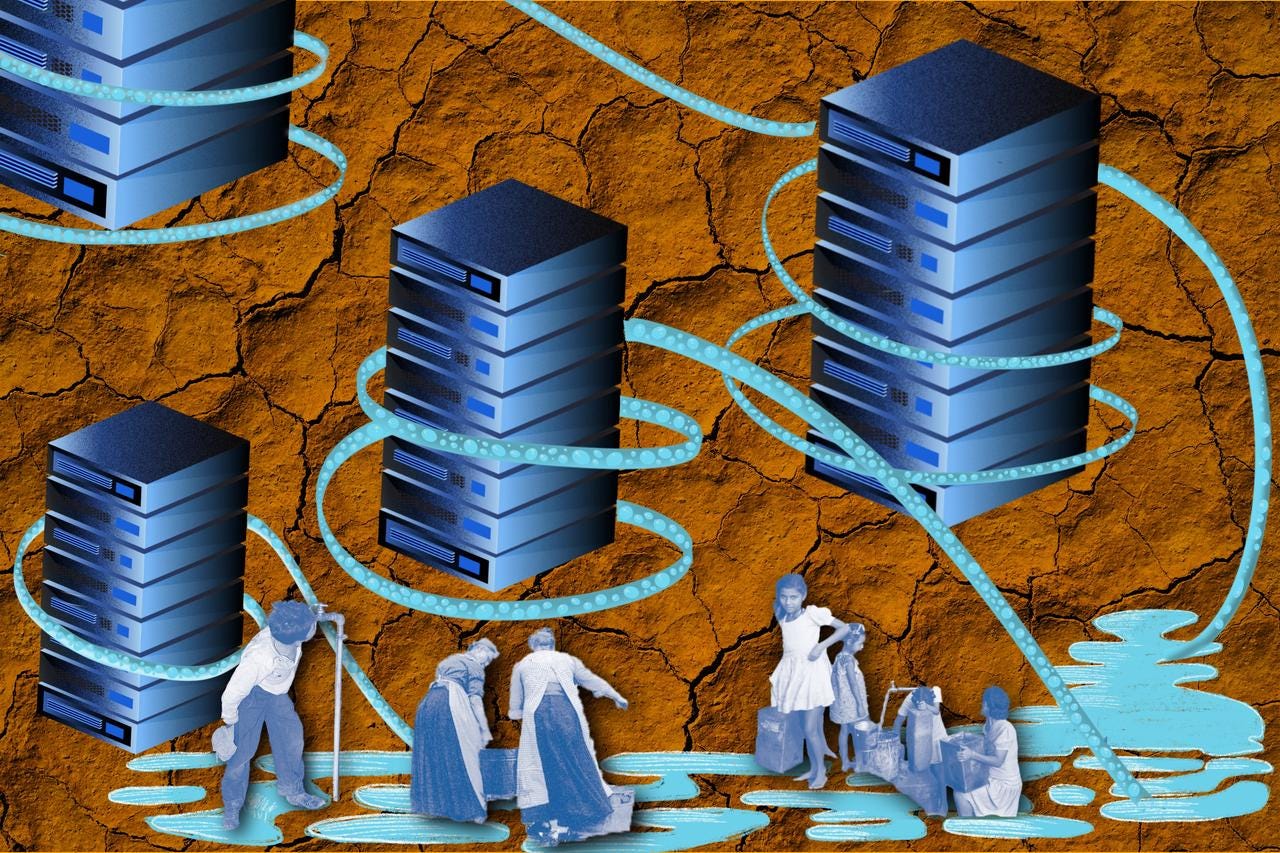
The public, increasingly, take the pessimistic view. People don’t trust AI and fear what it will do to their jobs, their privacy, their children’s futures. Even in a country like India, rapid AI adopters and prolific AI builders, anxiety is rising sharply. In the United States, home of the AI industry, the hostility has turned physical. Hundreds of community groups are organizing against data centers, blocking more than $152 billion worth of investment in 2025 alone. The homes of prominent AI executives have been attacked.
But look at what people do, as well as what they say: AI is the fastest-spreading technology in human history.
The AI industry itself has its own version of this paradox. CEOs warn of AI dangers, to the point of calling for a halt to AI development, but keep building it, for fear that someone else will get there first. The only thing worse than hell, it seems, is hell built by a competitor.
Companies will always be pulled toward profit; the incentives aren’t there for them to solve this problem on their own. Sometimes they chose to behave responsibly, as when Anthropic chose not to release the powerful Mythos model to the public, fearing it could be used for cyberattacks. But it’s hardly reassuring to a bank in Botswana or a hospital in Honduras that the security of their systems depends on a Silicon Valley CEO choosing to do the right thing. People are looking to governments to resolve the paradox. Eighty-two percent of people in a global survey wanted more government regulation of AI, and less than half of them trusted companies to regulate themselves.

But few are rising to the challenge. Elected politicians are trapped in their own version of the AI paradox. They want and need the positive version of the AI story to be true so they can persuade electorates that opportunity is at hand, as the economic outlook elsewhere darkens. They are dealing with electorates who increasingly don’t believe them and want action. And they face tech CEOs telling the story that they are in a race to the death, and the only thing stopping a bad guy with AI is a good guy with AI, so build, build, build.
Trapped in this dilemma, elected leaders — national and local — are most comfortable with immediate, focused actions like banning things (recently: social media for under-16s and data center construction). Talking to the public about the complexity of tradeoffs and decisions involved in AI, and acting seriously to resolve them, is something that few have contemplated.
But the reckoning is coming. AI is creating new risks in four areas: inequality, accountability between states and citizens, trust in institutions, and environmental breakdown. In a new paper, my co-author and I argue that humanity is not powerless in this quickly changing landscape. If politicians can’t or won’t take people’s fears seriously, even as they start to materialize, then the vacuum will be filled and they won’t like the results. U.S law enforcement bodies are already warning of the risk of large-scale unrest driven by anti-tech extremism. AI is just one serious incident away from a huge global backlash.
Beyond the Hype

AI is both enhancing and disrupting people’s lives around the world. A new report, “People, Power, and AI: Rethinking Development for the New Era
Politicians have more power than they think to create the positive world they want but, captured by the CEO’s narrative of the “AI race,” they are reluctant to seriously work together to create it. This is a mistake. Both the UN Secretary-General and the Pope have correctly identified that only global cooperation can take the heat out of the intensity of AI competition, offer companies and governments the security they need to create incentives to prioritize safe innovation, lead to shared information on risks and vulnerabilities, and safely manage any crises that occur.
It’s fashionable to argue that geopolitics makes this impossible. But history suggests otherwise. As the risks of climate change or nuclear apocalypse became too big to ignore, and beyond any single government’s ability to handle alone, it brought governments to the table. The machinery for that future AI moment is being built in the UN right now, with the inaugural Global Dialogue on AI Governance held in Geneva in July and the Independent Scientific Panel on AI publishing its preliminary report. It’s been an uphill battle to get these established, with several countries opposed and many more quietly skeptical that the effort will pay off.
But these are the institutions that might save AI from itself. They will bring people around the table if a crisis hits. They will be the forum for finding solutions and brokering trust between competitors. The question is if governments will invest in them before the crisis that makes them wish they had.