![[Re]Group: A Playbook for Turbulent Times](https://substackcdn.com/image/fetch/$s_!PUHU!,w_120,h_120,c_fill,f_webp,q_auto:good,fl_progressive:steep/https%3A%2F%2Fsubstack-post-media.s3.amazonaws.com%2Fpublic%2Fimages%2Ff2fb4256-d509-4e61-827b-2ee678efbba9_256x256.png)
![[Re]Group: A Playbook for Turbulent Times](https://substackcdn.com/image/fetch/$s_!OvcZ!,e_trim:10:white/e_trim:10:transparent/h_182,c_limit,f_auto,q_auto:good,fl_progressive:steep/https%3A%2F%2Fsubstack-post-media.s3.amazonaws.com%2Fpublic%2Fimages%2Fa2653539-a634-4ef5-9aab-bc4a7546ebc9_1344x500.png)

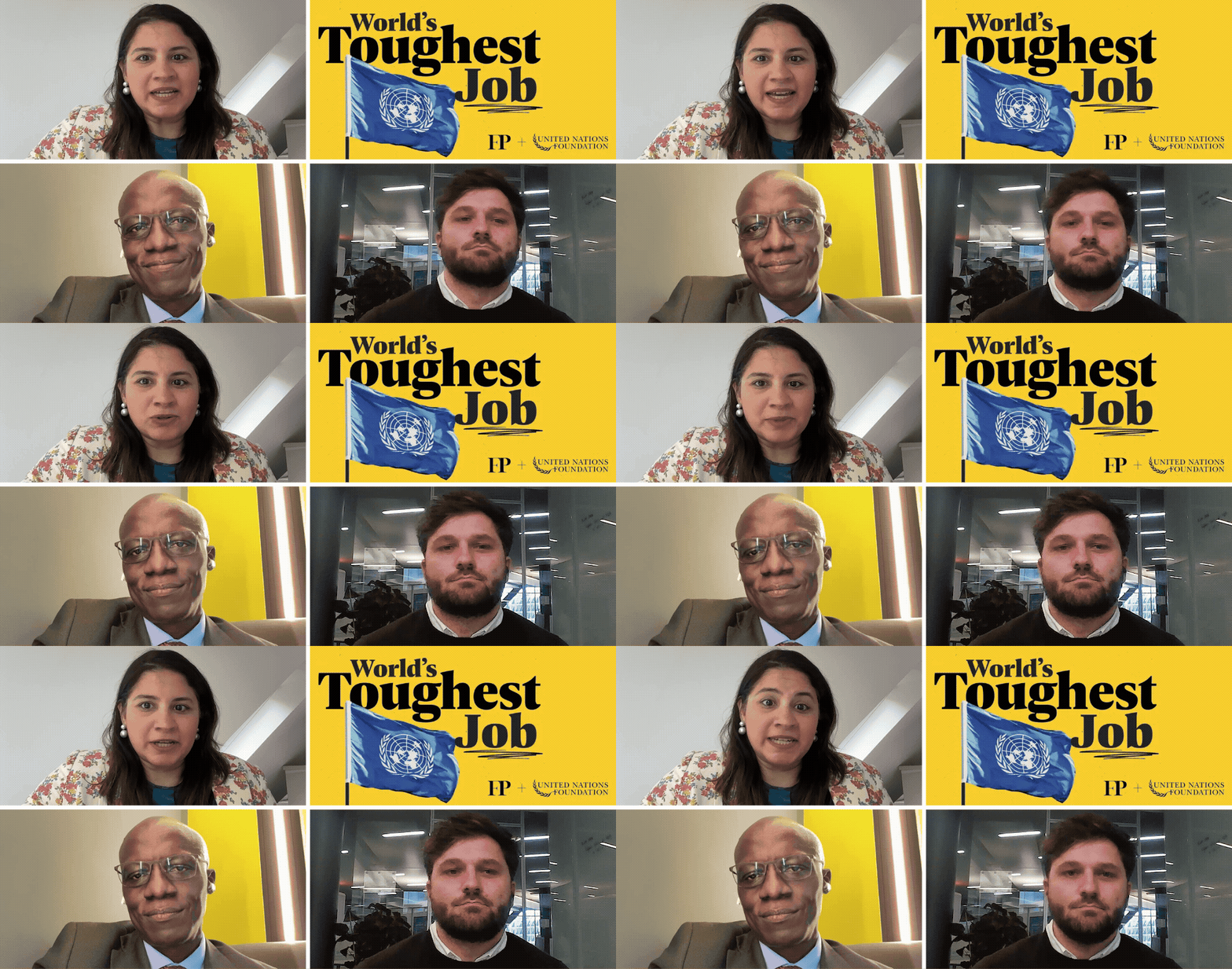
This week on World’s Toughest Job, a podcast co-produced by Foreign Policy and the United Nations Foundation, we tackle a defining challenge for the next UN Secretary-General: Does the international system have a say in the governance of artificial intelligence?
The episode opens with a look at the UN’s very first resolution: an attempt to govern the atomic bomb as the world grappled with a frightening new technology (read about that history here).

Next, Jasmin Bauomy and her co-host Mark Malloch-Brown are joined by an expert panel for a discussion of today’s technological frontier. With explosive innovation driven by private capital, tech monopolies are increasingly intertwined with the national security agendas of the world’s most powerful governments.
The panel explores whether the next Secretary-General can invent a form of diplomacy that brings tech CEOs directly to the table and whether the UN can mobilize the Global South, middle powers, and civil society to ensure that global governance isn’t captured by Silicon Valley lobbying or superpower rivalry.

Here’s what Ambassador Philip Thigo, Kenya’s Special Envoy on Technology; Dr. Nur Laiq, a Technology Policy and Geopolitics Fellow at the Harvard Kennedy School; and Maxime Stauffer, co-founder and CEO of the Simon Institute for Longterm Governance, had to say.
1. The new arms race is corporate.
The challenge of artificial intelligence mirrors early efforts to grapple with the atomic bomb, but unlike the state-controlled nuclear era — where science was locked inside secret government laboratories — today’s AI decisions are being made primarily by private tech CEOs.
This presents a new problem for public governance. “Since the 1990s, big tech has sold governments a deal,” Dr. Nur Laiq said, “essentially just saying, ‘Let us regulate ourselves, and we will deliver growth and innovation.’” But as co-host Jasmin Bauomy asked the panel, if a leading AI lab decides to withhold its newest model because it is deemed too powerful to release, does that mean we have global governance in the hands of one (unelected) man?
Frontier AI is controlled by tech monopolies whose capital expenditures eclipse national research budgets. This shifts the balance of global power. As Ambassador Philip Thigo noted, the UN finds itself in an ironic position. “You sit in an imperfect system that governs multilateralism, trying to challenge a power that is concentrated between a few companies and a few countries,” he said.
Maxime Stauffer agreed. While a tech company might pause its own rollout, relying on self-regulation is a symptom of a deeper governance gap. “It is unlikely that the U.S. government or the UN system will be able to specify safety standards in the next year or two or three years to be able to handle [advanced models],” she said, “so we need some form of action.”
2. Governments may have more leverage than they think.
The tech industry uses its origin story as a shield against oversight. “Silicon Valley likes to say that it’s built by nerdy geniuses in garages,” Laiq said. “Now, the reality is that a lot of the stack actually sits on public money and public effort, on defense budgets, on public universities and R&D, global supply chains and global labor, and, of course, our data.”
That gives governments leverage. As Laiq pointed out, “Governments and citizens aren’t just recipients, we’re co-builders and investors in this system. ... So AI firms are formidable, but they’re not untouchable.”
That said, the intimidation factor remains high. Stauffer acknowledged that “the state of knowledge of AI is still quite low among diplomats, and it’s quite hard to ramp it up.” Yet, the idea that policymakers must fully grasp the detail may be a trap. Laiq pushed back against the contention that only software engineers can write AI regulations. “You don’t have to be a banker to regulate Wall Street,” he noted.
Thigo, drawing on Kenya’s push for equitable AI governance, challenged the perception that the public sector is destined to be left behind. “I reject this false narrative from Silicon Valley that governments have no place to govern AI, or that they don’t have the capacity or competence, or that technology moves faster than laws are designed. I think it is a false narrative,” he argued. “I would tell the SG to double down on that.”
Does the UN Have a Seat at the AI Table?

In the United Nations’ early years, Secretary-General Trygve Lie negotiated with governments to stop the nuclear arms race. But today, the code that could reshape civilization is owned by private companies.
3. Beware the military-AI complex.
The push for AI governance increasingly collides with national security interests. Co-host Mark Malloch-Brown warned of an emerging “military AI complex,” where tech executives align with national security states — primarily in the United States and China — to build closed systems. These actors have little patience, he said, “when the ... woman from the UN comes knocking and says, ‘We want you to sit down at a conference table and discuss rules of the game.’”
For the rest of the world, superpower rivalry intensifies the risks from AI. Laiq pointed out that policymakers are concerned about “being forced to choose between rival AI blocks — an American stack or a Chinese stack — and then getting locked into technological dependence.” At best, governance discussions happen in invite-only forums where, as Thigo pointed out, “We don’t have a seat.”
States risk being relegated to passive consumers of the AI future rather than co-builders of it. The divide is already wide. “Only 1% of global data centers are in Africa,” Thigo said, claiming that the continent’s young demographic, young Kenyans in particular, are “the largest consumer of AI products per capita.” For the global majority, the fight isn’t just about managing AI risks; it is about ensuring they aren’t left out of the AI economy entirely.
4. The intergovernmental ‘Hail Mary.’
Despite its flaws, the United Nations remains the only platform where states can meet as equals. As Thigo put it: “Outside the UN, countries in the Global South have nowhere else ... to engage in these types of conversations.”
The UN is unlikely to have the power to create, let alone enforce, a top-down treaty, but should instead build what Stauffer calls “stepping stones” and “option value” for the future — promoting international interoperability and establishing shared frameworks before a catastrophic technological shock forces everyone’s hand.
However, the Secretary-General cannot act on AI alone. Effective regulation requires an injection of political vision from Member States themselves. Stauffer noted that he is often “taken aback by the lack of ambition or leadership among Member States to have a vision for what the UN can do on AI governance,” arguing that the primary job of the next Secretary-General should be to put the onus back on Member States to create and champion a vision.
Ultimately, the choice facing governments may be stark: find a unified platform or be pushed aside by more powerful interests. That may mean dusting off the 1946 playbook of collective security. In the age of artificial intelligence, Benjamin Franklin’s (apocryphal) warning at the dawn of another revolution may resonate as much for governments as for rebels: “We must indeed all hang together, or most assuredly, we shall all hang separately.”
Quotations have been lightly edited for clarity.
Listen to the latest episode of World’s Toughest Job
Does the UN Have a Seat at the AI Table?

In the United Nations’ early years, Secretary-General Trygve Lie negotiated with governments to stop the nuclear arms race. But today, the code that could reshape civilization is owned by private companies.
View all the episodes here.