![[Re]Group: A Playbook for Turbulent Times](https://substackcdn.com/image/fetch/$s_!PUHU!,w_120,h_120,c_fill,f_webp,q_auto:good,fl_progressive:steep/https%3A%2F%2Fsubstack-post-media.s3.amazonaws.com%2Fpublic%2Fimages%2Ff2fb4256-d509-4e61-827b-2ee678efbba9_256x256.png)
![[Re]Group: A Playbook for Turbulent Times](https://substackcdn.com/image/fetch/$s_!OvcZ!,e_trim:10:white/e_trim:10:transparent/h_182,c_limit,f_auto,q_auto:good,fl_progressive:steep/https%3A%2F%2Fsubstack-post-media.s3.amazonaws.com%2Fpublic%2Fimages%2Fa2653539-a634-4ef5-9aab-bc4a7546ebc9_1344x500.png)

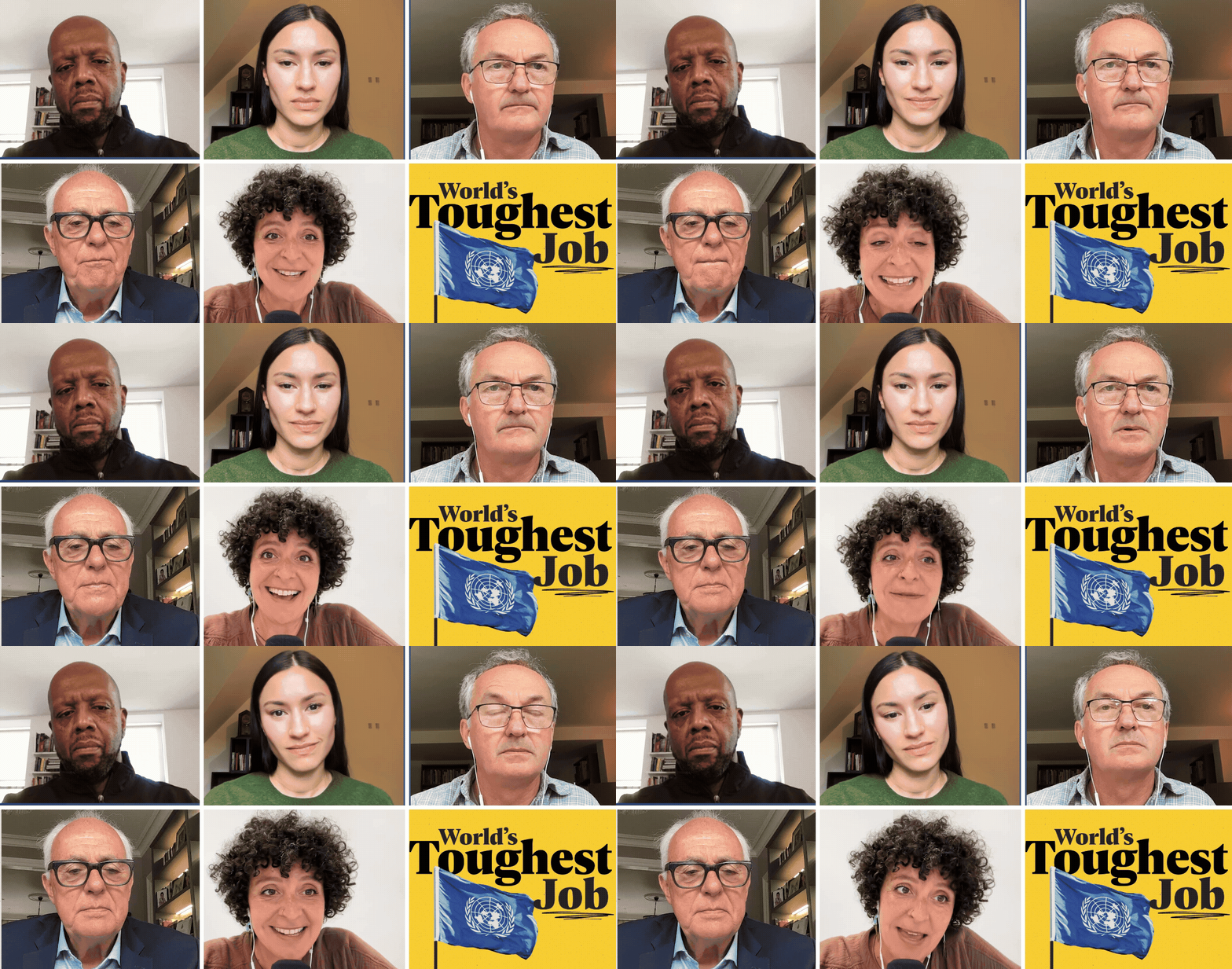
This week on “World’s Toughest Job,” a podcast co-produced by Foreign Policy and the United Nations Foundation, we ask: Can the next UN Secretary-General deliver for young people and young countries?
The world’s demographic center of gravity has shifted. While the Global North ages, a massive next generation is rising across Africa and parts of Asia. Our third episode tells the story behind the demographic data, as young people look for economic opportunities in a volatile world and young countries demand structural change and greater political representation.
Host Jasmin Bauomy and co-host Mark Malloch-Brown are joined by Saru Duckworth, a development researcher studying programs for marginalized populations; Ambassador Martin Kimani, President and CEO of the Africa Center and former Kenyan permanent representative to the UN; and Joe Studwell, author of How Asia Works and How Africa Works.

The episode starts in 1960 with the Year of Africa, when 17 African nations reached independence and Secretary-General Dag Hammarskjöld rallied the UN to respond to the structural needs of these new nations.
Our panel asks whether a new Secretary-General can follow this example, helping today’s young countries navigate a world of unchecked geoeconomic competition, while responding to the aspirations of a generation that fears that the future is no longer something to build toward but something to brace for.
1. The world’s last great baby boom is reshaping development.
In 1960, the global population stood at roughly 3 billion. At the time, developing countries had as many children as adults. That creates huge challenges: picture a country where the dominant unit is the young family and where there are relatively few adults to feed, teach, and care for very large numbers of kids (and not many taxpayers, either) There are many reasons that countries struggled to grow in the 20th century, and demographic headwinds are a big part of the story.
But even then, countries were changing. Those families were becoming smaller, as health improved and mothers were more educated and empowered. At first the population kept growing fast — with more young parents than ever — but as the population slowed, the last big demographic wave began to roll across society. Today, the same countries are still young, but only 30% of citizens are under 18 and 20% are aged between 18 and 30.
When Hammarskjöld rebooted the UN’s development system, his focus was on helping new states function after independence. And the main job? Looking after the very young, which explains why child survival and development had become an overriding priority for the UN by the 1980s. Today, though, the challenge is to harness the potential of the last great baby boom. And that drags the UN’s development mission in a very different direction.
The most profound development question of our era is whether economic opportunities will flow to where young people live, or whether those young people will move toward the opportunities. As Joe Studwell argued on World’s Toughest Job, the UN must recognize Africa as the “last developmental frontier of great consequence,” noting that the continent’s population will likely hit 4 billion by the end of the century (from 1.5 billion today). And as Mark Malloch-Brown reminded the panel, this isn’t just an African story — Afghanistan, Pakistan, Iraq, and other young countries in Asia have exactly the same need for economic opportunities.
2. The old risk suffocating the young.
The global population will likely peak in roughly 50 years, but in many parts of the world the peak is long past. Already, 63 countries have shrinking populations. The wealthy world (with the partial exception of the United States) and many major middle-income economies (barring India) are growing old fast. Over the rest of this century, more children will be born in Nigeria than in China, more in Pakistan than in all of Europe (Russia and the United Kingdom included), and more in Tanzania than in Brazil.
Yet global power structures are frozen in the past. Nigeria, Pakistan, and Tanzania do not have seats at the G20, while Europe holds seven (if Russia, the European Union bloc, and permanent guest Spain are included). The roundtable highlighted this growing disconnect: Are rich, old countries going to cede political power, or will young countries have to kick down the door to get it?
This tension isn’t just geopolitical; it’s economic. Ambassador Martin Kimani pushed back against viewing Africa’s youth boom as an inherent threat, framing it instead as an opportunity for economic takeoff. If young countries can get the policy environment right, they are entering territory when all that work caring for and educating children pays off. This “demographic dividend” is the same engine that fueled the East Asian financial tigers.
But capturing that dividend brings a new set of problems. Right now, Africa adds more than 10 million young people to the workforce every year but generates only 3 million formal jobs. If this “absorption crisis” isn’t solved, the world faces political volatility as an educated, connected, and increasingly activist generation finds itself locked out. As Saru Duckworth argued, there is no point educating children to grow up “facing economies that cannot absorb them structurally.”
3. A hyperconnected generation is demanding ‘the promise of participation.’
In 2010, I helped create a task force to explore Nigeria’s demographic future. It concluded that youth, not oil, was the country’s greatest asset. What struck me then was how fast young Nigerians were turning their country into a cultural superpower. After the 1992 release of the legendary thriller Living in Bondage, filmmaking exploded in Lagos, with movies shot on cheap VHS cassettes and sold in the streets. Punk filmmaking, in other words. By the mid-2000s, Nollywood was the world’s third-largest film industry after its more famous counterparts in America and India.
The cultural ingenuity of the next generation has now collided with the smartphone era. Back then, pessimists thought that much of the Global South would remain stuck on the wrong side of the digital divide, but today a digitally native generation has real-time visibility into global living standards. As Duckworth observed, young people in Nepal can now watch protests in Indonesia unfold on TikTok. Because of this expectation gap, delivering basic survival is no longer enough. Institutions must fulfill “the second half of the promise of development, which is the promise of participation,” she said.
Right now, the international system is failing that test. Marginalized youth, Duckworth warned, are united by a massive trust deficit: “It’s not just that the system doesn’t work for us, it doesn’t see us ... but also that we don’t trust it.” That drives young people onto the streets. Kimani pointed to recent youth protests in Kenya against austerity measures driven by the International Monetary Fund. Tens of thousands of young Kenyans tuned into a marathon six-hour session on X to audit the national budget line by line, ultimately forcing the government to reverse course. Leaders “cannot credibly embrace austerity ... while being able to manage the street,” Kimani noted. For any leader, the lesson is clear: Young people will no longer accept being shut out of the rooms where decisions are made.
4. The UN must champion the places where the future lives.
So, what does this demographic, economic, political, and cultural shift mean for the next Secretary-General, for the UN’s development system, and for its ambition to create shared prosperity? Our panel had three answers to this question.
First, it is time to embrace the end of the traditional, top-down, donor-driven model. Studwell criticized the old system, noting that aid agencies evolved into institutions that “want to predetermine where the money should go.” While the current drop in global development aid is causing undeniable damage, it could be the catalyst needed for structural change. Kimani argued that the withdrawal of aid provides “powerful incentives” for states to strengthen their own governance, simply because “there will no longer be a foreign taxpayer to subsidize the gaps.” For Malloch-Brown, this is a much-needed “second decolonization.”
Second, the UN needs to break its addiction to bloated agendas. Malloch-Brown noted that the institution’s “campaigning, donor-driven, goal-setting approach to development ... may have run out of road.” The panel pushed the UN to tackle the “hard stuff” of development from two directions: the macroeconomy and the last mile. Both Kimani and Studwell argued for a short list focused on macroeconomic transformation. For young countries to thrive, they argued that the UN must prioritize the foundational drivers of industrial and economic growth over sprawling, fragmented agendas. Duckworth focused on people, noting that extreme poverty stopped falling and global hunger is higher than when the Sustainable Development Goals were set in 2015, and that persistent pockets of deep poverty remain even in richer countries. A new Secretary-General, she suggested, must avoid the temptation of looking for easy wins and find ways to tackle the “stickier, hard-to-reach issues” that will reach marginalized young people left behind by current development patterns.
Finally, the panel agreed that development solutions need to be driven by the Global South. If the UN wants to help young countries build their own institutional capacity, it cannot do so from New York. As Studwell argued: “I’m not interested in seeing planning capacity for Africa built up in New York or London or D.C. ... I want to see planning capacity for Africa in Nairobi, in Addis, in Lagos, in Abuja.” Malloch-Brown agreed that the UN’s goal isn’t “digging shallow wells,” but helping countries build the institutions required to be the “effective agents of their own development.” As Dag Hammarskjöld did in 1960, that means repositioning the UN as a champion for the development choices and strategies that young countries set for themselves. That also means empowering young citizens on international platforms, Duckworth added, to ensure that they are no longer shut out of the places where decisions are taken.
Quotations have been lightly edited for clarity.
All demographic data is based on World Population Prospects 2024.
Listen to the latest episode of World’s Toughest Job
Can the Next Secretary-General Deliver for the World's Young People and Young Countries?

In 1960, when 17 African nations declared independence from colonial rule, the United Nations reinvented itself. Fast forward to today, Africa and parts of Asia are home to the largest generation of young people in history.
View all the episodes here.