![[Re]Group: A Playbook for Turbulent Times](https://substackcdn.com/image/fetch/$s_!PUHU!,w_120,h_120,c_fill,f_webp,q_auto:good,fl_progressive:steep/https%3A%2F%2Fsubstack-post-media.s3.amazonaws.com%2Fpublic%2Fimages%2Ff2fb4256-d509-4e61-827b-2ee678efbba9_256x256.png)
![[Re]Group: A Playbook for Turbulent Times](https://substackcdn.com/image/fetch/$s_!OvcZ!,e_trim:10:white/e_trim:10:transparent/h_182,c_limit,f_auto,q_auto:good,fl_progressive:steep/https%3A%2F%2Fsubstack-post-media.s3.amazonaws.com%2Fpublic%2Fimages%2Fa2653539-a634-4ef5-9aab-bc4a7546ebc9_1344x500.png)
![[Re]Group's avatar](https://substackcdn.com/image/fetch/$s_!w0DV!,w_108,h_108,c_fill,f_webp,q_auto:good,fl_progressive:steep/https%3A%2F%2Fsubstack-post-media.s3.amazonaws.com%2Fpublic%2Fimages%2F0517e9f8-af1c-41a5-b83c-2630660e4517_256x256.png)
By Pablo Angulo-Troconis and Christina Butler

This article was first published in its original form on United Nations Foundation.
To experience the full version:
2026 is shaping up to be a pivotal year for global AI governance. As the UN works to keep pace with a technology evolving in real time, the Global Digital Compact negotiations offer three lessons in translating technical complexity into political consensus.
“AI is moving at the speed of light,” UN Secretary-General António Guterres affirmed at a news conference in early February 2026. “No country can see the full picture alone. We need shared understandings to build effective guardrails, unlock innovation for the common good, and foster cooperation.”
Guterres has been signaling a new course for the UN on AI and a new phase of multilateral AI diplomacy. Building on the Global Digital Compact, two major mechanisms in the emerging global governance landscape are taking shape: the Independent International Scientific Panel on AI and the Global Dialogue on AI Governance. Together, they bring fresh attention to the question: What does credible, inclusive global AI governance and cooperation look like?
The Global Digital Compact and AI Governance Today
The UN is no stranger to discussions on AI governance. The Secretary-General’s 2020 Roadmap for Digital Cooperation called for AI that is “trustworthy, human-rights based, safe and sustainable and promotes peace.” The following year, in Our Common Agenda, the Secretary-General floated the idea of a Global Digital Compact to promote the regulation of AI to align with global values.
The International Telecommunications Union has been organizing AI for Good Summits since 2017 — a full five years before ChatGPT was even launched.
But the Global Digital Compact negotiations in 2024 moved conversations on AI governance an essential step further, catapulting them into the center of Member State diplomacy.
Negotiation rooms buzzed as delegations tackled digital rights, data governance, and AI governance at UN scale — many for the first time. Diplomats weren’t just discussing text; they were negotiating what the uncharted work of multilateral AI governance could even mean.
The Global Digital Compact forced an essential question onto the agenda: What role should the UN play in governing AI?
The answer was never going to be simple. Some countries favored a light touch approach that preserves market dynamism and innovation. Others pushed for stronger safeguards grounded in human rights and democratic resilience. Many emphasized capacity building and ensuring AI doesn’t further widen digital inequality.
Ultimately, the Global Digital Compact laid the groundwork for two distinct but complementary initiatives: the Independent International Scientific Panel on AI, designed to provide an independent, evidence-based foundation, and the Global Dialogue on AI Governance, which aims to translate that evidence into shared understanding and cooperation.
These mechanisms emerged for a practical reason: The negotiations made clear that Member States need both a trusted source of technical and scientific grounding and a standing political space to keep pace with fast-moving technology.
As the Panel and the Dialogue begin to take shape, the success of the Global Digital Compact offers three lessons for what is achievable.
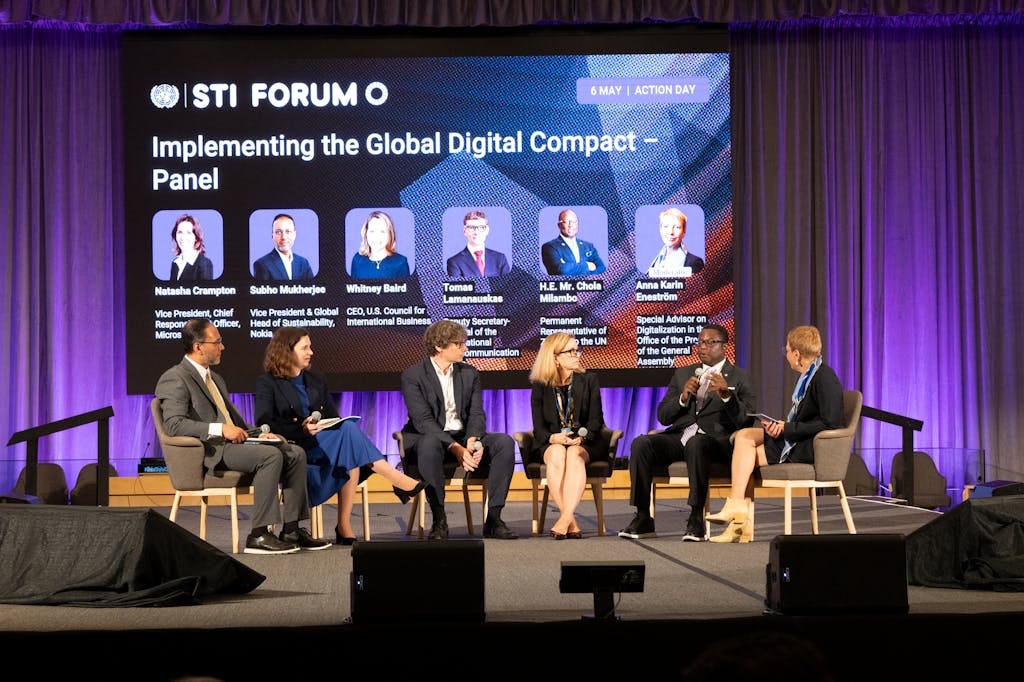
Consensus on Multilateral AI Governance is Possible
One of the most important takeaways from the Global Digital Compact process is that consensus on AI is possible. Even in today’s geopolitical climate, Member States have shown they can agree on AI-related outcomes.
The Global Digital Compact revealed why. In UN negotiations, shared language depends on shared understanding. And shared understanding rarely appears fortuitously during formal negotiations. Instead, it is built in the ecosystem around it: informal dialogues, expert briefings, off-the-record conversations, and neutral convenings where diplomats can ask questions without political cost.
During the Global Digital Compact negotiations, these spaces played an essential role because many delegations were engaging substantively with AI governance for the first time. In that context, informal learning was not a side activity — it was a prerequisite for progress.
Just as importantly, informal convenings such as those led by the United Nations Foundation prior to the start of official negotiations brought together actors who do not normally sit in the same room: diplomats, technical experts, private sector practitioners, civil society, UN entities, and other actors who do not normally sit in the same room. That multistakeholder engagement grounded negotiations in real-world applications, risks, and trade-offs.
All of this shows that to gain true consensus on global AI governance, the UN will need to treat informal, multistakeholder engagement both as an integral part of the governance model and as crucial building blocks in building shared understanding.
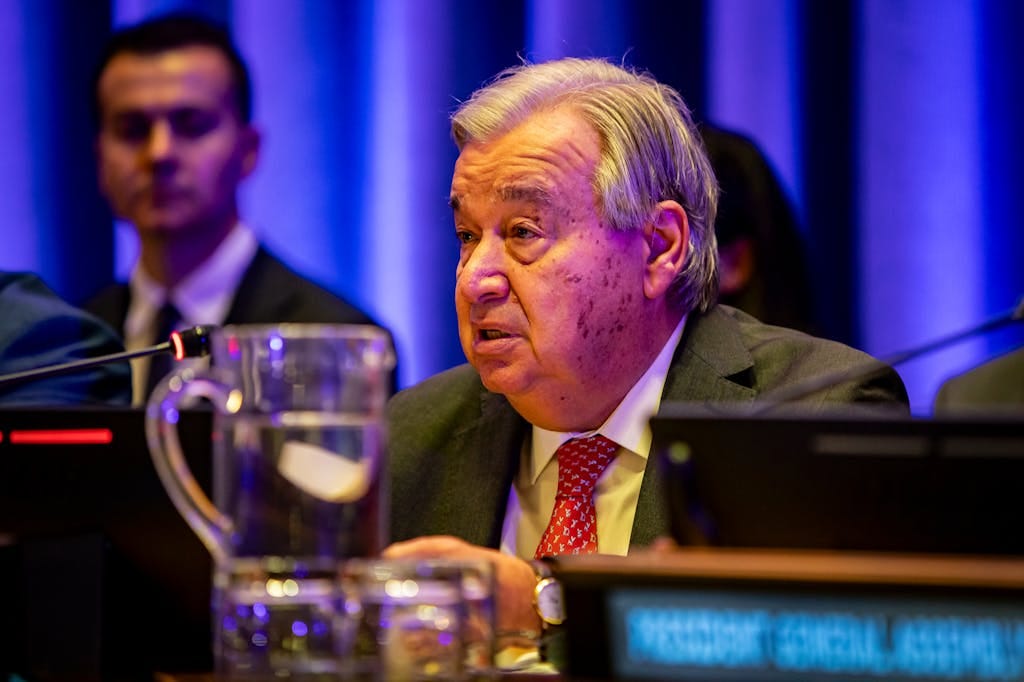
Global Legitimacy: the UN’s Advantage in AI Governance
The second lesson from the Global Digital Compact is about the UN’s unique role.
When changes of this magnitude hit the global system, they must be discussed in the UN — the one place where every Member State has a seat at the table. That legitimacy matters in AI because the risks and benefits are global, while the capacity to shape rules, standards, and markets is not.
Without an inclusive platform, AI governance will be shaped primarily by a small number of countries and companies. Many Member States, particularly across the Global South, will become mere bystanders as entire societies and economies are transformed by this powerful technology.
The Global Digital Compact process helped push back on that trajectory by establishing the simple principle that global AI governance needs to be built in a forum where participation is universal.
But it also revealed a harder truth: that legitimacy alone is no longer enough. Multilateral AI governance is not about choosing between innovation or protection, development or human rights, risk or capacity building, or other false dichotomies. It is about establishing a coherent approach that advances all of these critical considerations at once and produces actionable outcomes.
No single actor can meet this moment alone. Governments, companies, civil society, and the UN all have essential and complementary roles. The UN’s job is not to replace other efforts; it is to provide an umbrella where different approaches can be made interoperable, standards can be practical across different market realities, and the benefits of digital transformation remain open to all.
In 2026, success hinges on whether the UN can build trust in both the Panel and the Dialogue as credible, inclusive mechanisms that deliver for everyone.

Interoperability and Standards Are Crucial
Finally, the Global Digital Compact negotiations underscored how quickly fragmentation can take hold. Member States came to the table with fundamentally different assumptions about how AI should be governed. These differences weren’t simply ideological. They were rooted in economic realities, technological capacity, and security calculations.
The risk is a world of incompatible AI rules, evaluation standards, safety approaches, and accountability regimes.
This world would have predictable consequences: widening inequality, weaker oversight, and greater market failures. It would also increase risks in military and security contexts and other domains where the stakes are highest and inconsistent norms can amplify instability.
Global AI governance is a concrete possibility not only through high-level principles, but also through interoperability: how different systems, standards, and regulatory approaches work together to create a coherent approach for global AI governance.
The Test Ahead
Multilateral AI governance is a test the UN must pass — and quickly. No other platform can bring all countries together. But convening alone won’t be enough in an AI era defined by speed, concentrated power, and geopolitical competition. The UN will need to persuade Member States that it can contribute meaningfully, not just by convening around a scientific basis, but by clarifying, connecting, and accelerating global cooperation.
The Scientific Panel and Global Dialogue will be key to help the UN navigate the complex yet essential work around AI. At stake is whether the multilateral system can adapt fast, and thoughtfully, enough to govern the defining technology of the era.
About United Nations Foundation
For over 25 years, the UN Foundation has built novel innovations and partnerships to support the United Nations and help solve global problems at scale. As an independent charitable organization, the Foundation was created to work closely with the United Nations to address humanity’s greatest challenges and drive global progress.
Learn more: www.unfoundation.org.