



On Sept. 21, a group of countries including Australia, Barbados, Brazil, Canada, India, and Kenya launched Partners for Multilateralism, or P4M, pledging support for international law and reform of the UN. Twenty-three governments signed on, alongside the European Union (EU) and the Council of Europe.
The next day, 15 governments met in New York under the Shield of the Americas, a U.S.-led coalition that began with counternarcotics and has since spread into other areas. Not one of the 15 had signed the P4M declaration the day before.
Which club a government joins has become an index of its geopolitics. States still work through the UN, but they are also turning to smaller groups when their interests align. These coalitions can move faster and require less consensus than institutions built around almost 200 countries.
Canadian Prime Minister Mark Carney gave this approach a middle-power vocabulary at Davos in January, when he promised to build coalitions that work “issue by issue, with partners who share enough common ground to act together.” Clubs are not new, but they are clearly having a moment, the culmination of a trend now nearly a decade old.

A Decade of Clubs
Clubs, coalitions, and alliances have multiplied over the past 20 years, but with a marked acceleration after 2016.
At the Igarapé Institute, we documented the evolution of 194 arrangements founded between 2000 and mid-October 2026 and coded them by theme, convenor, and status. To qualify, an initiative must bring together three or more states around a shared goal outside universal UN treaties. These include formal bodies like the Asian Infrastructure Investment Bank, security groupings like the Coalition of the Willing on Ukraine, and issue-driven initiatives like the Global Methane Pledge.
Tracking when these groups formed, the policy fields covered, and which countries have joined reveals how diplomacy has shifted outside universal institutions, and why the UN increasingly struggles to keep pace.
The Post-2016 Surge
The acceleration in club formation in the past 10 years is unmistakable, even factoring in the limitation that older coalitions are harder to trace online. Through 2016, governments created roughly four a year. Since 2017, the rate has been nearly 13.
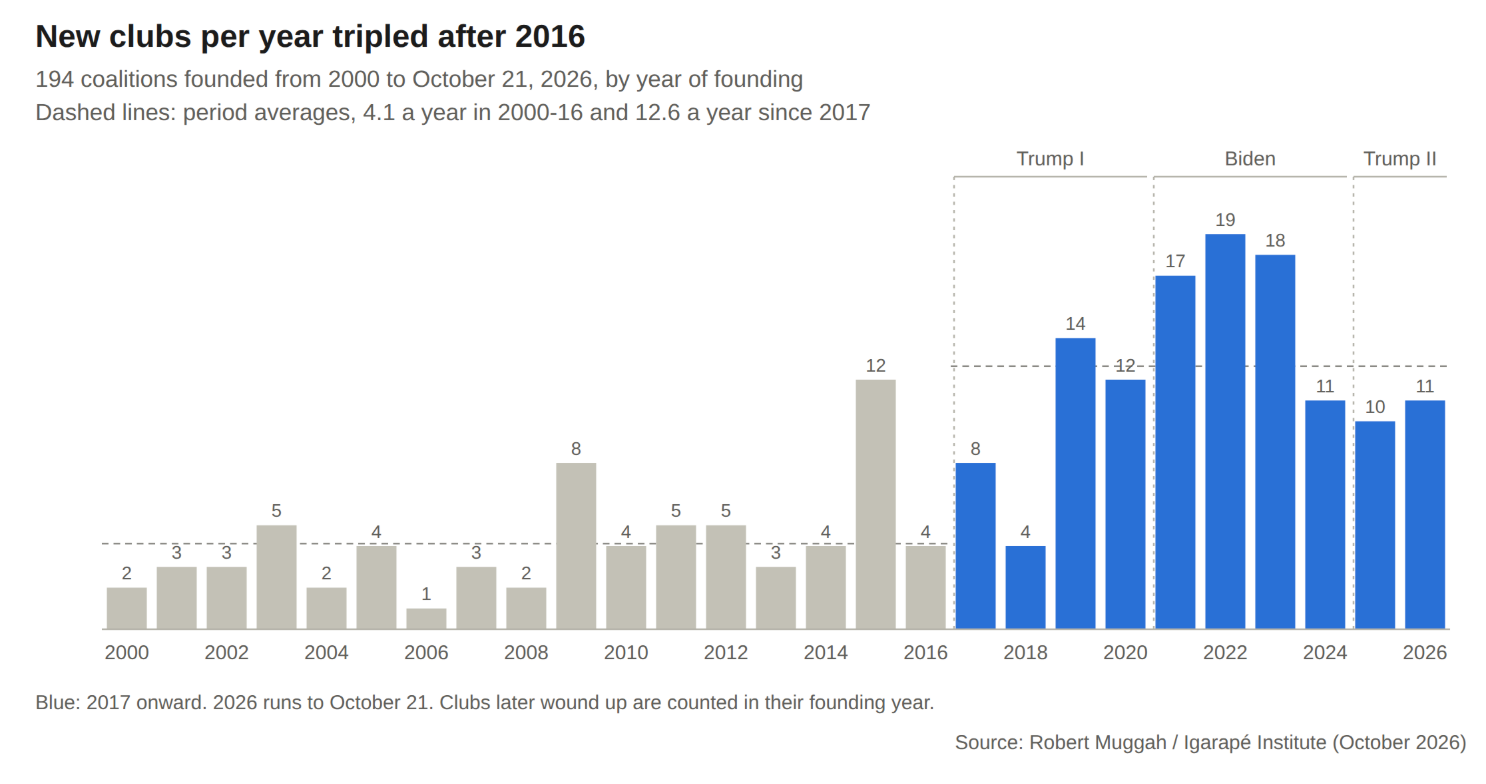
This break came with the first Trump Administration, the Brexit referendum, and the paralysis of the World Trade Organization’s dispute system. By the time Carney spoke at Davos, the new pattern had already produced more than a hundred bodies.
The burst of activity in 2025 and 2026 continues that trend. Twenty-one new clubs appeared in 21 months, a rapid pace, though still below the average of 16 a year recorded from 2021 through 2024.
The Geography of Alliances
Of the 194 clubs founded since 2000, 134 remain active today and publish full membership lists. The rest have been wound up (13), have gone dormant (21), or are still active but do not publish a complete roster (26).
The UK is the most connected, belonging to 72, followed by Australia with 65, Germany with 63, and Canada, France, Japan, and the U.S. with 62 each. China belongs to 34, fewer than India or Brazil. Beijing has tended to work through fewer, larger platforms such as the Belt and Road Initiative, BRICS, and the Shanghai Cooperation Organisation, while Western and middle powers sit inside a denser web of overlapping clubs.
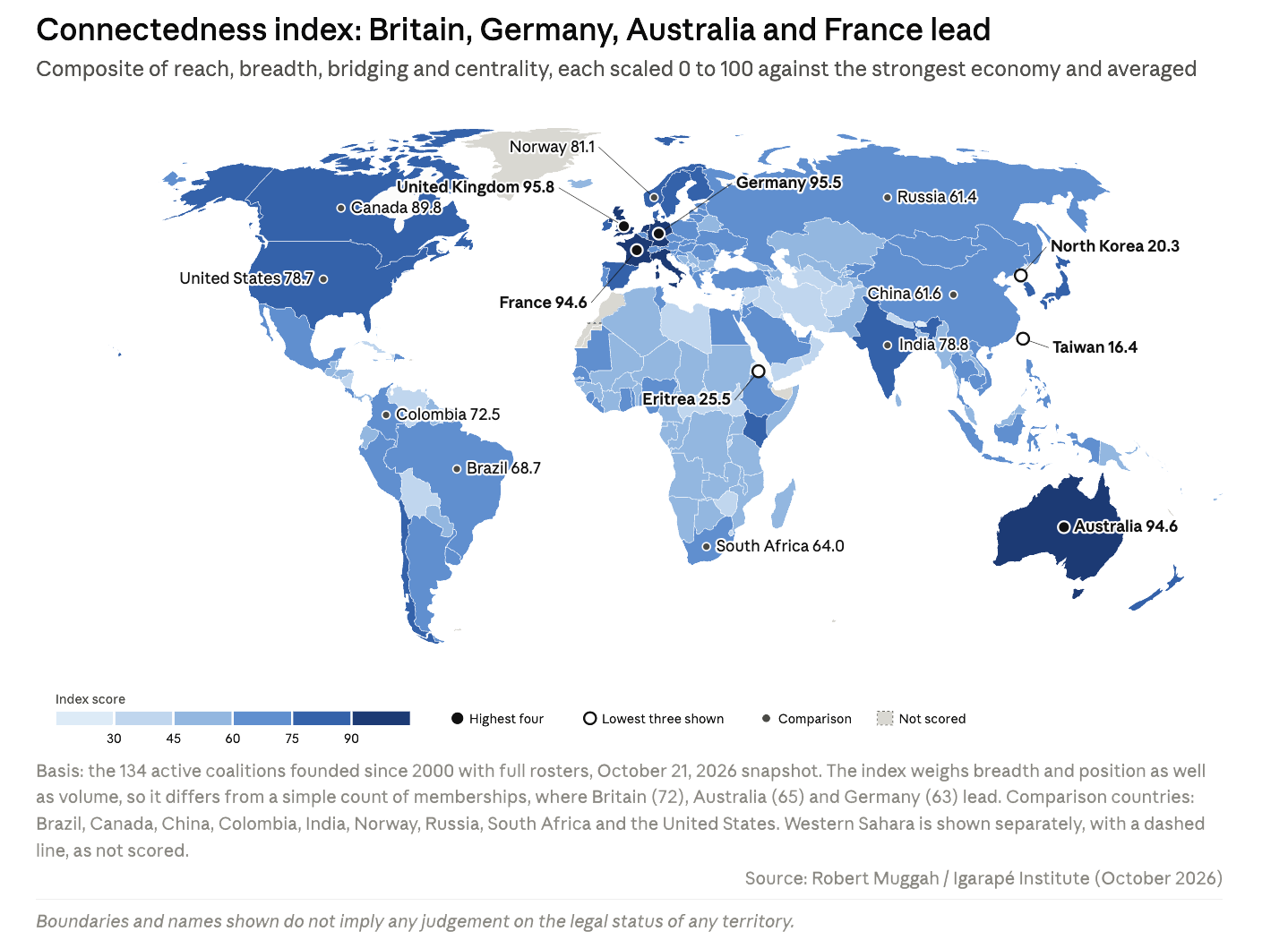
This is starting to change, as China creates a greater range of clubs. Across the 19 coalitions with published membership lists that have been created since the start of 2025, 168 countries have joined at least one and 73 belong to three or more. Western and middle powers lead the pack. Australia and the UK have joined eight, Canada, Germany, Kenya, Norway, and Türkiye seven, and the U.S. five.
China may have only joined three, but it founded all of them, along with a fourth whose membership it has not published. In May 2025, 33 states signed the convention creating the International Organization for Mediation in Hong Kong, which now counts 48 signatory or acceding states. That September, Xi Jinping proposed a Global Governance Initiative, and in November Beijing announced a green mining and minerals initiative at the G20 in Johannesburg. In December, 43 States formally launched a Group of Friends of Global Governance at the UN to carry Xi’s initiative forward.
Then in mid-July 2026, 29 states signed an agreement in Shanghai establishing the World Artificial Intelligence Cooperation Organization (WAICO), an independent intergovernmental body headquartered there. Eight more states signed within two weeks, bringing the total to 37. None is a G7 or EU member. WAICO is Beijing’s answer to the U.S.-led Pax Silica, and the four bodies together amount to China’s most concentrated burst of club-building in the record.
Every Field Is Clubbing
The surge is not confined to one corner of world politics. Coded by primary theme, club formation accelerated after 2016 in all eight fields the dataset tracks, though at very different speeds. Security, climate and energy, and trade, the three largest fields, have each produced two to three new clubs a year since 2017. Climate and security clubs now form at nearly three times their earlier pace, and trade clubs at close to double.
The steepest change is in fields that barely existed as club terrain a decade ago. Technology and critical minerals each had a single club through 2016. Since then, governments have launched 20 technology groupings, such as AI safety networks, and nine rival mineral alliances convened by Washington, Ottawa, Beijing, and African producer states. Health and democracy clubs remain few but now form three to four times as often.
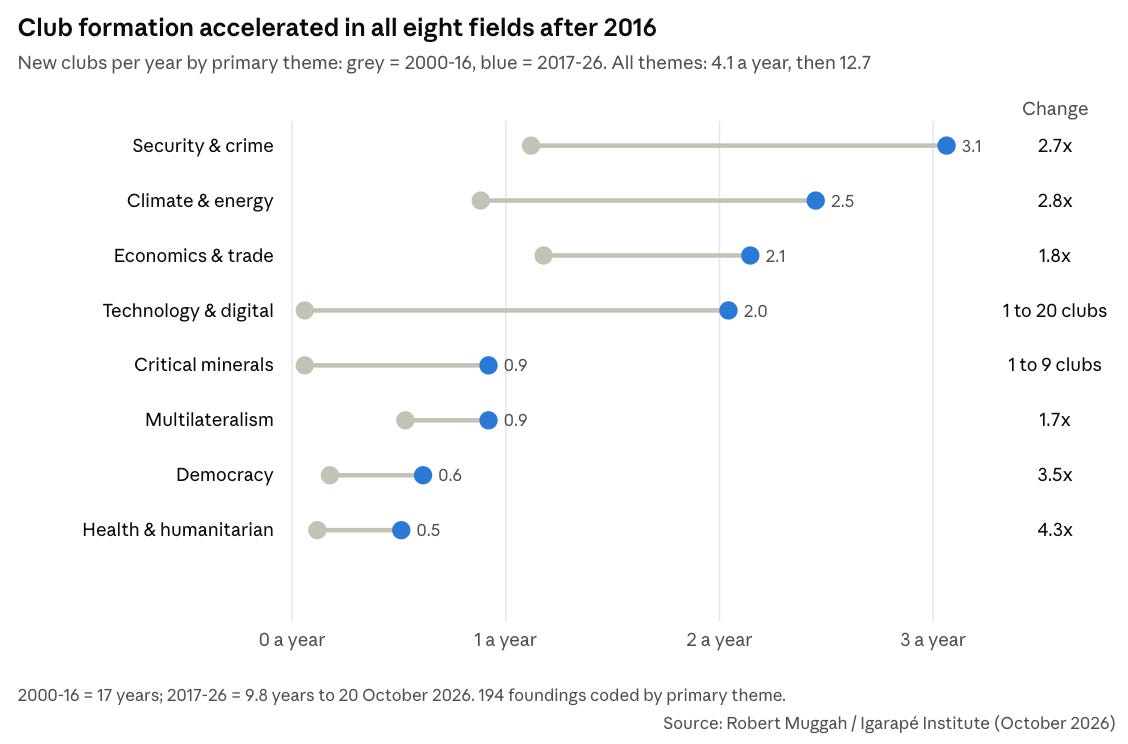
The exception is the category built to fix the UN itself. Clubs devoted to multilateral reform, from the Accountability, Coherence, and Transparency (ACT) Group to P4M, have formed at less than twice their earlier rate, the smallest increase alongside trade. Governments are not mainly building clubs to repair the universal system. They are building them to get specific things done around it.
Why Look Beyond the UN
Clubs multiplied partly because established institutions became harder to use for the problems governments wanted to solve.
In the Security Council, vetoes have repeatedly blocked action on major conflicts. The decade from 2016 to 2025 produced 49 vetoes, compared with 19 in the preceding decade. The UN is also under growing financial pressure. Its 2026 regular budget is about 7% below the approved 2025 level as the UN80 reforms consolidate functions and reduce costs.
There is also a mismatch of scale. Action on AI governance or countering organized crime often requires detailed coordination among relatively small numbers of governments and firms. A forum of 193 states can establish broad rules and confer legitimacy. It is less well suited to rapidly negotiating supplier standards, sharing intelligence, or coordinating sanctions and investment screening. Smaller coalitions increasingly fill that gap.
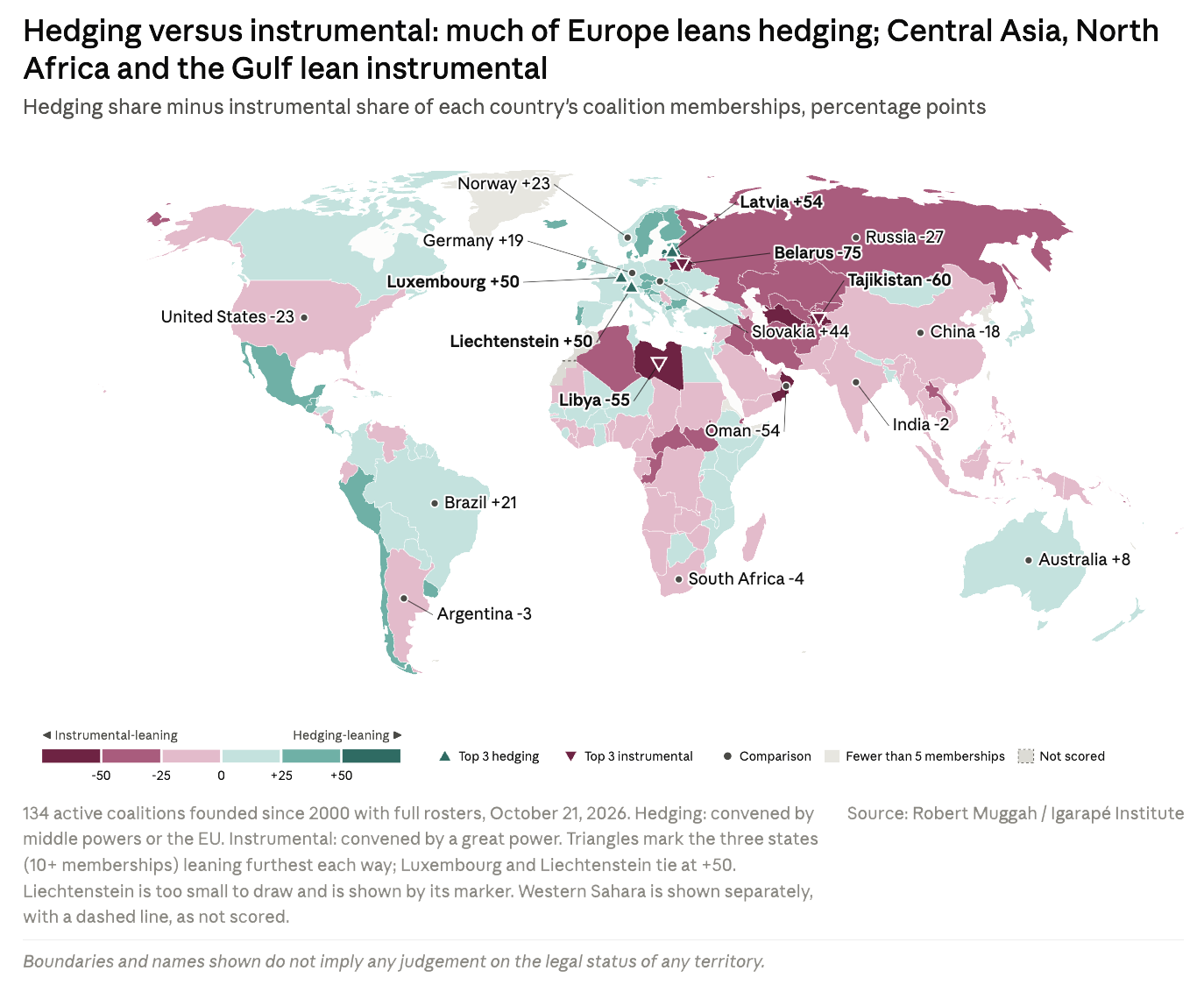
While roughly a fifth of the dataset consists of functional networks focused on technical standards or shared problems, others carry a more overt political meaning. Great powers seek a strategic advantage through instrumental clubs, while middle powers try to preserve room for maneuver through hedging clubs, and other states use contesting clubs to challenge existing arrangements.
The Instrumental Clubs
In our dataset, instrumental clubs are defined as coalitions convened by a single great power (the U.S., China, or Russia). They are designed to deliver concrete strategic benefits, from security cooperation to infrastructure finance.
Beijing created the largest of these clubs. Launched in 2013, the Belt and Road Initiative used lending and commercial ties to deepen relationships across five continents. It requires no common political identity and has little multilateral bureaucracy. With roughly 150 participants, it remains the largest instrumental club in the dataset, even if some functional networks now have broader membership.
Washington’s newest clubs are narrower, binding security cooperation to economic alignment. Launched in March 2026 as a coalition against transnational crime, the Shield of the Americas has grown to 19 members, though Brazil and Mexico have not joined (yet). By September, its remit had widened: 15 of its members agreed to target 24 criminal organizations for collective sanctions, while adding an economic pillar that covers investment screening, critical mineral supply chains, and trusted suppliers for digital infrastructure.
With the Board of Peace, the U.S. moved from regional to global security. Its charter was signed at Davos on Jan. 22 2026, and its current list runs to 27 states. At the end of the previous year, the Security Council had passed a resolution welcoming its creation as “a transitional administration with international legal personality” for the redevelopment of Gaza, but its charter gave a broader mandate over any area “affected or threatened by conflict.” This placed it squarely on the Security Council’s terrain, but as “a coalition of willing States” that has been built around an unusually powerful chairman. This freedom of maneuver gives Washington a parallel forum for action when the Security Council is deadlocked.
Pax Silica applies the same logic to technology. Washington launched it in December 2025 with seven signatories. By the time Italy joined in July 2026, it had grown to 24 states and the EU (Taiwan is a nonsignatory participant). The initiative links critical minerals, semiconductors, and the energy and data infrastructure required for advanced computing. Its emphasis on trusted supply chains turns access to technology and industrial capacity into a test of strategic alignment, with the State Department describing it as a platform for aligned partners to “build the AI ecosystem of tomorrow.”
Washington also reinforced the raw-materials end of the supply chain, replacing the Biden-era Minerals Security Partnership with the Forum on Resource Geostrategic Engagement (FORGE). FORGE has a more explicit brief to reshape markets in ways that counter Chinese dominance, proposing a preferential trade zone for critical minerals protected by enforceable price floors and tariffs. Warning of a global market “distorted beyond recognition” whenever “foreign supply floods the market” and kills allied mining projects, Vice President JD Vance invited members to use the forum to escape dependency on “arrangements we did not choose, and right now, arrangements that we cannot control.”

The Hedgers
Middle powers have little interest in choosing between Washington and Beijing on every issue. They have much to lose from a world where great powers impose preferences without restraint. In our dataset, we classify a hedging club as any coalition that is led by middle powers, the EU, or regional actors and that aims to uphold rules or preserve autonomy.
P4M is the latest attempt to turn shared anxiety into a coalition. Its declaration warns against protectionism and economic coercion, while reaffirming the UN Charter. Members, however, hardly form a geopolitical bloc. Brazil and India differ from Canada and Australia on China and Ukraine, while Kenya and Barbados bring their own priorities. The interest all partners share is narrower. They want rules strong enough to limit coercion and preserve their freedom of action.
P4M sits in a longer lineage of efforts to keep parts of the multilateral system working when formal institutions stall. Switzerland launched the ACT Group in 2013 to improve Security Council working methods. Canada convened the Ottawa Group on WTO reform in 2018, and France and Germany launched the Alliance for Multilateralism a year later. When Washington’s refusal to appoint judges paralyzed the WTO’s Appellate Body, the EU, Canada, and others built a stopgap appeals arrangement in 2020 that even China joined, though the U.S. did not.
In September 2025, 14 small and mid-sized trading economies launched the Future of Investment and Trade Partnership to defend open trade rules (it now has 19 members). Each used a smaller group either to press for reform inside a deadlocked institution or to sustain cooperation that the larger body could no longer provide.
Hedging now reaches well beyond trade rules and UN reform. The UK and France assembled a Coalition of the Willing in 2025 to support Ukraine and plan security arrangements for a possible settlement, working alongside NATO and the EU rather than through them. In July 2026, 10 European governments launched FREYJA to build a shared anti-ballistic missile capability. Canada used its 2025 G7 presidency to launch the Critical Minerals Production Alliance with the G7, Australia, and the European Commission, broadened in June 2026 to cover processing and recycling.
Climate diplomacy is following suit. The Global Clean Power Alliance works through separate missions on finance and supply chains, and in April Colombia and the Netherlands convened 57 countries in Santa Marta to speed the transition away from fossil fuels, in a process designed to feed back into the UN climate talks.
The dataset reveals a recurring political rhythm. During the first Trump term, more than half of new coalitions were middle-power hedging arrangements, while roughly a quarter were U.S.-led instrumental clubs. Under Biden, Washington returned to coalition-building, leading 23 of the 65 clubs created from 2021 through 2024, while there were only 18 new hedging clubs. Since January 2025 the pattern has flipped again: 11 of the 21 new coalitions are middle-power hedging arrangements, compared with four U.S.-led and four Chinese-led instrumental clubs.
Club-building appears partly countercyclical to American engagement. When Washington becomes less predictable or retreats from established institutions, middle powers build more machinery of their own. Increasingly, Beijing also moves into the space that the U.S. leaves behind. Will middle-power clubs endure if Washington again reengages? P4M will be the test case for that.
The Challengers
Contesting clubs are the smallest category in the dataset and the most overtly revisionist. They are built by governments that want to rewrite the rules rather than merely preserve them, and they are overwhelmingly convened from the Global South. The dataset records 16 since 2000, about 1 in 12 new clubs, including two since January 2025.
The lineage is long, and much of it centers on development. The India, Brazil, South Africa Dialogue Forum (IBSA) was formed in 2003, while BRICS has grown from a four-country summit in 2009 into a bloc of 11 members and 10 partner countries, with its own development bank. The Group of Like-Minded Developing Countries presses its case in climate talks, while the V20 group of climate-vulnerable economies does so in international finance.
Others challenge the status quo on law and security. The Hague Group, launched by Colombia and South Africa in 2025, coordinates legal and diplomatic measures concerning Israel’s conduct toward Palestinians. Venezuela’s Group of Friends in Defense of the UN Charter promotes a reading of multilateralism centered on sovereignty and opposition to unilateral sanctions. In the Sahel, Burkina Faso, Mali, and Niger formed the Alliance of Sahel States and later quit the Economic Community of West African States (ECOWAS) altogether (although the two blocs are now negotiating a framework for cooperation).
The newest contesting clubs target the architecture of finance and resources. In April 2026, finance ministers and central bank governors from about 30 developing economies launched a Borrowers’ Platform at the International Monetary Fund and World Bank spring meetings, the first standing counterpart to creditor clubs such as the Paris Club. Barbados Prime Minister Mia Mottley, whose Bridgetown Initiative has pushed for reform of the financial system, was among its champions, with Pakistan recently taking over as Chair from Egypt. In minerals, the Africa Minerals Strategy Group, founded in Riyadh in 2024 and chaired by Nigeria, now brings together 31 African States pressing to process more ore at home.
These clubs rarely command the financial or military muscle of their Western or Chinese counterparts. Instead, they use their collective weight to shift from rule-taking to agenda-setting, challenging richer states, creditors, and private firms on more equal terms. They still make up only a small share of our dataset, but their influence is growing.

House Rules and Membership Dues
Despite the efforts of Washington and Beijing to lock in partners, the proliferation of instrumental clubs has not split the world into rigid camps. Instead, countries also join hedging or contesting clubs, keeping at least one foot outside a superpower’s tent.
Coalition membership is treated as a portfolio. Countries join different groups for different purposes, often across geopolitical divides. Yet managing that portfolio comes with rising costs, from great-power retaliation and diplomatic fatigue to the risk that today’s club vanishes tomorrow.
Nor is this patchwork replacing the post-1945 architecture outright. What is emerging is a more layered order where the old multilateralism and the new geometry are intertwined.
A Network, Not a Pyramid
The newer clubs overlap unevenly, creating a network of partial alignments rather than a single bloc.
The Coalition of the Willing and P4M share a strong European and Commonwealth core, while Pax Silica has also brought these countries on board in significant numbers. Beyond the core, however, the overlap is limited. The Coalition of the Willing and P4M share 13 members, Pax Silica and the Coalition of the Willing 10, and Pax Silica and P4M only four. Australia, Finland, and Norway are the only countries in all three.
The Shield of the Americas has even less in common with this cluster of groups, with only Guatemala belonging to P4M and, for obvious reasons, no membership crossover with the Coalition of the Willing. What is striking is that only five of the Shield’s 19 members (plus, of course, its host) also belong to the U.S.-led Pax Silica, demonstrating that, even among Washington’s partners, alignment in one arena rarely carries over into another.
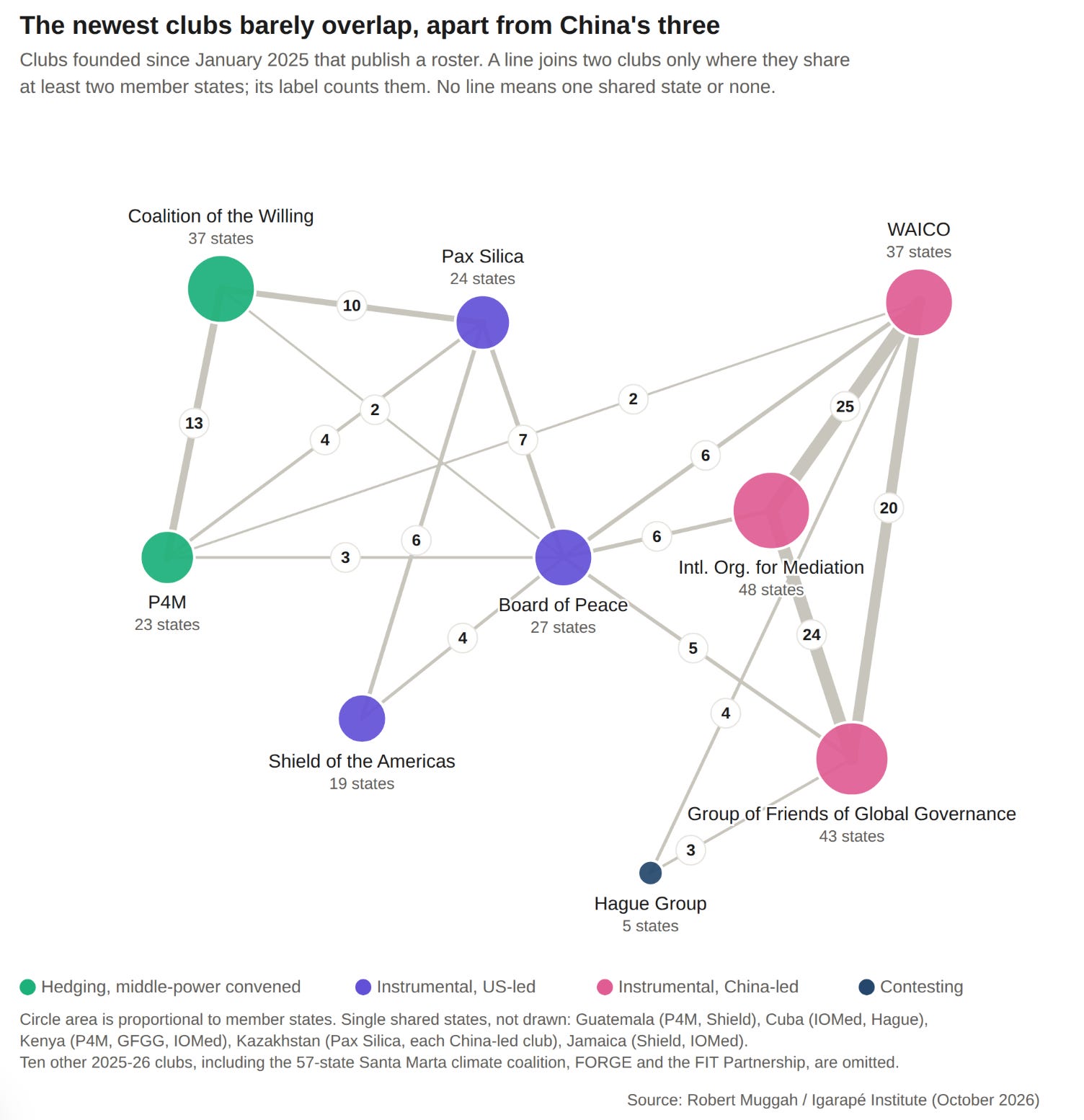
Countries frequently belong to coalitions that pull in opposite geopolitical directions at the same time. Six governments, including Indonesia, Pakistan, and Vietnam, sit in both the U.S.-led Board of Peace and China’s WAICO.
Attitudes to club membership also shift with domestic political winds. After changing governments in 2026, Colombia joined the U.S.-led Shield of the Americas in August. For a time it remained co-Chair of the Hague Group. It subsequently resolved this contradiction, withdrawing in October and describing the group as “a body formed to isolate and target Israel.”
The Price of Membership
Clubs create benefits by drawing boundaries. Trusted-supplier rules, investment screening, and preferential access can reward insiders while raising costs for outsiders. As economic security moves deeper into trade and technology policy, even technical standards can acquire geopolitical weight.
But membership can also invite pressure from rival powers. In July 2025, Donald Trump threatened an additional 10% tariff on countries aligning with what he called the “anti-American policies” of BRICS. He later said BRICS countries would face the levy “pretty soon” and claimed that this could force them to exit the bloc. The threat showed how club membership can quickly become entangled with market access.
Panama felt pressure more directly. During U.S. Secretary of State Marco Rubio’s visit in February 2025, Washington demanded action over what it regarded as excessive Chinese influence around the canal and threatened that the U.S. would take “measures necessary to protect its rights” under the U.S.-Panama treaty. A few days later, President José Raúl Mulino announced his country’s withdrawal from the Belt and Road Initiative, asking “what has it brought to Panama in all these years?” China denounced American “smearing and sabotage.” Panama maintained that the decision was its own.
Beijing applies pressure from both directions. For one, it warns governments away from rival clubs. In May 2021, China’s Ambassador in Dhaka said any Bangladeshi engagement with the Quad, formed by the U.S., Australia, India, and Japan, would “substantially damage” relations. The Ministry of Foreign Affairs called the grouping an “exclusive clique” aimed at China. Beijing has since used similar language against the Australia-UK-U.S. (AUKUS) security partnership and what it calls the “exclusive small circles” that Washington assembles in Asia.
Meanwhile, turning away from Beijing’s clubs can also prove expensive. Beijing’s 16+1 format with Central and Eastern Europe, launched in 2012, became 17+1 when Greece joined in 2019. Lithuania walked out in May 2021 and that November allowed a Taiwanese Representative Office to open in Vilnius. China subsequently downgraded diplomatic relations, and the EU later accused Beijing of discriminatory trade restrictions after Chinese customs data showed Lithuanian exports to China falling 80% in the first 10 months of 2022. Beijing rejected the EU’s account, arguing that Lithuania had violated the One-China principle. Estonia and Latvia left the grouping in August 2022, and Czechia said in 2023 it no longer takes an active part, leaving a 14+1 on paper and fewer in practice.
All this creates costs for those trying to hedge. A government may join a club for a narrow purpose, only for a rival power to read the move as strategic alignment, shrinking its room for maneuver as memberships accumulate. Proliferation also imposes a practical burden. While large diplomatic services can staff working groups and attend summits for multiple coalitions, smaller states struggle to keep up, concentrating influence among capitals with enough personnel and money always to be in the room.
And clubs may not last. Born out of the 2004 Indian Ocean tsunami response, the Quad petered out after the first formal dialogue in 2007 before being revived a decade later. The Hague Group began with eight members in 2025 and now lists just five. Thirteen bodies in our dataset created since 2000 have been wound up or superseded, most recently when the Minerals Security Partnership was folded into FORGE. Clubs are easier to create than treaties, and easier to leave.
UN Plus
The international system is becoming layered as more of the action shifts to smaller coalitions.
Many of these clubs still draw authority from universal or regional institutions. P4M explicitly seeks to strengthen the UN. Climate coalitions feed into the UN Framework Convention on Climate Change (UNFCCC) process. The Shield of the Americas has proposed invoking the Rio Treaty (the hemisphere’s 1947 mutual-defense pact) through the Organization of American States to authorize collective action against designated criminal groups. Even the Board of Peace had Security Council endorsement, although its broader charter raises questions about how far such bodies may eventually compete with established institutions.
Layering creates a “UN plus” order, in which the UN provides the baseline rules, while the diplomatic action shifts to the web of clubs built around it. Some functions, from setting norms to conferring political legitimacy, remain the preserve of universal institutions alone. Where broad agreement is impossible, however, smaller coalitions can move quickly, test new forms of cooperation, and expand as governments see an advantage in joining. But they are not cost-free. They can also fragment the international system, duplicate existing institutions, and disappear when political circumstances change.
Universal membership in the UN now tells us very little about how a state will behave when a crisis hits or a contentious decision looms. To read a government’s true alignment, look at its portfolio of clubs: which groups it joins, which it avoids, and how it balances competing invitations. The states most active in building this new geometry are not the superpowers trying to enforce discipline on their allies, but the countries maneuvering between them to keep their options open.
The old multilateralism is still standing, and everyone remains a member. But in the new club order, it is the clubs that provide the real tests of power, alignment, and collective action. Increasingly, they decide who gets waved inside, and who is left standing in line.
The full dataset, interactive explorer, and methodology for The New Club Order are available at the-new-club-world.netlify.app.

