![[Re]Group: A Playbook for Turbulent Times](https://substackcdn.com/image/fetch/$s_!PUHU!,w_120,h_120,c_fill,f_webp,q_auto:good,fl_progressive:steep/https%3A%2F%2Fsubstack-post-media.s3.amazonaws.com%2Fpublic%2Fimages%2Ff2fb4256-d509-4e61-827b-2ee678efbba9_256x256.png)
![[Re]Group: A Playbook for Turbulent Times](https://substackcdn.com/image/fetch/$s_!OvcZ!,e_trim:10:white/e_trim:10:transparent/h_182,c_limit,f_auto,q_auto:good,fl_progressive:steep/https%3A%2F%2Fsubstack-post-media.s3.amazonaws.com%2Fpublic%2Fimages%2Fa2653539-a634-4ef5-9aab-bc4a7546ebc9_1344x500.png)
![[Re]Group's avatar](https://substackcdn.com/image/fetch/$s_!w0DV!,w_108,h_108,c_fill,f_webp,q_auto:good,fl_progressive:steep/https%3A%2F%2Fsubstack-post-media.s3.amazonaws.com%2Fpublic%2Fimages%2F0517e9f8-af1c-41a5-b83c-2630660e4517_256x256.png)
For decades, the global financial system has had mechanisms for creditor nations to coordinate their strategies. During the IMF-World Bank Spring Meetings in Washington, developing countries pushed back, creating the first-ever Borrowers’ Platform.
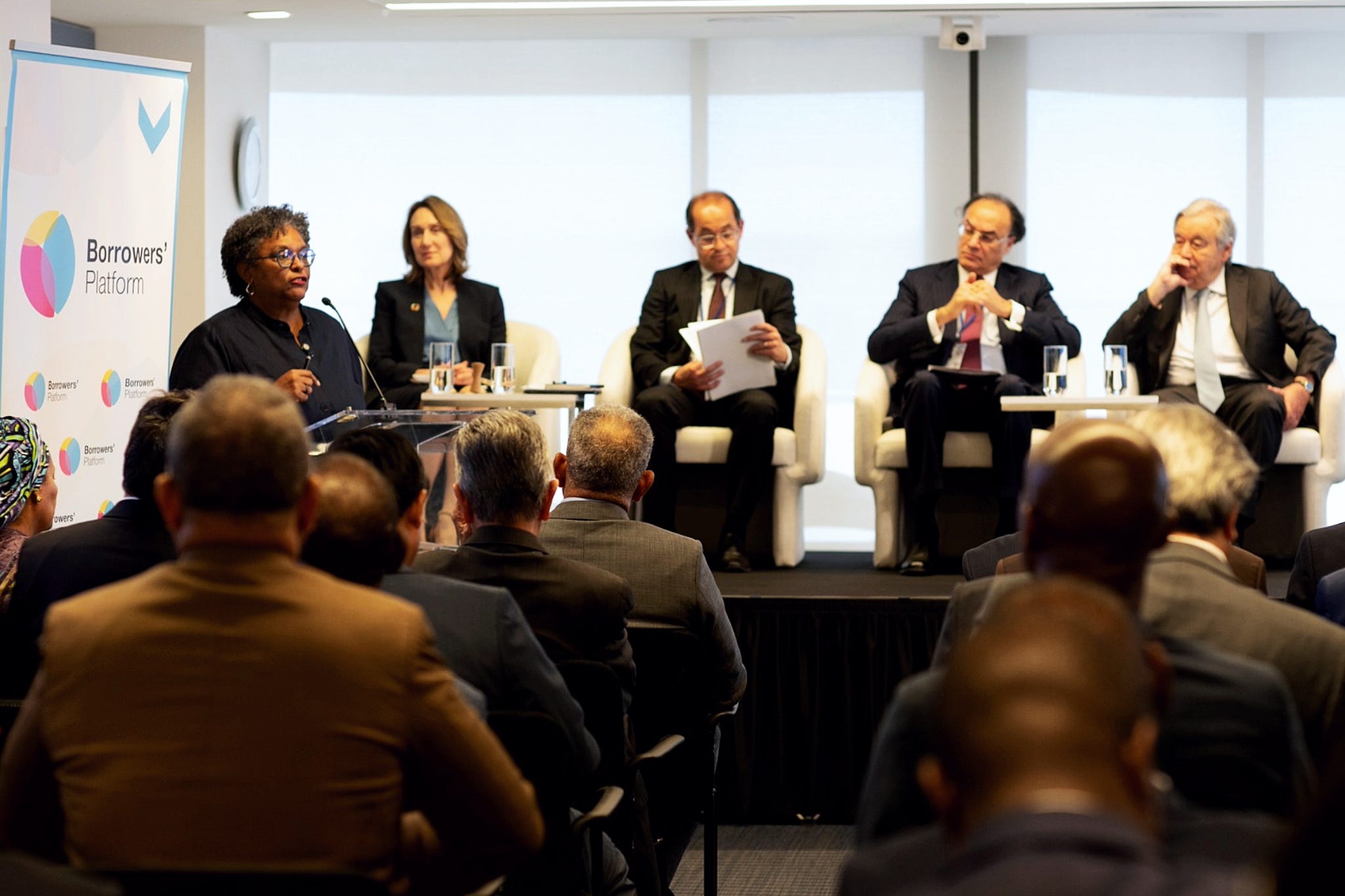
The initiative, which launched with prime ministers, ministers, and central bank governors from 30 countries, aims to reshape how developing countries manage sovereign debt and engage with the international financial system.
Here are four takeaways from the high-level launch segment, which featured UN Secretary-General António Guterres, Barbados Prime Minister Mia Amor Mottley, St. Vincent and the Grenadines Prime Minister Godwin Friday, finance ministers from Egypt and Pakistan, and UN Foundation President and CEO Elizabeth Cousens.
1. A debt trap and steep borrowing costs are damaging development.
Developing countries are caught in a trap where unsustainable debt burdens are eroding their development prospects.
The crisis is worsening: External debt for developing nations reached $11.7 trillion in 2024, driving annual debt servicing costs to roughly $920 billion. These costs are severely constricting fiscal space. In 2023, more than 60 developing countries — nearly half of them in Africa — spent over 10% of their government revenue solely on interest payments.
This debt servicing burden has triggered capital flight. In 2023, developing countries recorded a negative net resource transfer of $25 billion, meaning they actively paid out more to external creditors than they received in fresh disbursements.
The human and developmental toll of this capital drain is dramatic. In 2024, 3.4 billion people lived in countries that spend more on interest payments than on health or education.
What Leaders Are Saying
UN Secretary-General António Guterres
Over the past decades, developing countries have paid, on average, more than twice the interest rates faced by advanced economies. For African economies, the premium reaches three times benchmark rates.
Today, 3.4 billion people live in countries that spend more servicing debt than on health or education. Developing countries are forced to climb the development ladder with one hand tied behind their backs.
H.E. Mia Amor Mottley, Prime Minister, Barbados
We ask those who are least capable to pay higher interest rates than those who are capable. And then we wonder why we have a debt trap. There’s a point at which countries cannot work their way out of debt.
2. Borrowing nations have created a counterpart to established creditor networks.
Both creditor nations and private lenders have highly organized and well-resourced coordination mechanisms. The Paris Club is an informal group of 22 wealthy countries, while the Institute of International Finance is a coordinating hub for private and commercial creditors.
Through these institutions, lenders can organize committees to present a united front during debt crises. They also pool research, risk analysis, and legal expertise. By establishing the principles and norms that govern sovereign defaults, these clubs have been able to write the informal rules that govern the global financial and debt architecture.
In contrast, developing countries typically enter complex sovereign debt restructurings in isolation. Without a centralized institution of their own, borrowers are often disadvantaged at the negotiating table, lacking the shared institutional memory, technical capacity, and data transparency to which creditors have long had access.
A new platform was formally proposed by the UN Secretary-General’s Expert Group on Debt in June 2025 and mandated by the Sevilla Commitment later that year, with the aim of correcting this imbalance in the architecture.
What Leaders Are Saying
H.E. Muhammad Aurangzeb, Minister of Finance, Pakistan
In the Sevilla Commitment, we collectively recognized the need to strengthen cooperation among borrowing countries. For decades, the global system has evolved with well-established mechanisms for creditor coordination, but without a comparable space for borrowers. Today [April 15], we take an important step toward correcting that long-standing imbalance.
Elizabeth Cousens, President and CEO, United Nations Foundation
For the first time, borrowing countries across regions and levels will have a trusted space to come together, to share experiences, exchange knowledge, build common understanding, and strengthen their voice in the international system.
3. The platform is designed for peer learning, not collective bargaining.
The Borrowers’ Platform is not a debtors’ cartel looking to negotiate as a single bloc. Instead, it is a voluntary forum led by Member States and designed to help borrowing nations share policy experiences, build technical capacity, and enter individual debt negotiations on more equal footing than in the past.
By improving data transparency and enhancing debt sustainability practices, the platform aims to “send a positive signal to markets by enhancing debt sustainability practices and reducing uncertainty for investors — helping ensure that rising debt burdens do not derail development prospects.”
Leaders emphasized that a one-size-fits-all approach to debt resolution will not work for the group. The coalition spans large emerging markets, as well as Small Island Developing States and other smaller economies. While larger economies may possess the domestic buffers to endure protracted negotiations spanning 12 to 18 months, prolonged delays for smaller economies can trigger rapid economic collapse.
What Leaders Are Saying
H.E. Muhammad Aurangzeb, Minister of Finance, Pakistan
It will not be a collective negotiating platform, because we should equally be clear of what it is not. It will be a voluntary, Member State–led space. It is grounded in cooperation, peer learning, and the strengthening of the collective voice of borrowers.
H.E. Mia Amor Mottley, Prime Minister, Barbados
We must be able to recognize that for small countries, time is very often the major opponent, and things that a large country can withstand over the course of six months, 12 months, 18 months, a small nation needs to have done in under three months if it is to survive.
4. Members are working to operationalize the platform.
The platform’s founders are seeking to capitalize on political momentum, recruiting additional members with high levels of debt.
The Borrowers’ Platform will be anchored by an existing technical engine: UNCTAD’s Debt Management and Financial Analysis System. DMFAS, which will serve as the technical backbone for the platform’s secretariat, has supported over 75 governments with debt transparency and governance for more than 40 years.
Egypt has been elected interim Chair of the platform and will oversee its setup through a transitional committee. During the launch, Prime Minister Mottley urged the immediate appointment of an executive leader to scale the organization, noting that the platform is running against the clock amid mounting geopolitical and economic shocks.
What Leaders Are Saying
H.E. Mia Amor Mottley, Prime Minister, Barbados
Given that my country has hosted and still hosts almost all of the financial institutions in the subregion, I make formal our interests as Barbados to host the Secretariat of the Borrowers’ Club. ... I do believe that the CEO ought to be appointed as soon as possible if we are going to see progress beyond these 28 countries.
H.E. Ahmed Kouchouk, Minister of Finance, Egypt
What was once a long-standing aspiration of developing countries has now become a concrete and a collective step forward. Today stands as a strong statement of intent, that the voice of borrowing nations and countries belongs at the very center of the global financial dialogue.