


Last week, the U.S. Federal Aviation Administration (FAA) ordered the longest nationwide ground stop since 9/11. Some commentators pointed the finger at a new AI-powered traffic-planning tool rolled out days earlier, but Transportation Secretary Sean Duffy blamed “routine maintenance” to replace an aging copper telecom line that flooded the FAA’s routers with bad data, disrupting radar and radio links. As many as 1.5 million passengers were affected.
As the skies emptied and the blame game began, few noticed how quickly fallback mechanisms kicked in as data feeds could no longer be relied upon. Over four hours, more than 3,500 airborne planes landed safely, while international flights were canceled or diverted using standing protocols.
In an emergency, aviation’s systems degrade gracefully, allowing air traffic controllers to “drain the sky” as efficiency is sacrificed for safety. Outside emergencies, that same rulebook has been flexible enough to carry aviation from propeller planes to jets that can land themselves. That adaptability has fueled the growth of an industry that crosses borders by necessity, and now carries 5 billion passengers a year.
As calls for global AI governance grow louder, we need models where rules and innovation reinforce each other. In their search for solutions, policymakers have most often looked to the long struggle to control nuclear weapons. Yet nuclear technology was kept behind locked doors from day one, whereas AI is already woven into daily life in much the same way as aviation.
Perhaps it is time they looked to the skies instead, and to a lesser-known UN agency born from a bad-tempered wartime negotiation in the depths of a Chicago winter.
Competing Visions
At September’s UN General Assembly, everyone was talking about AI, with almost two-thirds of leaders raising it in their speeches, according to an internal UN report.
But the debate remains in flux. Proposals included a risk-assessment framework (UN Secretary-General), global principles (UK), a UN convention (Türkiye), a framework convention (Singapore), mandatory testing and incident reporting (Germany, Singapore), and an instrument on autonomous weapons (Austria). A joint declaration led by Finland and Norway, and backed by more than 30 countries, called for AI to remain under “human direction, oversight and control.” It urged countries to work through the UN to build on existing mechanisms while exploring whether a new AI institution is needed.
The tech world has its own ideas. Over the summer, Anthropic’s Dario Amodei backed a “global standards body,” Bill Gates called for “a new global organization for AI,” and Google DeepMind’s Demis Hassabis urged Washington to lead on shared international frontier standards. Nearly 1,400 employees from top AI labs also signed the “Pacing the Frontier” open letter asking the U.S. Government to “support an international effort to develop the technical and governance tools needed to deliberately pace the frontier of automated AI development.”
Business wants clarity and consistency. An International Chamber of Commerce report warns that a patchwork of national AI standards is already driving up the cost of doing business. Meanwhile, frontier AI labs have begun granting independent evaluators staff-level access to test their models. This raises the question of who evaluates the evaluators. A fast-growing AI assurance industry wants to audit models against a globally recognized benchmark that does not yet exist.
The UN has taken initial steps to fill the governance gap, launching the Independent International Scientific Panel on AI to build a shared evidence base, and the Global Dialogue on AI Governance to bring every country to the table. The Organization still has a comparative advantage in its universal membership and legitimacy with the Global South, though it will only keep that edge for so long while a “new club order” of rival AI blocs competes for control.
The next UN Secretary-General will be under pressure to help Member States sift through these competing visions and build political consensus on what happens next. But that will require overcoming the belief that any meaningful UN role will act as a brake on innovation. That same fear led to a bitter fight between wartime allies as they sought ways to govern another world-changing technology a few hundred days before World War II finally came to an end.
Learning To Fly
“The British are stubborn, but disagreeably so. The Americans are stubborn, but charmingly so.” So said one delegate from the more than 50 nations gathered at the Stevens Hotel in Chicago in late 1944 to negotiate the Convention on International Civil Aviation. Now better known as the Chicago Convention, the agreement established rules for global air travel and created the International Civil Aviation Organization (ICAO) to oversee them.
World War II had transformed the nascent aviation industry with long-range aircraft, proliferating airfields, and newly deployed radar systems. But with international flights governed by fragmented prewar agreements, governments feared that peacetime aviation would be held back by a lack of uniform technical standards and cross-border transit rights.
The U.S. wanted to turbocharge the growth of the industry. In Chicago, its delegation pushed for “freedom in the air,” hoping to capitalize on the U.S.’s wartime lead in aircraft production. But the UK wanted control. It countered with a call for “order in the air” and demanded an international authority to allocate routes and regulate fares. As TIME magazine reported that December, Churchill’s government “feared that the sky-filling transport fleet of the U.S. would monopolize global flying.”
The debate over these economic questions was never really settled, leaving market access and landing rights to be sorted out through bilateral deals between countries. But the Anglo-American standoff obscured the progress being made in the subcommittees that agreed on shared standards for weather reporting, air traffic control, and cross-border pilot licensing. It was on these technical issues that negotiators could find common ground. “Gentlemen, everybody is against bad weather,” U.S. delegate and New York Mayor Fiorello La Guardia joked to reporters.
ICAO formally came into existence in April 1947, following the Chicago Convention’s ratification, and became a UN specialized agency later that year. Ever since, it has acted as the guardian of an evolving set of Standards and Recommended Practices organized into 19 technical annexes. These provide a benchmark for countries to harmonize their aviation laws while leaving national regulators responsible for implementation and enforcement. The result? Any aircraft that flies from one country to another operates under consistent safety, security, and technical rules.
This framework has given the industry the confidence to make long-term investments in new aircraft and technology while driving accident rates to historic lows. No analogy fits AI perfectly, yet civil aviation may be our best guide for how safety and innovation can support each other.

Atoms and Airplanes
In 1953, U.S. President Dwight D. Eisenhower came to the UN General Assembly to give a speech written in what he called “the new language” of atomic warfare.
His Atoms for Peace address led to the creation of the International Atomic Energy Agency (IAEA), which is now the basis for a proposal from OpenAI’s leaders for an IAEA-style authority able to “inspect systems, require audits, test for compliance with safety standards, [and] place restrictions on degrees of deployment.” This agency would manage AI’s existential risks while staying out of “issues that should be left to individual countries.”
But the nuclear analogy has limits. The IAEA was created after Hiroshima and Nagasaki to police scarce physical materials and state-run industrial plants. In contrast, AI is dual-use software that can be easily copied, modified, and shared across borders, making nuclear-style verification nearly impossible. And while experts and the public worry about catastrophic AI risks, there is still fierce debate over if, when, and how those thresholds will be crossed.
As governments learn to speak the “new language” of AI, there are without doubt lessons in the nuclear model, but they should also look to other examples of how a disruptive technology has forced the international system to innovate. This is where an “ICAO for AI” is worth exploring.
Following the 1944 template, this model separates safety rules from commercial competition. A multilateral track would promote interoperability, while contentious questions like export controls and access to compute would be left to bilateral deals and smaller coalitions.
The ICAO example also shows how to build a “culture of safety” around AI without limiting its potential. In aviation, decoupling accident investigation from legal liability has favored prevention over blame. Pilots, airlines, and manufacturers report incidents and near misses without fear that those disclosures will be used against them in court, while a shared taxonomy makes safety data comparable across borders and legal systems.
Accountability still exists. Regulators punish “gross negligence, willful misconduct, or … criminal intent,” but not honest mistakes or transparent reporting. Applied to AI, that approach could encourage frontier labs to be open about what is going wrong before risks can spread across borders.
The Four Winds
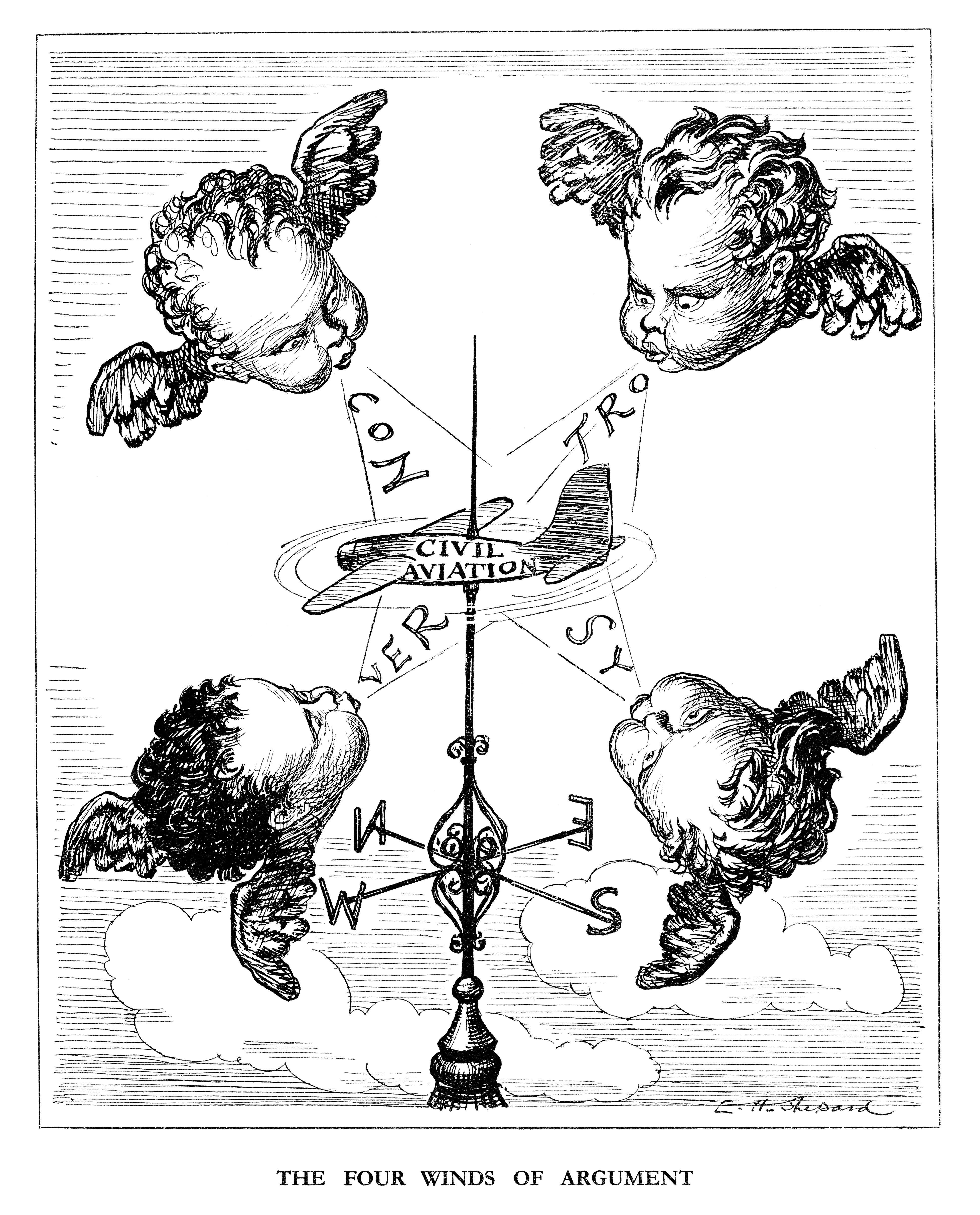
The deadlock over postwar civil aviation rules played out in the open, which was rare for societies still in the grip of wartime secrecy. In London, it caught the eye of E.H. Shepard, staff cartoonist for the satirical magazine Punch and famed illustrator of Winnie-the-Pooh. Just a day before the Chicago Convention was signed, Shepard published a cartoon showing a plane buffeted from each side by the four winds of “CON-TRO-VER-SY.”
Today’s geopolitical landscape will continue to feed “CON-TRO-VER-SY” over AI, but this offers an opportunity to clarify what global governance is meant to deliver. In Chicago, negotiators did not wait for parliaments to ratify a treaty before starting work. Instead, they set up a lightweight interim body to show what the new model could achieve long before ICAO officially opened its doors. For AI, starting with functions rather than institutional structures is the surest way to keep the focus on solving real problems rather than designing new bureaucracies.
Political conditions are rarely static. An astute 10th Secretary-General will recognize that the toolbox needs to be ready and waiting before diplomatic windows open. Nuclear offers one reference point and aviation another, with perhaps a dozen other multilateral models worth exploring.
In 2027, the second Global Dialogue on AI Governance and the review of the Global Digital Compact offer a chance to get serious about laying this groundwork and prove that the UN can shape AI rules that build trust, reduce uncertainty, and keep innovation alive.


