![[Re]Group: A Playbook for Turbulent Times](https://substackcdn.com/image/fetch/$s_!PUHU!,w_120,h_120,c_fill,f_webp,q_auto:good,fl_progressive:steep/https%3A%2F%2Fsubstack-post-media.s3.amazonaws.com%2Fpublic%2Fimages%2Ff2fb4256-d509-4e61-827b-2ee678efbba9_256x256.png)
![[Re]Group: A Playbook for Turbulent Times](https://substackcdn.com/image/fetch/$s_!OvcZ!,e_trim:10:white/e_trim:10:transparent/h_182,c_limit,f_auto,q_auto:good,fl_progressive:steep/https%3A%2F%2Fsubstack-post-media.s3.amazonaws.com%2Fpublic%2Fimages%2Fa2653539-a634-4ef5-9aab-bc4a7546ebc9_1344x500.png)

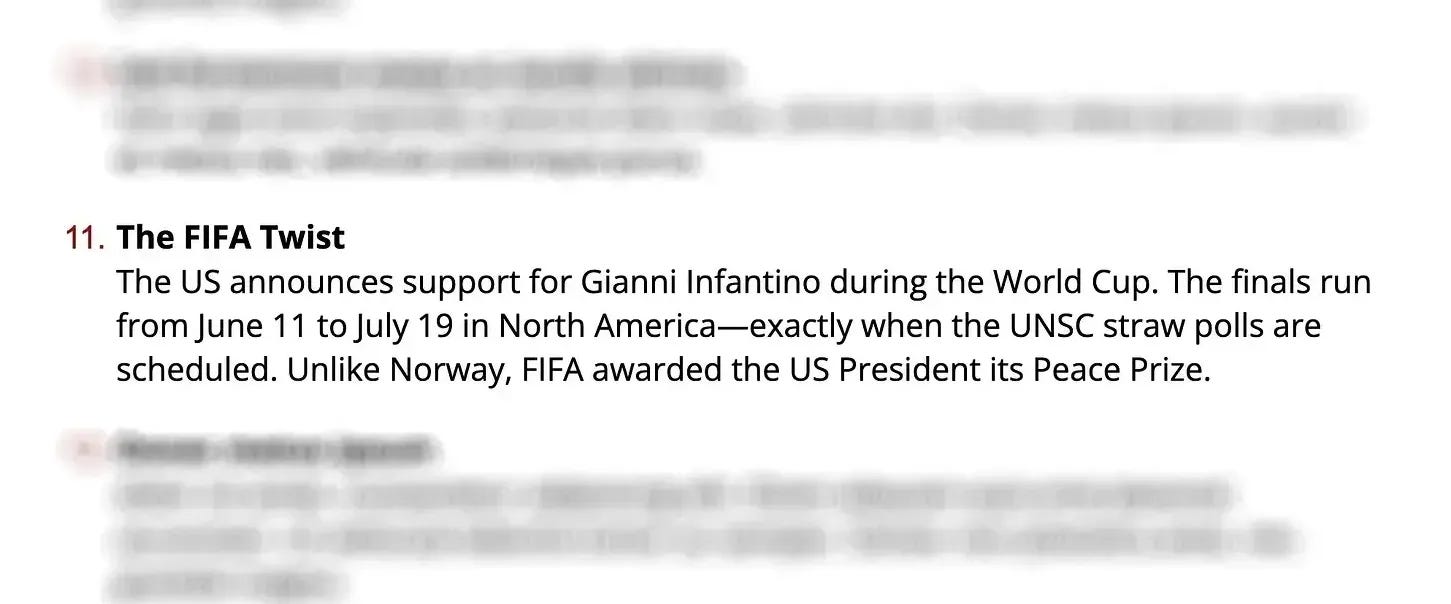
Entry #11
In the new year, I sat down with a colleague to write a list titled “99 Things That (Probably) Won’t Happen When The UN Selects the Next SG.”
Entry number 11 was called The FIFA Twist and read as follows:
“The U.S. announces support for Gianni Infantino during the World Cup. The finals run from June 11 to July 19 in North America — exactly when the UNSC straw polls are scheduled. Unlike Norway, FIFA awarded the U.S. President its Peace Prize.”
This was just a brainstorm — a bit of fun really. But it was also an attempt to stress test what might happen as an unpredictable selection process was launching in increasingly unpredictable times.
In the end, we only made it as far as number 81 before we ran out of steam. That final entry was called The Boring Outcome.
It read simply: “It all goes smoothly.”
Between the Pedestrian and the Unpredictable
Throughout the year, we have tried to keep both ends of the spectrum in mind: the pedestrian and the unpredictable.
For most of 2026, this has been a fairly standard race, with just six candidates who have dutifully presented their ideas in public, and vigorously lobbied for support in private.
Over the next week, however, the campaign moves into the Security Council, where ambassadors will hold the first in a series of confidential straw polls.
If you want to know how that system works, we just published Less Solid Things, a deep dive on the history of the Council’s secret ballots, described by their Ugandan inventor as a “very vague test” of a candidate’s viability.
Less Solid Things

How the UN Security Council’s secret straw polls became a “very vague test” for narrowing the field and selecting the next Secretary-General.
If the precedent set by the selections of Ban Ki-moon and António Guterres holds, The Boring Outcome will prevail:
A leader emerges: One candidate separates from the pack during the initial July rounds of polling.
Momentum builds: Across successive straw polls, that front-runner’s support inches upward while underperforming candidates read the room and bow out.
The red card stays in the pocket: No permanent member uses their red ballot paper to threaten the leading candidate with a veto.
If that pattern repeats, the Security Council will coalesce around a consensus nominee by early October, and the General Assembly will endorse by acclamation. It would be an orderly, textbook transition for the 10th Secretary-General to take office on January 1, 2027.
Underpricing the Weird
But over the weekend, something happened that made us wonder whether we have been underpricing the weird and the not-so-wonderful — the black swans and the red-team scenarios.
I am sure you saw it: a thinly sourced story in the New York Post claiming President Trump, fresh from the World Cup final, wants to install… FIFA chief Gianni Infantino on the 38th floor of the UN Secretariat.
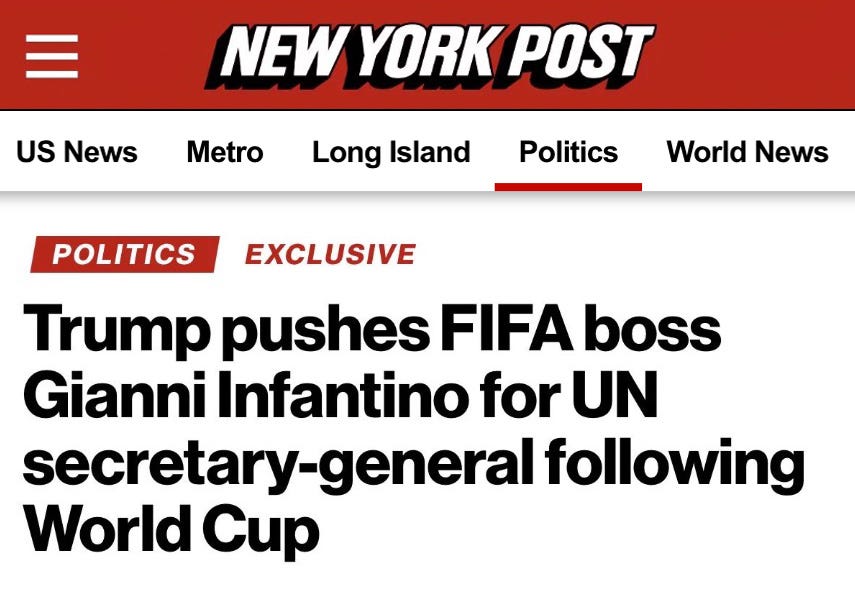
Yep. Infantino. Because he “knows how to manage” a fragmented global membership, the article says.
Let’s put aside for a moment whether this is a test balloon being flown with serious intent. Instead, note that this rumor generated more global media coverage in 24 hours than The Boring Outcome has over the entire past six months.
And let’s also use it to illustrate exactly what it takes to bring a wildcard candidate — a dark horse, a late entrant — into this race.
The barrier to entry is low: just a formal nomination from a single UN Member State that hasn’t already nominated someone else. (And remember, nominating governments are free to withdraw their support at any time and renominate someone new).
That nominator could even be the United States itself — although it is worth noting that no permanent member of the Security Council has formally nominated a candidate in recent history (and convention says that P5 nationals can’t get the job).
The Ultimate Cheat Sheet

Read The Ultimate Cheat Sheet for everything you need to know about the selection of a new Secretary-General.
When the Vetoes Fly
If you read our companion guide to the straw polls and our history of past contests, you’ll know that deadlock is the mother of unpredictability.
Trygve Lie, the UN’s first Secretary-General, got the job because the United States and the Soviet Union blocked each other’s nominees. And when the Soviets later vetoed Lie for a second term, the General Assembly bypassed the Council and extended his contract — a fudge worth keeping in mind if, as some diplomats fear, the Council finds itself still deadlocked in November and December.
Dag Hammarskjöld likewise emerged from nowhere while superpower vetoes were flying. He didn’t know he was under consideration until a reporter called him with the news. His successor, U Thant, spent weeks in the party searching for a compromise candidate, only to discover that he was the compromise the Security Council was looking for.
The pattern held through the rest of the century. Javier Pérez de Cuéllar came into the race to settle a war of attrition between Washington and Beijing, while Kofi Annan only became a front-runner after the United States vetoed Boutros Boutros-Ghali’s second term against the wishes of the rest of the world.
So as the straw poll tallies begin leaking out of the Council chamber, do not just look at who is leading the pack. Listen for signs of a divide between the Permanent Five.
Straw Polls
Reading List
If Less Solid Things, our primer on Security Council straw polls, leaves you wanting more, here is what to read:
Ambassador Olara Otunnu: If you want to know how the straw polls were born, listen to the man who invented them. “What I was testing had no meaning, only a very vague test... All I want you to do is tell me which of these candidates you would discourage—that’s all.”
Ambassador John Bolton: The former U.S. Permanent Representative’s memoir provides an unvarnished look at the power of the P5. “We excluded all Secretariat personnel, including the translators... De La Sablière gave out UN pens, so that each of us would be writing in the same color; I joked that they should all be given back for budget purposes, although I noticed some perm reps kept theirs for souvenirs.”
Ambassador Koro Bessho: Written by the Japanese Permanent Representative who oversaw the crucial July 2016 straw polls, this UN memo is a critique of the straw poll system. “Straw polls should be replaced by official votes at a private meeting of the Security Council… The President should… make the results public.”
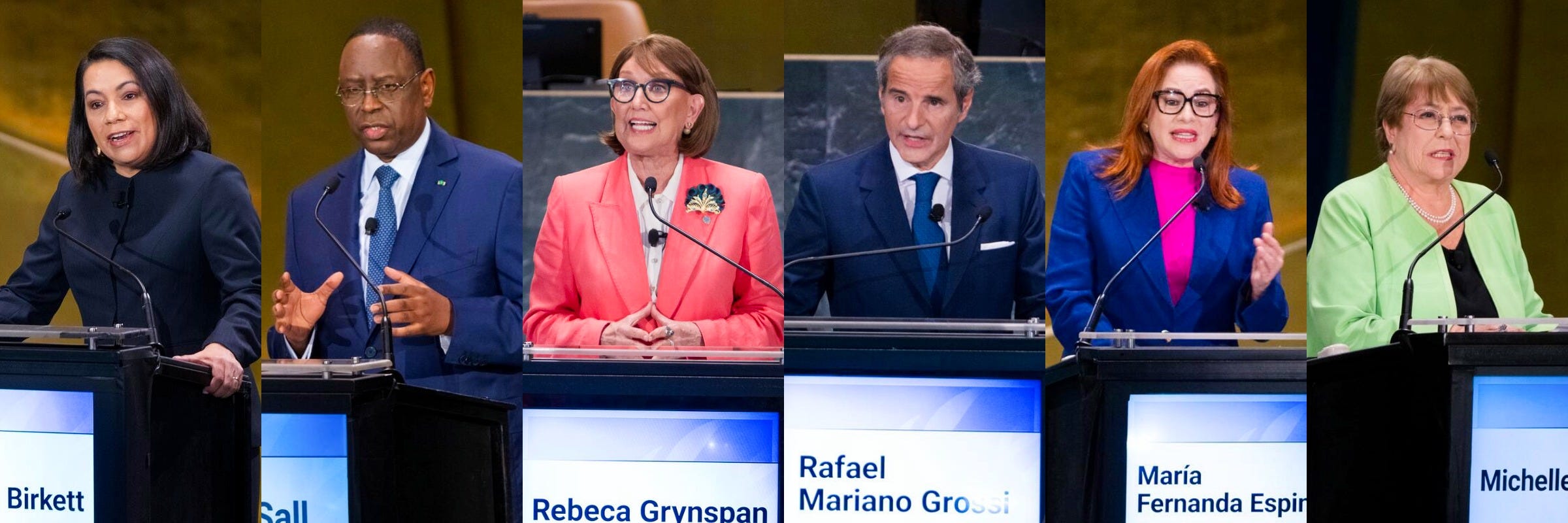
The SG Roundup
Macky Sall, former President of Senegal who was nominated initially by Burundi, secured support from his home country of Senegal, signaling broader support for his candidacy on the African continent.
Carolyn Rodrigues Birkett of Guyana has secured support from the CARICOM community of nations (15 Member States). CARICOM member Antigua and Barbuda is the nominating country another candidate, María Fernanda Espinosa.
The UN Town Hall — a U.S. presidential-style debate — took place in the UN General Assembly Hall on July 23, with all candidates answering questions shaped by civil society on a live simulcast on UN Web TV and Bloomberg TV (you can also watch on YouTube, read a report on France 24).
The Youth Job Description
From the Archive
We have heard this week from diplomats who complain that past selections have seen surprisingly little debate about the merit of candidates.
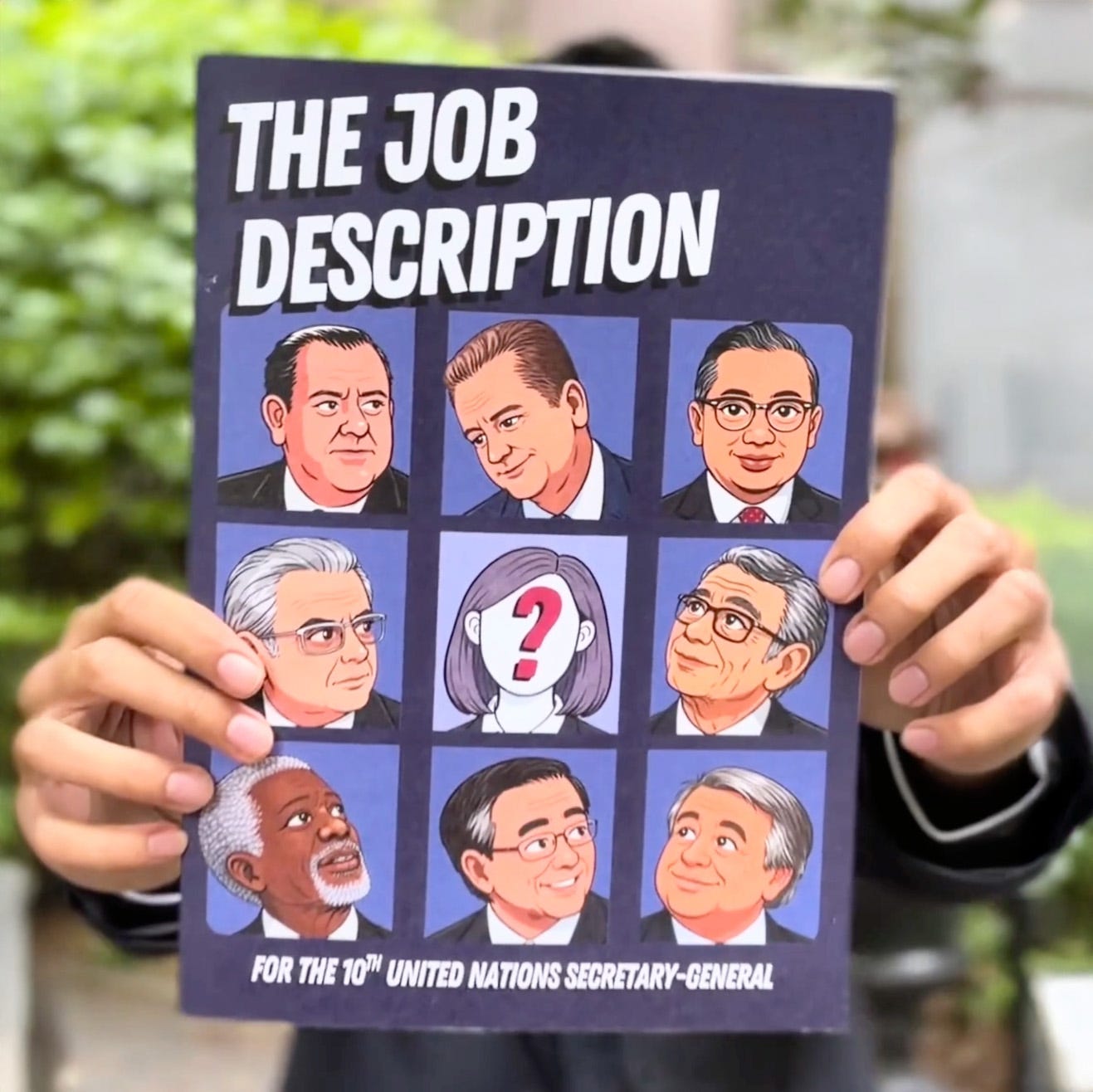
Our Future Agenda, using inputs from more than 2,000 young people from around the world, crowdsourced a Job Description that might help with their deliberations.
Their verdict: In a world marked by deepening distrust and cascading crises, the next leader will be judged not by their ability to win a straw poll, but by whether they can turn global commitments into visible action, stronger accountability, and better decisions about our collective future.
Read: The Job Description and it’s not too late to complete the survey
And in case you missed it…
Check out Beyond the Hype: AI, Human Well-Being, and the Policy Choices Ahead, an essay by Claire Melamed and Paul Ladd on why AI risks aren’t sci-fi scenarios, but the potential for disruptions to jobs, public services, democratic trust, and our environment.

UN Foundation President and CEO Elizabeth Cousens sat down with Bloomberg TV ahead of the UN Town Hall with the six candidates to be Secretary-General. “This selection has always been consequential for the UN. There’ve only been nine Secretaries-General in history, but this one comes at a uniquely defining moment for the UN and for everything it stands for.”
A favor before you go
As the straw polls kick off this week, please forward this digest to colleagues and friends. Building this community relies entirely on word of mouth. And if you haven’t already, please listen to World’s Toughest Job — our podcast series with Foreign Policy.