![[Re]Group: A Playbook for Turbulent Times](https://substackcdn.com/image/fetch/$s_!PUHU!,w_120,h_120,c_fill,f_webp,q_auto:good,fl_progressive:steep/https%3A%2F%2Fsubstack-post-media.s3.amazonaws.com%2Fpublic%2Fimages%2Ff2fb4256-d509-4e61-827b-2ee678efbba9_256x256.png)
![[Re]Group: A Playbook for Turbulent Times](https://substackcdn.com/image/fetch/$s_!OvcZ!,e_trim:10:white/e_trim:10:transparent/h_182,c_limit,f_auto,q_auto:good,fl_progressive:steep/https%3A%2F%2Fsubstack-post-media.s3.amazonaws.com%2Fpublic%2Fimages%2Fa2653539-a634-4ef5-9aab-bc4a7546ebc9_1344x500.png)

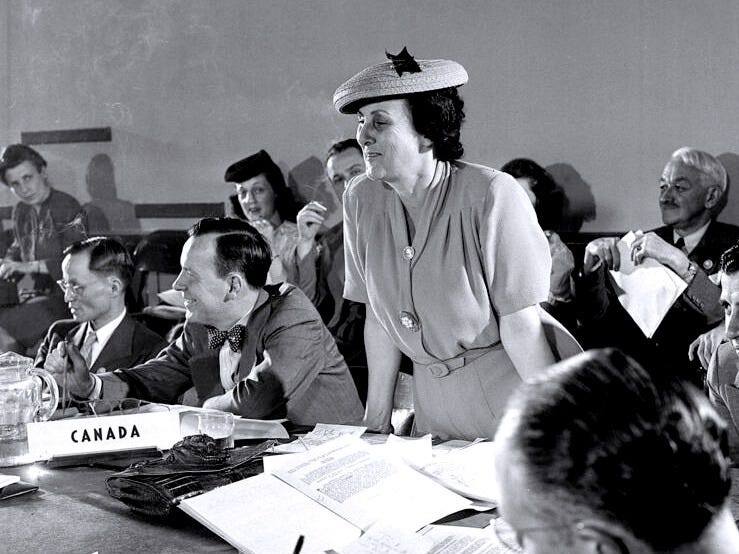
In the spring of 1945, 850 diplomats gathered in San Francisco to create the blueprint for the postwar international architecture. Almost all of the delegates to the UN Conference on International Organization (UNCIO) were men.
But although few in number, women were present as the UN was born. A small group from Latin America, led by Bertha Lutz of Brazil and Minerva Bernardino of the Dominican Republic, argued that the Charter for the new Organization could not simply rely on general references to human rights.
Building on years of preparation, Lutz and Bernardino pushed for as many references to “women” as possible in the Charter. “Men have never found it unnecessary to make a statement of their rights,” Lutz said. “Why, then, should it be unnecessary to make a statement of the rights of women?”
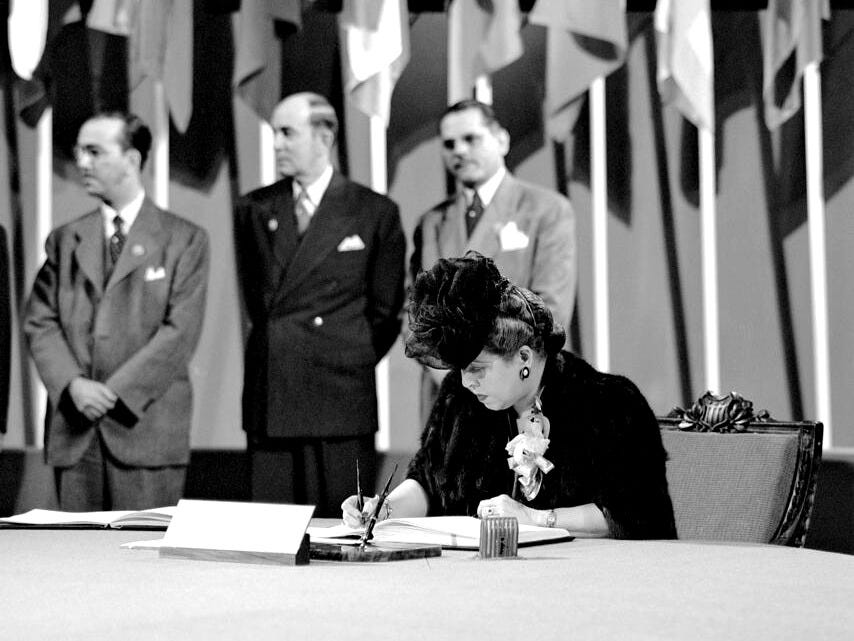
Their persistence was rewarded. The Charter became the first international agreement to explicitly proclaim “the equal rights of men and women.” Just as importantly, they secured Article 8, which guaranteed that the UN would place “no restrictions on the eligibility of men and women to participate in any capacity and under conditions of equality in its principal and subsidiary organs.”
In Where the Future Was Built, UN Foundation’s history of the UN and the global women’s movement, we argued that “if the UN is a veritable intergovernmental ocean, then geopolitics is its tides.” Today, those tides have turned against the agenda Lutz and Bernardino helped establish. With the institutional infrastructure that has sustained gender equality eroding at an alarming speed, the rollback of women’s and girls’ rights is now well underway.
As the UN prepares to elect its 10th Secretary-General, the incoming leader faces a difficult political calculation. Will she bow to pressure to deprioritize or abandon the gender equality agenda? Or will they accelerate the fight to secure it?

The Turning of the Tide
Feminist pioneers like Lutz and Bernardino understood the UN’s strategic value. They secured recognition for the rights, dignity, and humanity of girls and women, while opening the door for their participation at the newly created Organization, including at the top.
Convinced of the need for a global body devoted to women’s rights, they pushed for the creation of the Commission on the Status of Women (CSW). But this Commission has itself now seen attacks on equality. In March 2026, CSW70 showed the power and direction of the pushback, as for the first time its final outcome could not be agreed by consensus.
One might assume that under intense geopolitical pressure from the powerful, governments of all kinds would just scrap gender equality. But they didn’t. And they won’t.
The reason is simpler than we care to acknowledge in international policy circles. The lives of girls and women are not abstract concepts that can just be ignored and negotiated away. Governments know that girls and women have rights. Time and again, history shows that they are ready to fight for them. No matter the country, there is always a woman, an organization, or a group of people at a church, a school, or a labor union ready to demand those rights are protected.
But the backlash is real. According to UN Women’s Gender Snapshot 2026, “across regions, institutions that focus on gender equality are being dismantled, funding for gender equality is on a steep decline, and civic space is shrinking.”
One in three national gender equality mechanisms report an erosion in institutional power over the past two years, including through cuts in personnel, reduced influence in decision-making, elimination of key units, and downgrading of institutional status or the reassignment of mandates to other entities. Nearly one in four (23%) report a reduction in operating budgets, while 9% have lost an autonomous budget.
Without fully functioning institutions, gender equality is no more than a desire. These figures reflect deliberate political decisions, indicating a stark lack of political will and commitment to uphold, sustain, and defend the rights of girls and women.
And yet, during the opening of the 81st UN General Assembly, Member States expressed limited concern over the loss of these institutions or the deterioration of rights, with only a few exceptions that used Afghanistan to paint a picture of what systematic gender discrimination looks like in real life. Most leaders seem to be waiting for further proof that the backlash against women extends far beyond a single country.
Counteracting the Poison
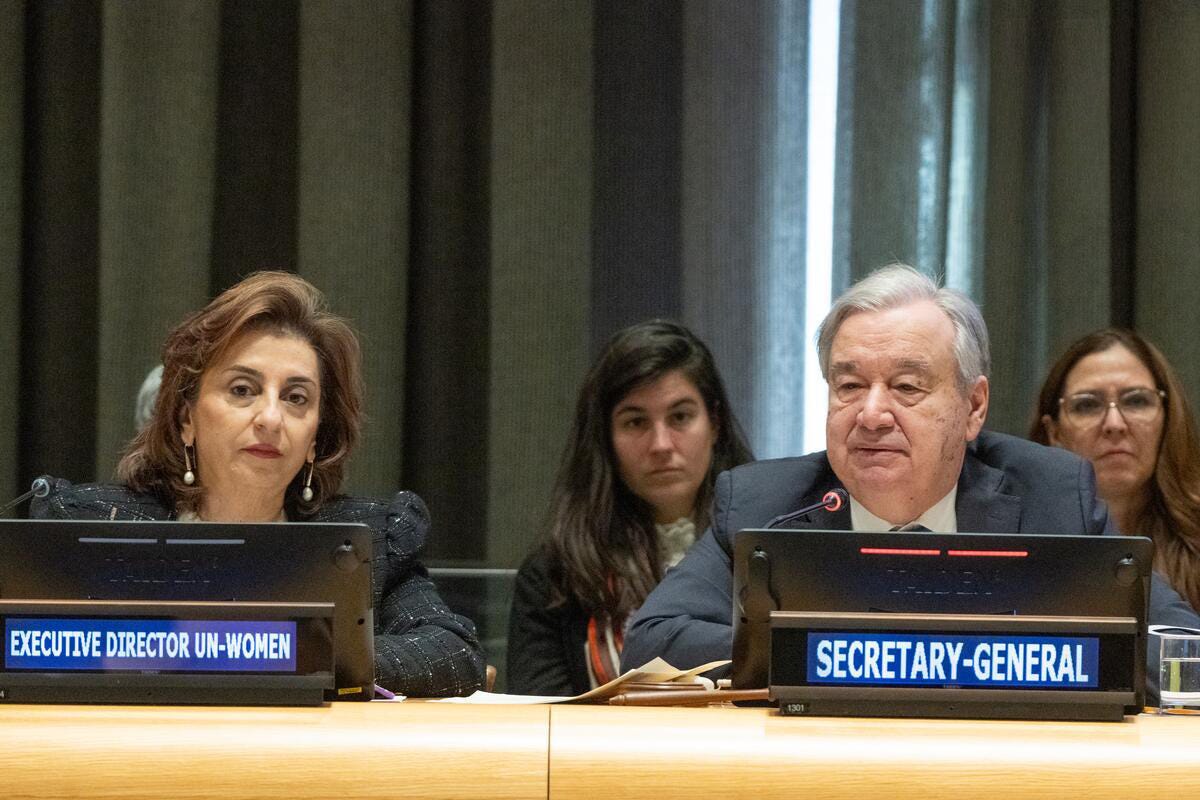
António Guterres, the current Secretary-General and the ninth man to hold the post, sees the problem clearly. “Women’s rights are under siege,” he said recently. “The poison of patriarchy is back — and it is back with a vengeance.”
Guterres has set a high, if narrow, bar for his successor. As he took the oath of office, he pledged that “by the end of my mandate, we should reach full gender parity at the Under-Secretary-General and Assistant Secretary-General levels, including special representatives and special envoys.” This promise has been delivered.
The next leader will face immediate pressure from those whom Guterres accused of “tearing up progress” for gender equality. In a fragmented world where the rules-based order is being dismantled, a new Secretary-General will be asked to prioritize other issues, crises, and constituencies by those who want the UN to go “back to basics.”
Defending girls and women could seem politically risky, or even be perceived as a liability by the incoming leader. The transition will give those who see gender equality as a threat, as well as those who claim the work has already been done, a fresh opportunity to push for the agenda to be downgraded or abandoned.
But as Guterres himself has argued, the “antidote is action.” That is why the next Secretary-General must do more than defend ground first staked out in the 1940s. Simply seeking to protect existing commitments, programs, institutions, and funding will not be enough.
For that antidote to do its work, the next leader will need a vision for girls and women that is built for a world in constant crisis, and a plan to navigate shifting coalitions, reckon with corporate actors that outspend and outmaneuver governments, and contend with the rapid rise of AI and other technologies that offer both hope and menace to humanity.
Delivering the Antidote
Turning this vision and plan into reality means replacing a “culture of caution” with a drive for “agency and action” on gender equality. So what concrete steps should the UN’s new leader take?
Make women central to peace and security
A renewed focus on peace and security is a top priority for Member States and for the public. Girls and women must be central to the mission, not an afterthought. Yet nearly eight in ten peace processes worldwide fail to include a single woman negotiator or mediator.
As the new Secretary-General transforms the UN’s peace and security pillar, they must put the full integration of the Women, Peace and Security agenda at the heart of that work. That means fulfilling the UN’s promise to deliver measurable results: “more conflicts ended through inclusive political solutions; more women directly shaping peace agreements, security sector reforms and recovery plans; and more survivors of violence gaining access to justice, reparations and protection.”
Will the new leader rapidly tackle the almost total absence of women at the top of peacekeeping missions? Could they condition UN support on the “full, equal, and meaningful inclusion of women by all parties in all stages of a peace process,” as the High-level Advisory Board on Effective Multilateralism recommended?
Protect feminist movements for the future
Women’s movements that have fought for decades to turn rights into reality are now operating under extreme duress. Hit by an ideological backlash, a deepening funding crisis, and the assumption that supporting the grassroots is optional, the feminist civil society ecosystem is primed for a mass extinction event. At the same time, the battleground is shifting fast, as the online world and AI reshape reality in ways that intensify discrimination and violence against girls and women. Gender bias is trained into many AI systems, while 99% of all deepfakes are sexual in nature and 96% target girls and women.
As Joni Mitchell sang, “You don’t know what you’ve got ‘til it’s gone.” The next Secretary-General must not overlook the power and contributions of women’s movements. Supporting and enlisting women in delivering a new mandate is not only the right thing to do, but politically savvy, given their technical expertise, advocacy, and capacity to demand accountability and mobilize at global and country levels.
An immediate priority is to expand and formalize engagement with feminist civil society across the UN’s work, while bringing these voices into the conversations that will shape the future. Nobody is better positioned than the Secretary-General to bridge the divide between women’s advocates, governments, and the tech corporations developing and deploying AI. Will they use their convening power to bring these actors into sustained dialogue, demanding accountability from private companies for algorithmic bias and digital abuse?
Keep the promises of the 2030 Agenda to girls and women
Progress on development is impossible without investing in girls and women. With not a single target for Sustainable Development Goal 5 on track, the commitment to gender equality by 2030 is slipping out of reach, while the money is drying up just when it is needed most. Between 2023 and 2024, Official Development Assistance committed to gender equality fell by 13%, direct aid to women’s rights organizations plummeted by 28%, and major private funders are now retreating as well.
The next SDG Summit in September 2027 will be a pivotal moment in the Secretary-General’s first year. Can the new incumbent use the summit to announce that the UN system will finally deliver on the Gender Equality Acceleration Plan target of allocating at least 15% of its program spending to activities where gender equality is the main objective?
And can she rally a new coalition of public and private funders to close the financing gap and kick-start delivery of all 17 SDGs for girls and women?
A Defining Test
At moments of crisis and despair, even when its shortcomings have been glaringly evident, people have still looked to the UN. It has served as a beacon for those demanding to be heard and seen, for those seeking justice, and for those looking for protection from war, famine, and systemic abuse.
As a new leader prepares to take on the world’s toughest job, she will have to decide whether to take the UN into a more cautious era or stand firm on the Charter’s commitment to “the equal rights of men and women.”
The next Secretary-General must act as a fierce standard-bearer for the rights of girls and women, not because gender equality is a politically correct cause, but because it is fundamental to the principles upon which the Organization was founded. In an age of backlash and retreat, that kind of leadership is the antidote the world needs.


