![[Re]Group: A Playbook for Turbulent Times](https://substackcdn.com/image/fetch/$s_!PUHU!,w_120,h_120,c_fill,f_webp,q_auto:good,fl_progressive:steep/https%3A%2F%2Fsubstack-post-media.s3.amazonaws.com%2Fpublic%2Fimages%2Ff2fb4256-d509-4e61-827b-2ee678efbba9_256x256.png)
![[Re]Group: A Playbook for Turbulent Times](https://substackcdn.com/image/fetch/$s_!OvcZ!,e_trim:10:white/e_trim:10:transparent/h_182,c_limit,f_auto,q_auto:good,fl_progressive:steep/https%3A%2F%2Fsubstack-post-media.s3.amazonaws.com%2Fpublic%2Fimages%2Fa2653539-a634-4ef5-9aab-bc4a7546ebc9_1344x500.png)

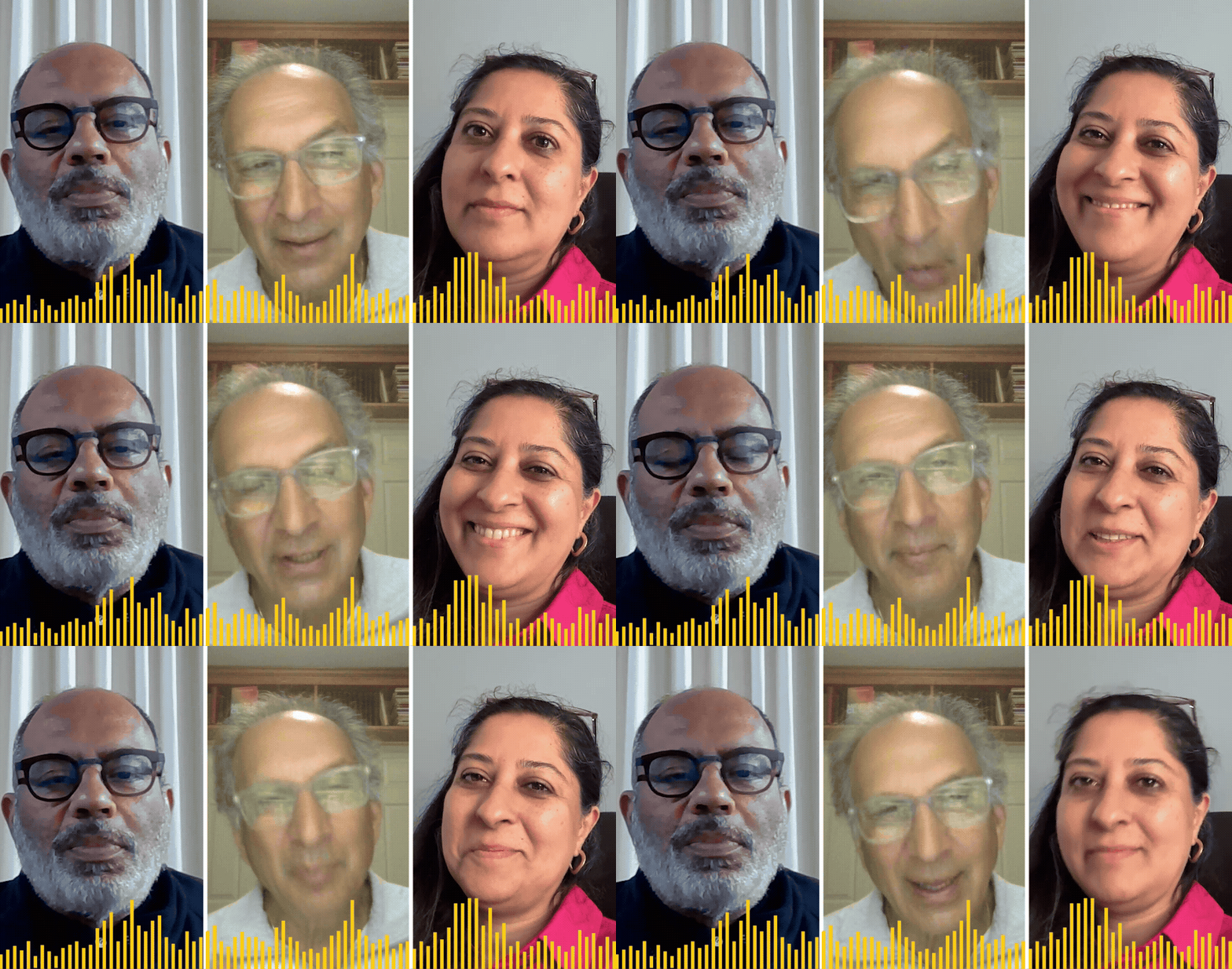
This week on World’s Toughest Job, a podcast co-produced by Foreign Policy and the United Nations Foundation, we ask: As the world faces compounding economic crises, how should the next Secretary-General respond?
The episode opens with a look back at the 1990s, when Secretary-General Boutros Boutros-Ghali launched a direct challenge against the International Monetary Fund and the World Bank’s Washington Consensus and tried to wrest some control over global economic governance back to the UN. (Read about that history here).

Next, Jasmin Bauomy and her co-host Mark Malloch-Brown are joined by an expert panel for a discussion of today’s economic order, which, thanks to the closure of the Strait of Hormuz, faces a real-time stress test of its capacity to absorb shocks.
With global public debt at record levels, the G20 paralyzed by infighting, and developing nations harmed by fallout from a system they do not control, the new leader will take office at a time when the multilateral financial architecture is under severe strain.
The panel explores whether the next Secretary-General can forge a new economic consensus, how developing nations can build their own financial power rather than compete for aid, and whether the UN can, and should, champion a global tax convention, a Borrowers’ Platform, or other new approaches.
Here’s what panelists Homi Kharas, Senior Fellow at the Brookings Institution; Carlos Lopes, Honorary Professor at the Nelson Mandela School of Public Governance at the University of Cape Town; and Attiya Waris, Professor of Fiscal Law and Policy at the University of Nairobi, had to say.
1. Shocks are hardwired into the economic system, but the global steering committee is asleep at the wheel.
The era of optimism about globalization is over. In its place is a fracturing order defined by rapid shifts in economic power, growing inequality, rising protectionism, and, above all, repeated shocks.
In fact, the vulnerability of globalization to these shocks has become one of its defining characteristics. In the 1990s, just as governments had finished watering down Boutros-Ghali’s Agenda for Development, the Asian Financial Crisis was brewing. The world has since faced a cascading series of complex emergencies with severe global economic impacts (a theme we will explore further in episode 7 of World’s Toughest Job on June 23).
As Homi Kharas pointed out, “I don’t think there are many people who think that the frequency and severity of [these] kinds of shocks … is now going to disappear, that it was just an unfortunate string of bad luck. Many people are now thinking that that bad luck is actually part of the hardwiring of the global economy.”
Historically, the system has upgraded itself only when in a panic. The G20 was established at the finance minister level in the wake of the Asian Financial Crisis and was elevated to the leader level when the 2008 global financial meltdown occurred. Today, however, the G20 — which one of its architects hoped would become a “steering committee” that could break the deadlock on the world’s biggest challenges and a route to reform of “the great institutions of globalization” — is itself struggling to reach a minimum level of consensus. And while regulatory reforms after successive crises may have increased top-level resilience, Carlos Lopes noted that they often come at the cost of collateral damage for economies in the Global South.
For a new Secretary-General, this is the reality. If the global economy is already heading toward its next crisis, there is essentially no one at the wheel.
2. As traditional global institutions drift apart, countries are building alternatives.
Our history lesson this week explored the tensions between two multilateral tribes — the universalists of the UN in New York, with their links to foreign ministers, and the Bretton Woods camp in Washington.
Attiya Waris noted that the IMF and World Bank are formally part of the UN family, but this happened in a deal that gave them political independence and budget autonomy. Part of the system, then, but “really not,” she said. Mark Malloch-Brown sees this as creative tension. While there is “a much deeper technical bench strength around financial issues in the Bretton Woods institutions,” he said, there is “much greater policy ambition in the UN.” Reaching the best outcomes, he added, requires “that push and pull between the two.”
For many developing nations, that push and pull is broken. With grant financing in decline, the UN’s leverage is weakening, concentrating more power in the better-funded World Bank and IMF. But with Bretton Woods voting power skewed toward Western economies, emerging markets are poorly represented relative to their share of global GDP. Consequently, as Lopes bluntly stated, developing countries are “increasingly seeing the IMF [and] World Bank structures as beyond repair.”
As Kharas noted, “the world of multilateralism, of universal collective action to solve global problems ... is disappearing.” Lopes agreed. “Realistically we are moving from … universalism to managing fragmentation,” he said. In its place, a two-track reality is emerging. On one hand, smaller coalitions of like-minded countries are teaming up to tackle immediate issues in a trend Kharas calls “plurilateralism.” On the other hand, emerging powers are building parallel financial architecture, from alternatives to the SWIFT messaging network to the BRICS-led New Development Bank. Highlighting how this shift is playing out regionally, Waris pointed out that “there’s [a new] African credit rating agency that’s a public agency, not a private company unregulated like it is in the United States right now.”
3. To fix a rigged system, developing nations are demanding equalizers rather than charity.
The rules of the global financial system have historically been dictated by wealthy creditor nations, leaving developing countries deeply vulnerable to economic shocks and trapped in compounding crises.
“The Paris Club is a group of creditor countries. They created the rules of the game,” Kharas said. “And every individual debtor country was basically given a ‘take it or leave it’ kind of proposition.” To counter this one-sided approach, developing nations are creating innovative mechanisms to level the playing field. A new Borrowers’ Platform has been created with backing from the UN’s trade and development wing, UNCTAD (and support from Kharas and his colleagues). Launched by 30 countries during the April 2026 IMF-World Bank Spring Meetings, it acts as a counterpart to established creditor networks. Rather than functioning as a collective bargaining cartel, this voluntary forum allows borrowing nations to share policy experiences and enter complex debt restructurings on a more equal footing than they were previously subjected to. As the current UN Secretary-General António Guterres said at the launch: “Today, 3.4 billion people live in countries that spend more servicing debt than [on] health or education. Developing countries are forced to climb the development ladder with one hand tied behind their backs.”
On the revenue side, the panel agreed that the Global South must break free from the cycle of competing to be recipients of a shrinking pool of foreign aid. Pointing out that Africa is paradoxically a net exporter of capital, Lopes said the continent must focus on harnessing its own untapped domestic wealth rather than pleading for outside help. “We can completely change the reality because we have about $4 trillion worth of assets that are not invested in the continent,” he said. “And to be chasing the 50 billion coming from aid and concessional lending every year ... is obviously something that doesn’t make sense. This is not about charity.” This makes Lopesis a supporter of the New African Financial Architecture for Development, which aims to “scale Africa’s financial firepower in support of Africa’s transformation.”
Some governments are also pushing for a legally binding UN Framework Convention on International Tax Cooperation to ensure global financial transparency. Waris believes that getting such a convention — planned for presentation to the General Assembly in late 2027 — to the finish line will be a critical task for the incoming UN chief. “I think there isn’t anything more important right now than us being able to put that into play, and getting countries to ratify and roll out those treaties,” she said. Malloch-Brown cautioned that the next Secretary-General will face fierce pushback from wealthier nations. Pushing a global tax agenda, he said, will likely require “more sympathetic governments in the U.S.” and elsewhere before the new Secretary-General “is going to want to lead with her chin on that.”
4. On the global economy, the next Secretary-General needs to frame problems and articulate policy choices
The panel was clear-eyed about the limits of the Secretary-General’s economic power. As Kharas said, the incoming UN chief must accept that “the real action” on the global economy lies outside the UN, while Member States increasingly want to coordinate economic policy among themselves without intermediation. The Secretary-General’s job, Kharas argued, is not to dictate or act as a top-down coordinator, but rather to facilitate discussion and pull people together.
Lopes believes the UN needs a visionary more than a micromanager. He framed the core dilemma: the next Secretary-General can either play it safe as a cautious “system stabilizer” or can take the path of global leadership by defending “institutional neutrality” and brokering agreements among fragmented alliances. Waris agreed that the leader’s tone will be everything. Acknowledging that the world is currently “quite despondent,” she argued that the next Secretary-General must “raise the level of ambition” and project optimism — or risk being entirely “weighed down by the enormity of it.”
Ultimately, Malloch-Brown said, the UN’s true strength isn’t executing financial strategies but “framing the problem” and articulating policy choices. The new leader must act as “a fierce spokesman,” laying out a clear vision of “just how unfair the global economy remains.” Kharas saw an opportunity to look to the future. With time running out for the 2030 Sustainable Development Goals, he said that designing their replacement will be one of the first and most important economic tasks awaiting the new Secretary-General.
But as the Hormuz blockade pushes the global economy toward the IMF’s worst-case scenario — a near-recession with growth dropping to around 2% and headline inflation above 5% — the next UN leader may face more immediate concerns. Guterres called for a regular summit to force the UN, the G20, the International Monetary Fund, and the World Bank into the same room. While the Pact for the Future ultimately watered down the mandate to exclude the G20, the Secretary-General used his convening power to bring them to the inaugural summit anyway. Some assume this initiative is destined to expire quietly in the graveyard of good ideas that lack political support. But who knows? In another global financial crisis, the next Secretary-General might just find this summit is exactly the tool the world needs.
Quotations have been lightly edited for clarity.
Listen to the latest episode of World’s Toughest Job below
As Another Economic Crisis Looms, How Should the UN Respond?

In 1994, United Nations Secretary-General Boutros Boutros-Ghali proposed a radical, new vision to reform the global financial infrastructure. He called it “An Agenda for Development.” But his proposal was watered down in committee and largely ignored by the financial powers of the time.
