![[Re]Group: A Playbook for Turbulent Times](https://substackcdn.com/image/fetch/$s_!PUHU!,w_120,h_120,c_fill,f_webp,q_auto:good,fl_progressive:steep/https%3A%2F%2Fsubstack-post-media.s3.amazonaws.com%2Fpublic%2Fimages%2Ff2fb4256-d509-4e61-827b-2ee678efbba9_256x256.png)
![[Re]Group: A Playbook for Turbulent Times](https://substackcdn.com/image/fetch/$s_!OvcZ!,e_trim:10:white/e_trim:10:transparent/h_182,c_limit,f_auto,q_auto:good,fl_progressive:steep/https%3A%2F%2Fsubstack-post-media.s3.amazonaws.com%2Fpublic%2Fimages%2Fa2653539-a634-4ef5-9aab-bc4a7546ebc9_1344x500.png)

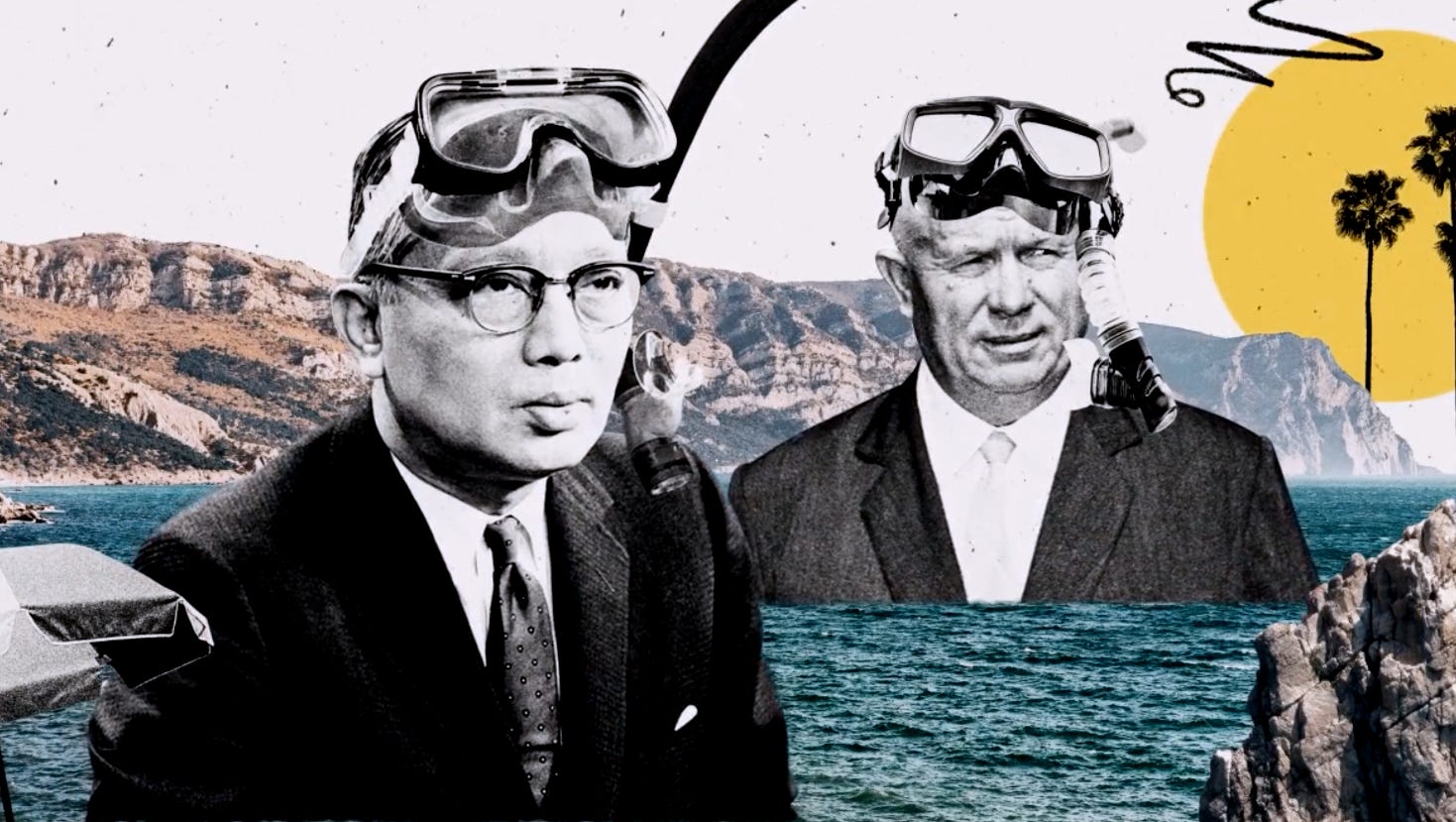
It is August 1962, and U Thant, acting Secretary-General of the United Nations, is sitting by the Black Sea. He is visiting Soviet leader Nikita Khrushchev at his dacha in Yalta. The two men have finished a lunch spent discussing a divided Berlin and the UN’s fragile finances.
It is a sweltering day. Khrushchev suggests a swim and strips down to his bathing suit. U Thant politely declines. But as his grandson, the historian and author Thant Myint-U, recounts in the second episode of our podcast, World’s Toughest Job, Khrushchev is insistent.

The two end up bobbing in the water, U Thant in a borrowed swimming costume that doesn’t fit. What he doesn’t know is that Khrushchev is already secretly sending nuclear missiles to Cuba. But — that deception notwithstanding — this moment established the rapport U Thant would need just weeks later. When the Cuban Missile Crisis brought the world to the brink of nuclear war, U Thant was able to pick up the phone and act as a “firebreak” between Washington and Moscow.
After dedicating our first episode to the type of leader the world needs, the rest of the series focuses on the inbox the next Secretary-General will inherit. Each time, we draw lessons for the tenth Secretary-General from how their predecessors survived the crises of the 20th century. By exploring U Thant’s diplomacy during the Cold War, we can delve into the playbook the next Secretary-General will need to reclaim the UN’s role as a guarantor of international peace and security.
Everyone knows the Cuban Missile Crisis was dangerous. But we also seem to forget just how close we came to disaster. Consider the night of October 27, 1962. A Soviet submarine, depth-charged by U.S. destroyers and cut off from Moscow, prepared to launch a 10-kiloton nuclear torpedo. Launch required consensus from three officers. Two said yes. One — Flotilla Chief of Staff Vasili Arkhipov — said no. At the same time, U.S. forces were preparing for a land invasion, unaware that Soviet troops on the island were already armed with tactical nuclear warheads and positioned to use them. Had the Marines landed, they would have been met with nuclear fire, forcing a full strategic response.
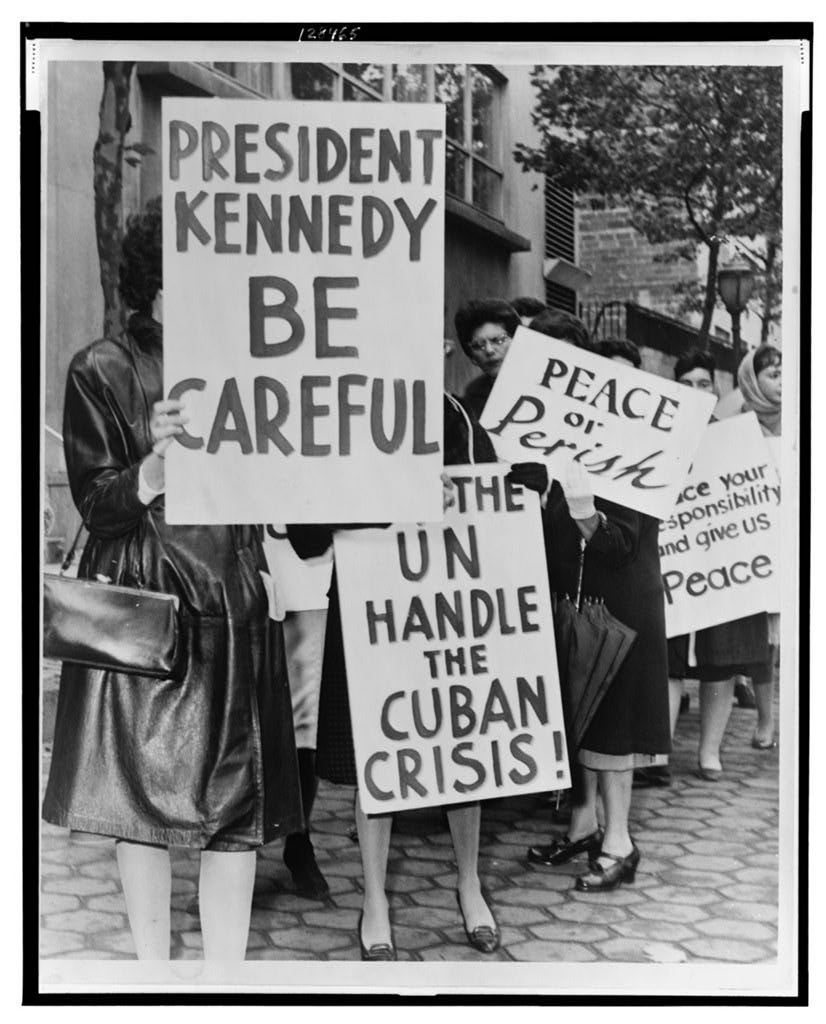
President Kennedy later estimated the probability of disaster at “between one in three and even.” Looking at the historical record, he did not overstate the risk. In our podcast, Thant Myint-U reflects on how Armageddon was actually avoided and wonders how to value the role played by his grandfather’s mediation. “What percentage? I don’t know,” he says. “5%, 10%, 20%? I don’t know. But without him, there might not have been a firebreak.” I had wondered the same thing after reading Thant’s book. And as part of the research for [Re]Group, I decided to try and work it out.
This is a simple calculation, looking only at the immediate economic costs of a nuclear war in 1962. It does not even attempt to account for the catastrophic loss of life, the physical destruction, or the sudden end of the post-World War II order. Instead, consider two baselines: What if a limited nuclear exchange caused an economic shock on par with the Great Depression (a 15% loss of global GDP)? And what if a wider war mirrored the devastation of the Black Death (a 33% loss)? Using Kennedy’s lower-bound estimate of a 33% risk of war, and modeling the conservative “Great Depression” shock, we only need to give U Thant a mere 1.7% of the credit for the peaceful outcome to pay for every single dollar spent on the UN from 1945 up to that point — including the construction of its New York headquarters and the massive peacekeeping mission in the Congo.
And if we give him a bigger role? If we assume a “Black Death” level shock, adjust the risk to a coin toss, and put his attribution at 10% — the middle of his grandson’s guess—the math scales dramatically. This single act of diplomacy generates enough expected value to fund the entire UN system, including all of its regular budgets and peacekeeping operations, straight through to the mid-1990s.
But, as Thant Myint-U argues, the United Nations was driven by two parallel imperatives in the 20th century. Beyond preventing nuclear war, an “equally important” mission was creating “a world without empire.” When we look back at the rapid dismantling of European empires, we are looking at the largest transfer of territory in human history. It was also arguably the UN’s most successful, and largely forgotten, peacekeeping operation. By offering a legal, orderly timeline for imperial handover—through both the Trusteeship Council and the General Assembly—the UN’s diplomatic machinery acted as a massive shock absorber. It reduced the need for colonies to fight wars of national liberation, and ensured that those who did had an international mechanism to help resolve them.
We see this contrast when comparing catastrophic wars in Vietnam and Algeria, where imperial powers refused to use the UN’s “conveyor belt” to statehood, to the international system’s ability to shield independence in Botswana and protect it through peacekeeping in the Congo. The UN’s Blue Helmets have continued to reduce the risk of war, offering a further return on investment in peace and security. Consider the period between 2001 and 2013. The UN spent $59 billion globally on peacekeeping. Counterfactual modeling shows that without those missions, the world would have experienced three to four additional major civil wars. Given the average cost of a conflict of that type, the UN preserved up to $216 billion in economic value. The investment paid for itself nearly four times over.
Why look backward at these numbers? Because the evidence of the UN’s value isn’t actually that hard to find. When you add up the averted costs of nuclear exchanges and civil wars, finding the international system’s return on investment is like shooting fish in a barrel. It proves the most banal of truisms: war is ruinously expensive, while peace is absurdly cheap.
But there is a catch, which brings us back to the case study for this episode of World’s Toughest Job. The paradox of prevention is that when it works, nothing happens. Over the decades, the machinery of peace becomes invisible. And because we can no longer see the mechanisms keeping us alive, war once again becomes fashionable.
This is why roundtable guests focused so heavily on the type of leader the UN needs in 2027. With great power rivalries intensifying and the norms governing conflict rapidly decaying, the old bureaucratic playbook is no longer enough. As Zeid Ra’ad al-Hussein argued, the times demand a risk-taker, not a cautious administrator. Otherwise, as Thant Myint-U warned, forgetting how wars were once prevented will lead only to our “sleepwalking back into the cataclysmic bloodshed of the early 20th century.”