![[Re]Group: A Playbook for Turbulent Times](https://substackcdn.com/image/fetch/$s_!PUHU!,w_120,h_120,c_fill,f_webp,q_auto:good,fl_progressive:steep/https%3A%2F%2Fsubstack-post-media.s3.amazonaws.com%2Fpublic%2Fimages%2Ff2fb4256-d509-4e61-827b-2ee678efbba9_256x256.png)
![[Re]Group: A Playbook for Turbulent Times](https://substackcdn.com/image/fetch/$s_!OvcZ!,e_trim:10:white/e_trim:10:transparent/h_182,c_limit,f_auto,q_auto:good,fl_progressive:steep/https%3A%2F%2Fsubstack-post-media.s3.amazonaws.com%2Fpublic%2Fimages%2Fa2653539-a634-4ef5-9aab-bc4a7546ebc9_1344x500.png)

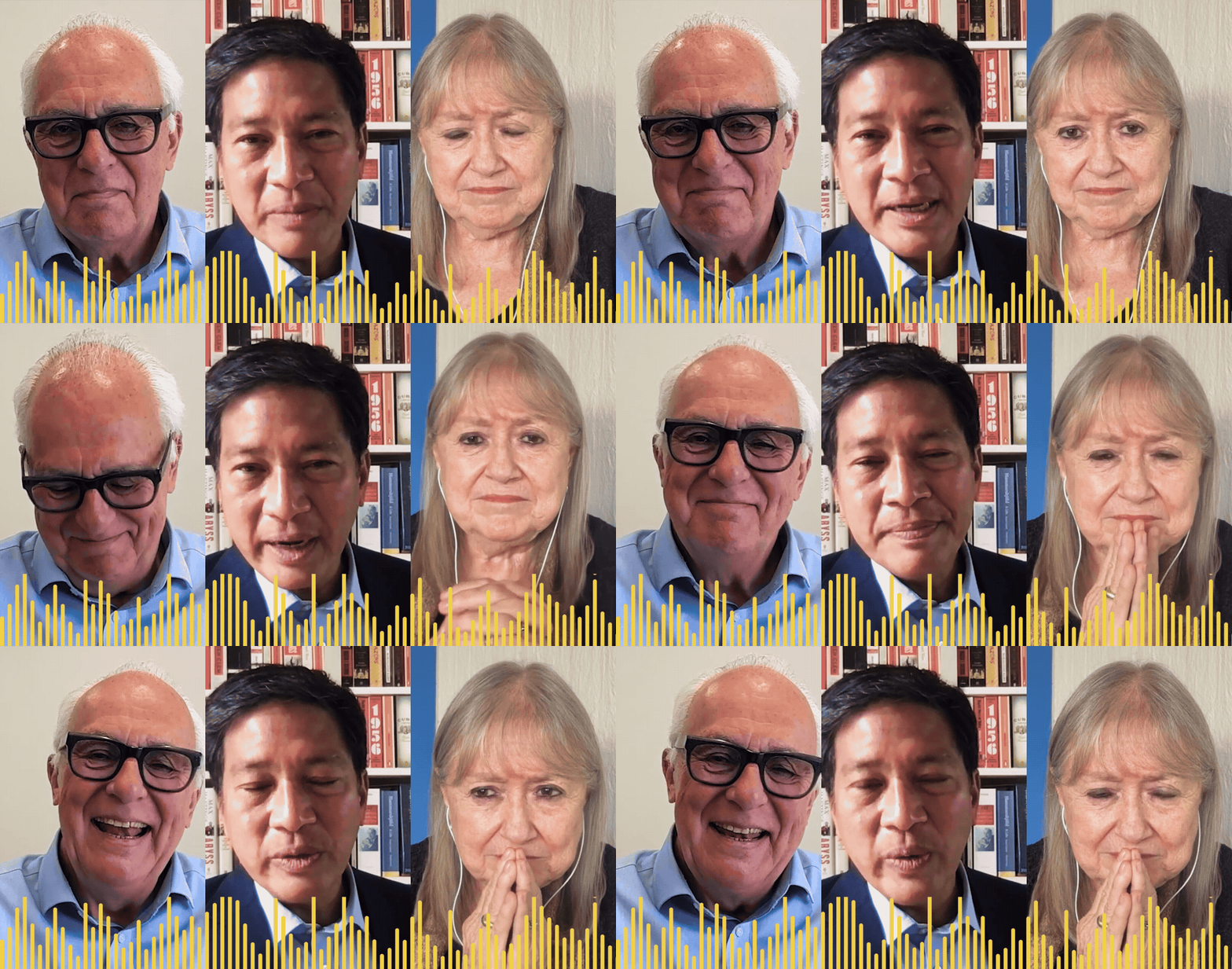
This week, we launched World’s Toughest Job, a podcast co-produced by Foreign Policy and the United Nations Foundation. Hosted by audio storyteller Jasmin Bauomy and co-hosted by Mark Malloch-Brown — the former UN Deputy Secretary-General — this eight-part series looks past the political horse race to explore the challenges facing the next UN Secretary-General.
In our first episode, we set the scene and ask what kind of leader the world needs right now. We explore the innovation required to bypass a deadlocked multilateral system, and how the next Secretary-General can use their moral and political voice to defend human dignity at a time of growing geopolitical tensions.

Here are four takeaways from their discussion:
1. The UN is facing an existential election.
When we think of the UN, we usually think of vetoes and deadlocked Security Council meetings. But if the next Secretary-General fails, the institution won’t suddenly close down. As Richard Gowan points out, the real danger is that the UN fades away to become “an interesting museum piece on the East River where school groups come and teenagers look a bit bored wandering around the halls.”
We can’t afford that because we rely on multilateralism to keep the world running. As Nudhara Yusuf explains, the UN does much more than prevent wars; it sets the baseline rules for international travel, telecommunications, and even space systems. “I think if we don’t get that right this year, we are going to reach a tipping point in history where we’ll look back and say, we made a mistake,” she adds.
2. The UN has always been about more than keeping the peace.
There is a lot of talk right now about taking the UN “back to basics.” Often, that is interpreted as a narrow focus on mediation and security. But Thant Myint-U reminds us that the UN was always fueled by two equal convictions.
The first was a world without war. In a future episode of World’s Toughest Job, he will tell the story of how Secretary-General U Thant stepped between a deadlocked U.S. and Soviet Union during the Cuban Missile Crisis to help pull the world back from the nuclear brink.
The second conviction was a world without empire. Asserting state sovereignty and ensuring a fairer economic system for newly decolonized nations was core business for the UN for the first half of its existence. Today, the UN must constantly balance mitigating risk — managing peace, security, and a wave of global emergencies — with the demand to create and broaden opportunities for the Global South. No Secretary-General will succeed without balancing both sides of this coin.
3. Don’t wait for permission. Ask for forgiveness.
If a Secretary-General waits for a divided Security Council to give them a mandate, they will be paralyzed. Any Secretary-General needs to improvise, especially during periods of turbulence. As Susana Malcorra puts it: “What I learned in the United Nations is that unless something is specifically prohibited, you can do it and eventually ask for forgiveness.”
This becomes even more true when the geopolitical chessboard is changing and UN leaders need to build new coalitions to solve global problems. That requires the mindset of a chess grandmaster. Where others see gridlock, Mark Malloch-Brown argues a successful Secretary-General sees a geopolitical Venn diagram. He experienced this firsthand as Deputy Secretary-General under Kofi Annan, who combined public celebrity with behind-the-scenes leverage to discover shared interests where none seemed to exist.
How a leader finds that path to impact depends entirely on their temperament. Thant Myint-U notes that contemporaries found Dag Hammarskjöld literally “electrifying” in a room, while U Thant had the opposite effect, using his calming presence to convince adversaries a compromise could be found. Others, like Ban Ki-moon, pursued patient diplomacy to secure breakthroughs like the Paris Agreement. But whatever their personal style, the rule remains the same: act first, and use the moral authority of the office to pull the world along with you.
4. Embrace the “Icarus Arc.”
Even the most successful Secretaries-General eventually fly too close to the sun. Mark Malloch-Brown points out a recurring historical pattern: a Secretary-General arrives with political momentum, but has to make increasingly tough choices. Whether it was Dag Hammarskjöld in the Congo, U Thant navigating the Cold War, or Kofi Annan dealing with the Iraq War, their political support from the permanent members of the Security Council inevitably frayed.
Forcing change comes at a cost. The more risks you take and the more you get done, the more political capital you burn. But the alternative — keeping your head down to survive — is worse. As Thant Myint-U pointed out, if a new Secretary-General is “seen taking risks for peace in Ukraine... in the Middle East, in Sudan,” they have a chance of leaving a legacy, even if that angers the powers that be.
What’s Next?
Episode 1 defines the leadership required for the job. The rest of the series looks at the impossible missions waiting in the new Secretary-General’s inbox. Over the next seven episodes, we are going to pair the challenges the UN’s next leader will face — from AI and climate change to economic turbulence — with how a past Secretary-General handled a similar challenge. Join us to learn what the leaders of tomorrow can learn from the stories of our multilateral past.