![[Re]Group: A Playbook for Turbulent Times](https://substackcdn.com/image/fetch/$s_!PUHU!,w_120,h_120,c_fill,f_webp,q_auto:good,fl_progressive:steep/https%3A%2F%2Fsubstack-post-media.s3.amazonaws.com%2Fpublic%2Fimages%2Ff2fb4256-d509-4e61-827b-2ee678efbba9_256x256.png)
![[Re]Group: A Playbook for Turbulent Times](https://substackcdn.com/image/fetch/$s_!OvcZ!,e_trim:10:white/e_trim:10:transparent/h_182,c_limit,f_auto,q_auto:good,fl_progressive:steep/https%3A%2F%2Fsubstack-post-media.s3.amazonaws.com%2Fpublic%2Fimages%2Fa2653539-a634-4ef5-9aab-bc4a7546ebc9_1344x500.png)


An Anatomy of Dread
We are not a happy bunch.
Two polls out last week prove it. The UN Foundation and GeoPoll asked people in 20 countries how they feel about the future. The hopeful: 34%. The worried: 57%.
Rockefeller and Focaldata asked whether people think the world has gone downhill in the past year. Nearly 70% say yes, more than double the share who think things have grown worse in their own lives and those of their families.
So it’s not trouble at home that keeps people awake at night but the fear that there’s … something out there … lurking in the shadows. The farther the lens pulls back, the darker things seem to get. Many of us feel like extras in the first act of a B-movie, waiting to find out which monster of the week will emerge from offscreen.
So, what’s first through the door? War is our main fear. Both surveys agree our first priority is for the international system to prevent it.
Next comes anxiety over material and economic survival. Reducing poverty and inequality ranks second in the UN Foundation poll, while the global economy, food and water, and poverty round out the second tier for Rockefeller. Climate change is the third monster of the week in both polls, followed by the need to fight for human rights in an era in which they are increasingly violated.
Panic about artificial intelligence, which is both real and growing, is yet to breach the perimeter, with governance of frontline technologies at the bottom of both surveys. Is that because tech isn’t seen as enough of an immediate threat to survival? Or because most are skeptical that these risks will be tackled through international cooperation rather than decisions taken by a handful of governments?
A Failing Grade
In 2025, Reuters put a heavy spin on the Rockefeller data: “Poll shows huge support for global cooperation, but failing grades for UN, others.” Only 58% trust the United Nations, it complained. Only 58%?
This figure remains remarkably consistent across multiple surveys and years. Not just last year’s Rockefeller poll, but also this year’s from UN Foundation (58%) and six waves of the Edelman Trust Barometer (58% to 61%). The latest Rockefeller numbers show slightly higher levels of trust, at 62%.
Since neither of us went through the American school system, this “failing grade” left us scratching our heads.
Global diplomacy isn’t graded on a fixed scale. Graded on a curve, the picture looks very different: you can’t slap the UN with an “F” when it beats out national governments, non-governmental organizations, and — ironically — the media (Edelman 2026). In the Rockefeller survey, the UN ranks second only to WHO among international institutions (and WHO is, of course, part of the UN).
The reality is that the UN sits on a stable foundation of public trust. But goodwill and performance are different things. In 2023, FES/YouGov found the UN to be one of the most favorably viewed international institutions, even while the public was more divided on whether it “deals effectively with international problems.”
As we’ve argued before: trusting an institution and believing it can actually do its job are not the same. And that brings us to the real issue: delivery.

The Pragmatists and the Skeptics
The UN Foundation poll asked about trust in institutions like the UN to “make progress on the global challenges you identified earlier.” In other words: their ability to confront the monsters of the week we opened with.
When asked to pick two reasons why, the Trusting were motivated:
First, by the belief that international institutions “uphold international law and protect human rights across the world” (57%).
Then, by the belief that institutions have “delivered results” (41%) or that they are “the only realistic way to solve problems no single country can fix” (41%).
And lastly, because “they give countries like mine a voice on the world stage” (33%).
The Distrustful, on the other hand, are:
More likely to believe that international institutions lack teeth (60% complain they “cannot enforce international law or protect human rights when nations choose to violate them”) or that the system is “dominated by a few powerful countries” (45%).
Less likely to care about bureaucracy. Only 32% say the UN is “too slow and bureaucratic to get things done,” and just 29% think it “interferes too much in the affairs of individual countries.”
Both groups, in other words, believe that principles matter. But pragmatism sustains the Trusting (“If it works: fine”), while inequality drives distrust far more than inefficiency (“Who cares if it works? It’s the unfairness that grinds my gears”).
Meet the cast
Trusting versus distrustful. Globalist versus country-first. Everyone loves a binary, but real people are messier. To explore what kind of relationship a new Secretary-General could build with these messy global constituencies, we turned to another storytelling trick: character archetypes.
We love a back-of-the-envelope calculation at [Re]Group, so to build these archetypes, we ran the numbers twice.
First, we fed the UN Foundation polling data to a machine learning algorithm to see where respondents naturally clustered. The results were fascinating, but it is somewhat unsettling when all the number-crunching is hidden in a black box.
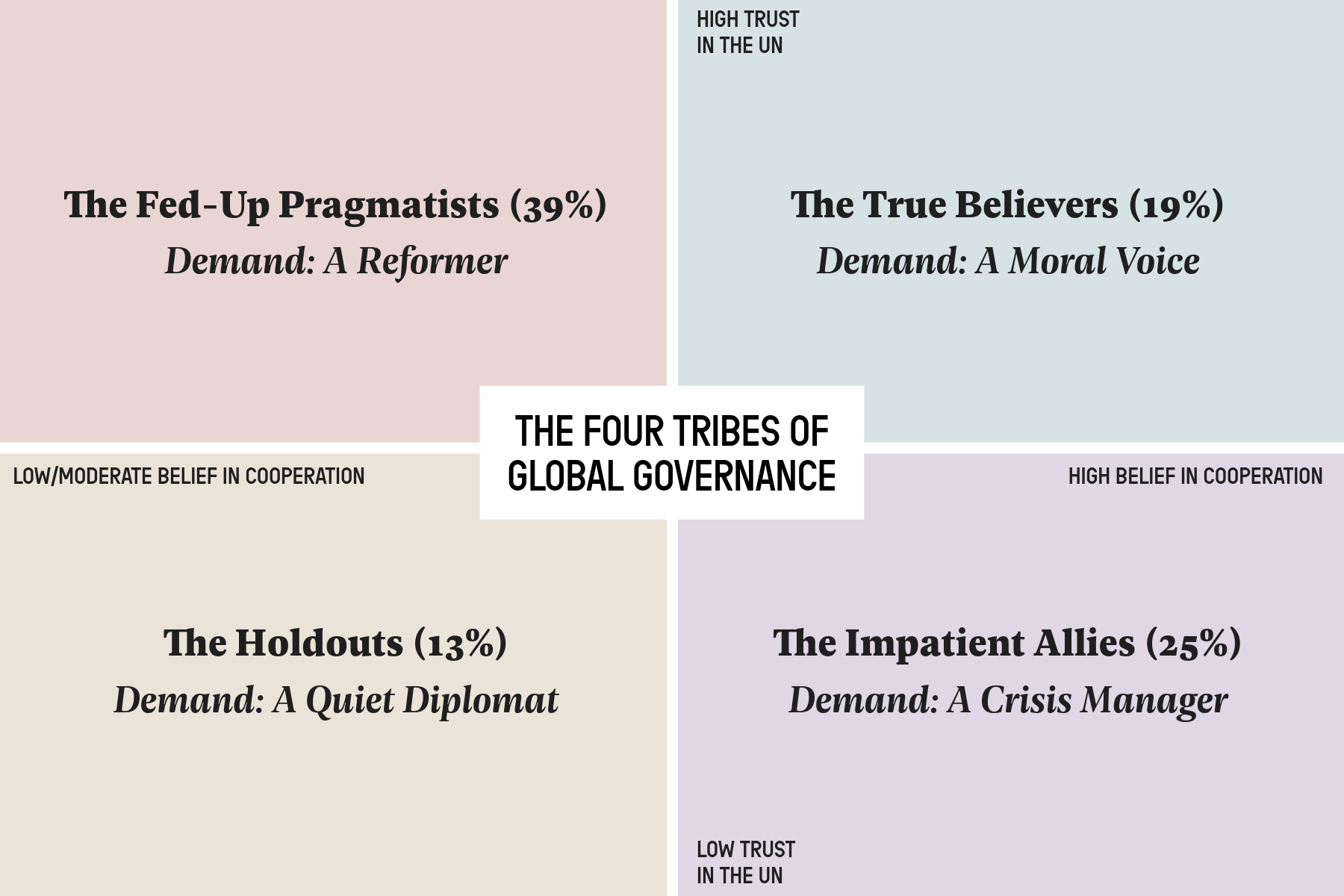
So we then ran a more traditional cross-tabulation, filtering for belief in global cooperation and trust in the UN. Reassuringly, both methods came up with more or less the same four groups. Here is what the second cut looked like.
True Believers (19%)
This group skews young. It holds a torch for the UN and believes deeply in global cooperation. They read the UN Charter aloud over dinner and are disappointed only by the way it describes the Secretary-General as a “chief administrative officer.”
They aren’t looking for a manager. They want a leader who will use the global pulpit to champion universal values, human rights, and a radical response to planetary threats.
Fed-Up Pragmatists (39%)
This is the largest bloc. Sensible people with practical instincts, and a big blind spot: that contentious change would come swiftly if only everyone were a bit more reasonable.
They also believe in global cooperation, but their trust in the UN is hanging by a thread because they see the bloat, the endless committees, and the inefficiency. They want a Secretary-General who can end wars and deliver results on other pressing challenges.
Impatient Allies (25%)
Your classic swing voters, and perhaps the most fascinating group of all. They are sure that global problems are best solved when countries work together, but they are deeply distrustful of the capacity of the international system — the UN included — to make that happen. Why? Because the system lacks enforcement power.
They want a strong leader who can bang heads together, and enforce international law.
Holdouts (13%)
These are “country-first” skeptics with no time for globalists, or for the citizens of nowhere who trash sovereignty and disrespect borders. They tend to be older and live in wealthier countries.
Some of them wouldn’t mind if the UN did the decent thing and disappeared. But if it has to have a leader, they want one who stays in the shadows and doesn’t cross national red lines. Or one who cuts costs and reduces the ambition of what the system tries to achieve.
No Huge Mistakes
It will be tempting for a new Secretary-General to look at these four tribes and think the UN has a problem that better PR can fix. That the answer is just more speeches, slicker video clips, and social campaigns accelerated by AI. To quote Julia Roberts: “Big mistake. Big. Huge.”
Conventional communication preaches to the choir: the 19% of True Believers who already think the UN is doing a fine job. The other tribes mostly aren’t listening. Which is good. Because when they do pay attention, all they hear is more … words.
That incenses the Fed-Up Pragmatists and Impatient Allies in equal measure, because they want action above all. And if the Holdouts are listening (and they do so more often than you may think), what they hear is yet more globalist overreach.
The recipe to win over the Pragmatists and Allies isn’t better messaging; it is action plus visibility. This is a theme we have covered with former Deputy Secretary-General Mark Malloch-Brown (“get some early wins that will be seen and will have global impact, so people sit up and realize the UN is back in town”) and former Under-Secretary-General for Political Affairs Jeff Feltman (who urges the new leadership to push the UN from a “culture of caution” to one of “agency and action”).
It might be tempting to write off the fourth tribe: the Holdouts. But out in the field, the UN is used to engaging with adversaries who actively oppose it. Why should Headquarters only deal with its friends? As academics Allison Carnegie and Richard Clark pointed out in our recent interview, the international system is already having to learn a new language to talk with populists. At a time when many governments are struggling, a new Secretary-General will need to use it to explain how international action enhances national sovereignty, rather than undermines it.
A final thought: most people form their opinions of the UN indirectly, influenced by those who deal with the international system firsthand: politicians, diplomats, journalists, and others whose work spans borders. Yet while we routinely survey the general public, we have far less data on what these intermediaries and opinion-formers think. If we want to reimagine global governance, that is a deficit we need to correct.
