![[Re]Group: A Playbook for Turbulent Times](https://substackcdn.com/image/fetch/$s_!PUHU!,w_120,h_120,c_fill,f_webp,q_auto:good,fl_progressive:steep/https%3A%2F%2Fsubstack-post-media.s3.amazonaws.com%2Fpublic%2Fimages%2Ff2fb4256-d509-4e61-827b-2ee678efbba9_256x256.png)
![[Re]Group: A Playbook for Turbulent Times](https://substackcdn.com/image/fetch/$s_!OvcZ!,e_trim:10:white/e_trim:10:transparent/h_182,c_limit,f_auto,q_auto:good,fl_progressive:steep/https%3A%2F%2Fsubstack-post-media.s3.amazonaws.com%2Fpublic%2Fimages%2Fa2653539-a634-4ef5-9aab-bc4a7546ebc9_1344x500.png)

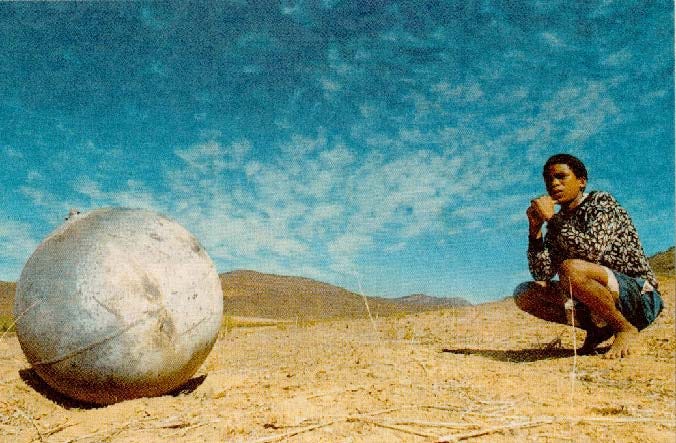
To borrow from Hemingway, this is a disaster that unfolds “gradually and then suddenly.”
A decommissioned weather satellite drifts 800 kilometers above the Earth, launched decades ago to map sea ice. A ruptured pressure tank, a micrometeoroid impact, perhaps a missile strike. One instant the satellite is there, and the next it explodes.
A 1,000-kilogram cylinder of aluminum and dead solar panels is now an expanding cloud of shrapnel. For a time, nothing happens. But then another satellite is in the wrong place at the wrong time. And a fist-sized chunk of a fuel valve tears through its aluminum hull.
A couple of its fragments soon take out an Earth observation platform and a navigation beacon. And so it goes. Collisions breed more collisions, until the space around us is as inhospitable as an asteroid field in a Star Wars film.
The space age is over before it has really begun.
“Sir, the possibility of successfully navigating an asteroid field is approximately 3,720 to 1!”
Art Imitates Life
If this sounds like science fiction, it is.
In Alfonso Cuarón’s 2013 film Gravity, the Russian government destroys one of its own satellites, creating a cloud of fragments that shreds nearby communications networks. Life gets complicated for astronauts Sandra Bullock and George Clooney, out on a routine spacewalk to upgrade the Hubble Space Telescope. Spoiler alert: Bullock survives. Clooney does not.
Or maybe you’ve read Neal Stephenson’s 2015 novel, Seveneves, where the moon splits into seven chunks, which collide and splinter into fragments at an exponential rate.
“The good news is that the Earth is one day going to have a beautiful system of rings, just like Saturn,” the U.S. President is told in a briefing. “The bad news is that it’s going to be messy.”
“Messy” means meteorites burning up in Earth’s atmosphere over thousands of years, boiling the oceans and sterilizing the surface of the planet.
Not ideal, in other words.
The Deadly Toolbag
The truth unfolds on a longer timeline — less Hollywood apocalypse and more a slow throttling of our orbital highways — but the underlying science is the same.
On Nov. 1, 2023, NASA astronaut Jasmin Moghbeli was on a spacewalk to perform maintenance on the International Space Station’s solar arrays. You can watch as she loses control of a tool bag, and it drifts slowly away into space.
Slowly, however, is relative to the velocity of the space station itself. In absolute terms, that lost bag of tools was traveling at around 17,500 mph (28,000 km/h) — fast enough to obliterate any spacecraft that crossed its path. That impact would create thousands of new pieces of deadly shrapnel. Which would, in turn … Well, you get the idea.
Moghbeli’s tool bag was tracked by U.S. Space Force, which cataloged it as debris object #58229, until it safely burned up upon atmospheric reentry the following year.
That five-digit tracking system is fast running out of numbers. At any one time, thousands of larger objects are being actively monitored, while 1.2 million are too small to be tracked at all but are still deemed potentially lethal.
And even the small stuff — 140 million or so tiny fragments — can do serious damage. In 2016, a sliver of metal or a paint flake left a gouge in the space station’s quadruple-glazed windows. The culprit was about the size of a single particle of smoke.
The Godfather
The godfather of space debris is Donald J. Kessler, a former NASA scientist, now in his 80s.
In 1978, Kessler and a colleague published a blockbuster paper challenging the NASA consensus that space was large enough to be self-cleaning. They called it: “Collision Frequency of Artificial Satellites: The Creation of a Debris Belt.”
Kessler hypothesized a tipping point. When there is not much space traffic, collisions are rare and debris decays before it becomes a problem. But at a certain point, random collisions create dangerous objects faster than the atmosphere can drag them down.
That leads to a chain reaction. Even then, Kessler warned that some orbits could be past the point of no return, even if no new debris was added. It was, he said, much like the formation of an asteroid belt, just on a much shorter timeline.
The aerospace community picked up on the theory. Soon, they were calling it Kessler Syndrome.
Hole in the Sky
I was thinking about Kessler Syndrome as we made the eighth and final episode of World’s Toughest Job, a podcast co-produced by Foreign Policy and the United Nations Foundation. It also starts with an unfamiliar danger in the skies far above our heads.

In 1974, chemists F. Sherwood Rowland and Mario Molina warned that a class of “miracle” chemicals, used for everything from air conditioning to consumer aerosols, was releasing chlorine atoms that would strip out the Earth’s ozone layer. In 1995, this discovery won them a share of the Nobel Prize in chemistry.
Chlorofluorocarbons were soon the target of a grassroots boycott, while the U.S. government banned “non-essential” CFCs in an early application of what we now call the precautionary principle.
But the chemical industry and some governments remained skeptical, until British scientists published an observational study showing a massive depletion of the stratospheric ozone layer over the Antarctic.
For centuries, humanity had believed the atmosphere was too vast for us to alter. We dumped chemicals with impunity, assuming the sheer scale of the planet would dilute our impact. That illusion died in a 1985 paper entitled: “Large losses of total ozone in Antarctica reveal seasonal ClOx/NOx interaction.”
“There was literally a hole in the sky,” recalled Brian Mulroney, then prime minister of Canada. “It caught the public imagination in a way few discoveries do. The truth of the matter is that it scared the hell out of anybody with a brain in his head — and that applied to all governments.”
The Ray-Ban Plan
“All governments” is a bit of a stretch, but the danger spurred some unusual suspects into action.
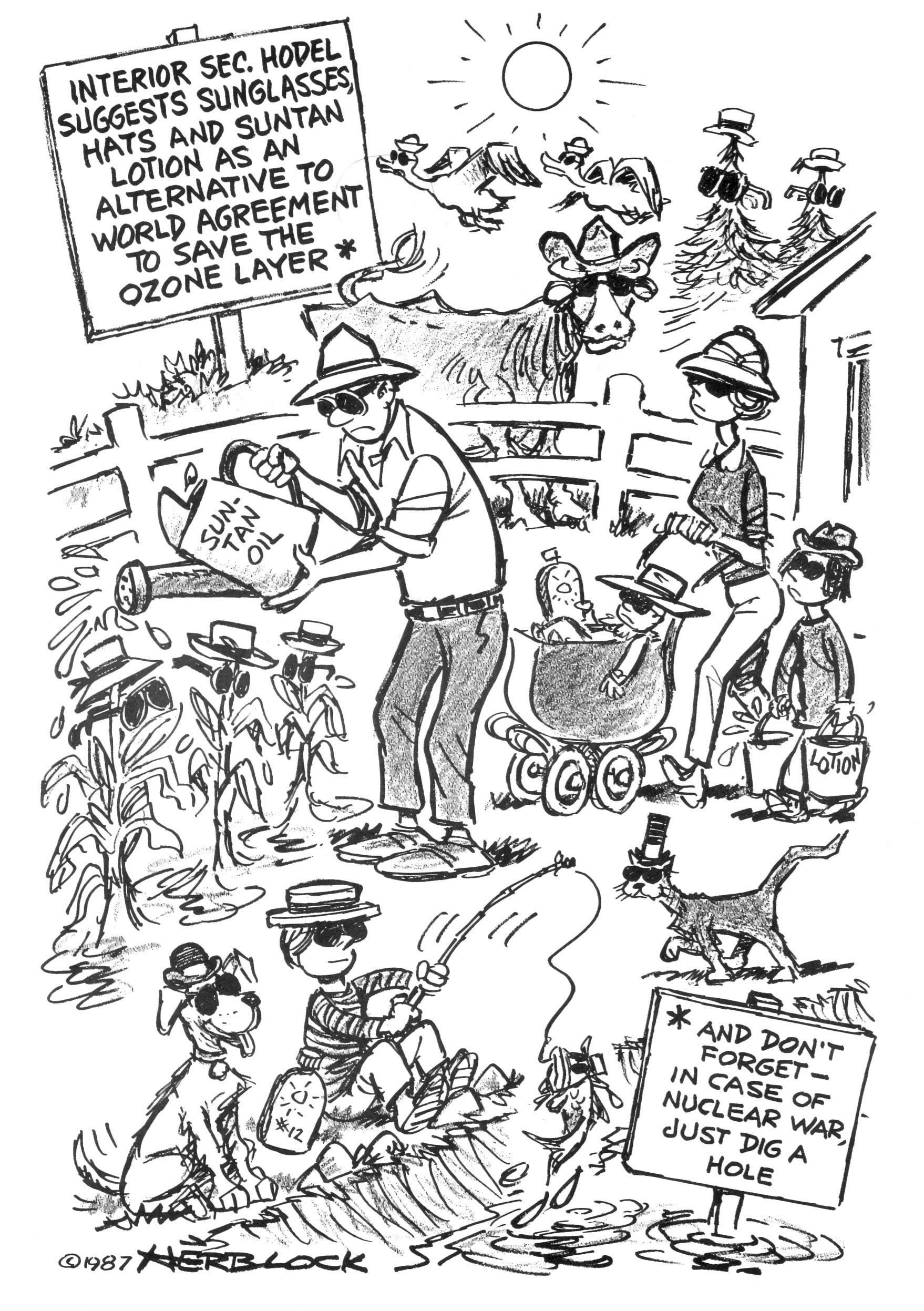
U.S. President Ronald Reagan supported the control of ozone, based on his own experience of skin cancer. He faced down opposition from those in his own cabinet who thought Americans should instead wear hats and sunglasses. Campaigners mocked it as the “Ray-Ban plan.”
Across the Atlantic, British Prime Minister Margaret Thatcher approached the problem like the research chemist she had been before entering politics. She too supported global regulation and found herself battling European nations that were citing “scientific uncertainty” to protect national chemical lobbies.
In New York, the fifth UN Secretary-General, Javier Pérez de Cuéllar, wanted the United Nations to do more on the environment, not a traditional multilateral priority. He was increasingly attentive to the views of the emerging “global citizen” and also saw an issue with potential to bridge Cold War divides.
Pérez de Cuéllar left the heavy lifting to Dr. Mostafa Tolba, the Egyptian microbiologist who ran the UN Environment Programme (UNEP) from its headquarters in Nairobi. Tolba denied he was an autocrat. He just wouldn’t let governments push him around, he said.
These and other leaders invented a playbook that the UN has brought to every subsequent environmental threat.
The Ozone Playbook
The playbook did the easy things first and the hard things later.
Step one was establishing a single source of truth. Tolba spent years forcing rival scientific groups toward consensus. “Only six months after the scientists spoke with one voice,” he recalled, “we managed to get a legally binding treaty.”
Step two was creating a framework to get governments talking. The 1985 Vienna Convention had no binding targets for replacing CFCs, but it built trust. Keep the same negotiators in the same room, Tolba believed, and eventually they will stop shouting and start listening.
Step three was making the negotiations “intergovernmental plus.” You couldn’t solve a chemical crisis without the chemical companies. The Americans, in particular, wanted to signal to the market that profits awaited whoever led the charge on CFC replacements.
Step four was setting binding targets that didn’t scare the horses. Tolba saw that a ban on CFCs would collapse the 1987 Montreal Protocol, which was bolted onto the Vienna framework. The compromise was a 50% cut but with a “ratchet mechanism” to tighten targets if the science worsened.
The final step was forming a North-South Grand Bargain. As an Egyptian public servant, Tolba had believed the environment was a luxury for poorer countries. Leading UNEP had changed his mind, but only if the polluter paid up. So three years after the Montreal Protocol was signed, an agreement was reached to create a fund to support the transition from CFCs.
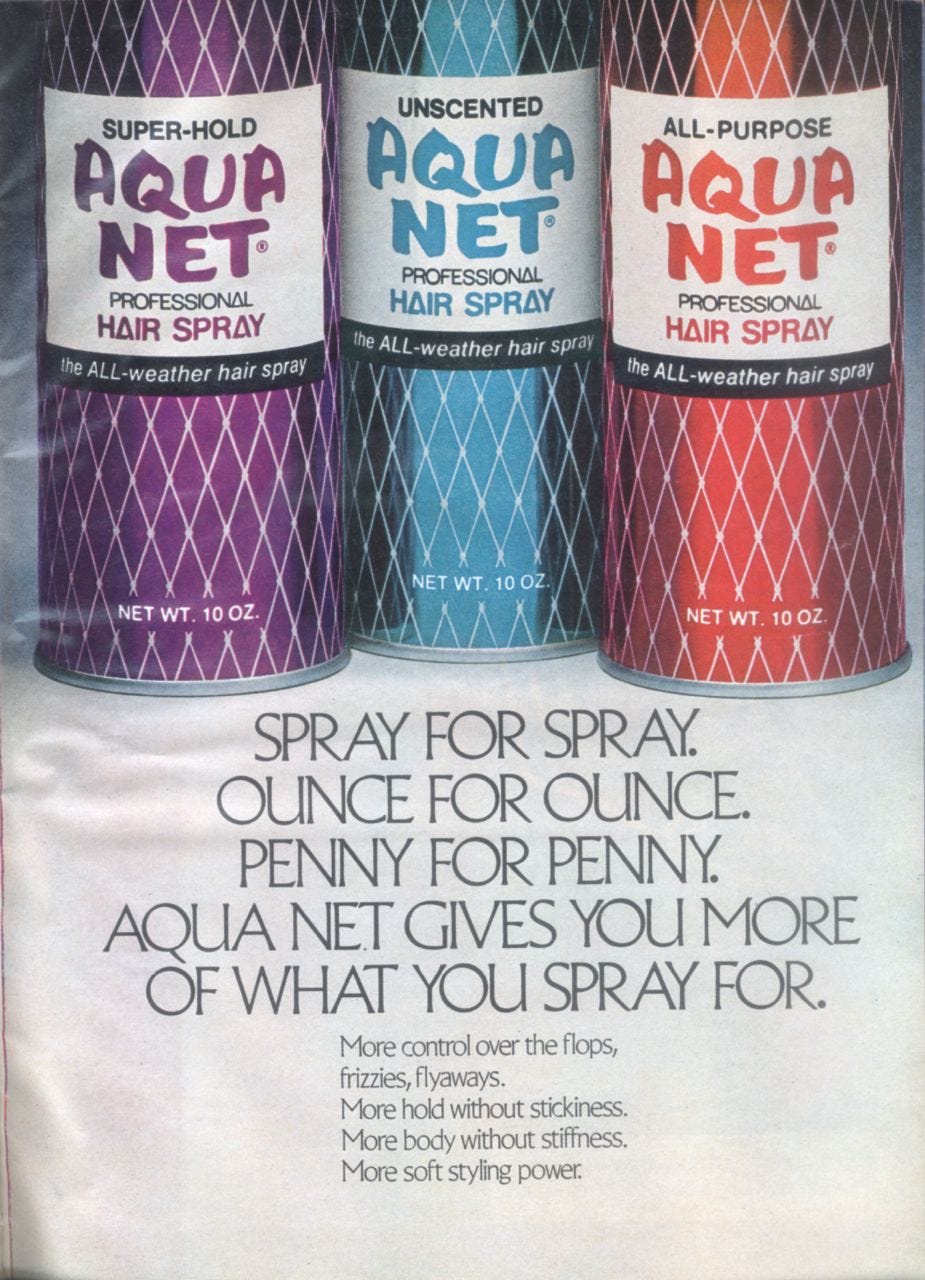
After that the Montreal Protocol accelerated towards universal ratification (the only UN treaty to cross that benchmark). 99% of CFCs have now been phased out.
It Was Only Ozone
Ask a diplomat in New York about Montreal, and you’ll be told that the treaty was an important achievement. But it was “only ozone” — rather a niche threat compared with the complex crises we face today.
This reflects multilateralists’ tendency to obsess over failure and discount success, to the point where we have lost any collective understanding of what value the international system adds, and how.
In the case of ozone, that value was colossal. Almost unimaginable.
If CFCs were still in widespread use today, skin cancer would be the least of our problems. The world would be facing the collapse of terrestrial and marine ecosystems, with damage to food and fisheries alone far exceeding the global cost of a phaseout.
But the real kicker is the climate impact. The Montreal Protocol will prevent roughly 2.5°C of global warming over preindustrial levels by the end of this century. It’s a staggering number, given that recent macroeconomic research suggests that a temperature rise of that magnitude would cut global economic output in 2100 by a quarter to a half.
So that is an international treaty that cost tens of billions of dollars and will save trillions (probably even tens of trillions) across the rest of this century. Few investments deliver that sort of bang for the buck.
But it was “only ozone,” wasn’t it?
The Final Frontier
In 1989, Margaret Thatcher told the UN General Assembly it should use the ozone playbook to start tackling climate change. In 1997, the Kyoto Protocol agreed binding targets for reducing emissions of greenhouse gases.
During the long struggle to get enough ratifications to bring the Kyoto Protocol into force, I was part of an effort to set up the world’s first network of environmental diplomats.
Naively, I assumed that foreign policy was basically about preventing war and creating global public goods, until I realized that many old-school ambassadors considered environmental diplomacy a bit of a passing fad.
Now a New Space Age — driven not just by superpower governments, but by private corporations launching commercial megaconstellations — is permanently altering another planetary domain.
Once it took time and patience to spot a satellite, even though they can be seen with the naked eye. Now it is child’s play.
A thousand satellites orbited the Earth in 2010. We passed the 10,000 threshold in 2024, and more than 5,000 more have launched since then. By 2030, there could be 100,000 or more satellites orbiting above our heads.
As space becomes dangerously crowded, many diplomats remain unsure whether this is a premier league issue or not. But they may need to update their priorities — or they will be forced to when the collisions begin.
Kessler in SloMo
Space debris is already more than a theoretical threat. It is projected to cost upward of $40 billion over the next 10 years.
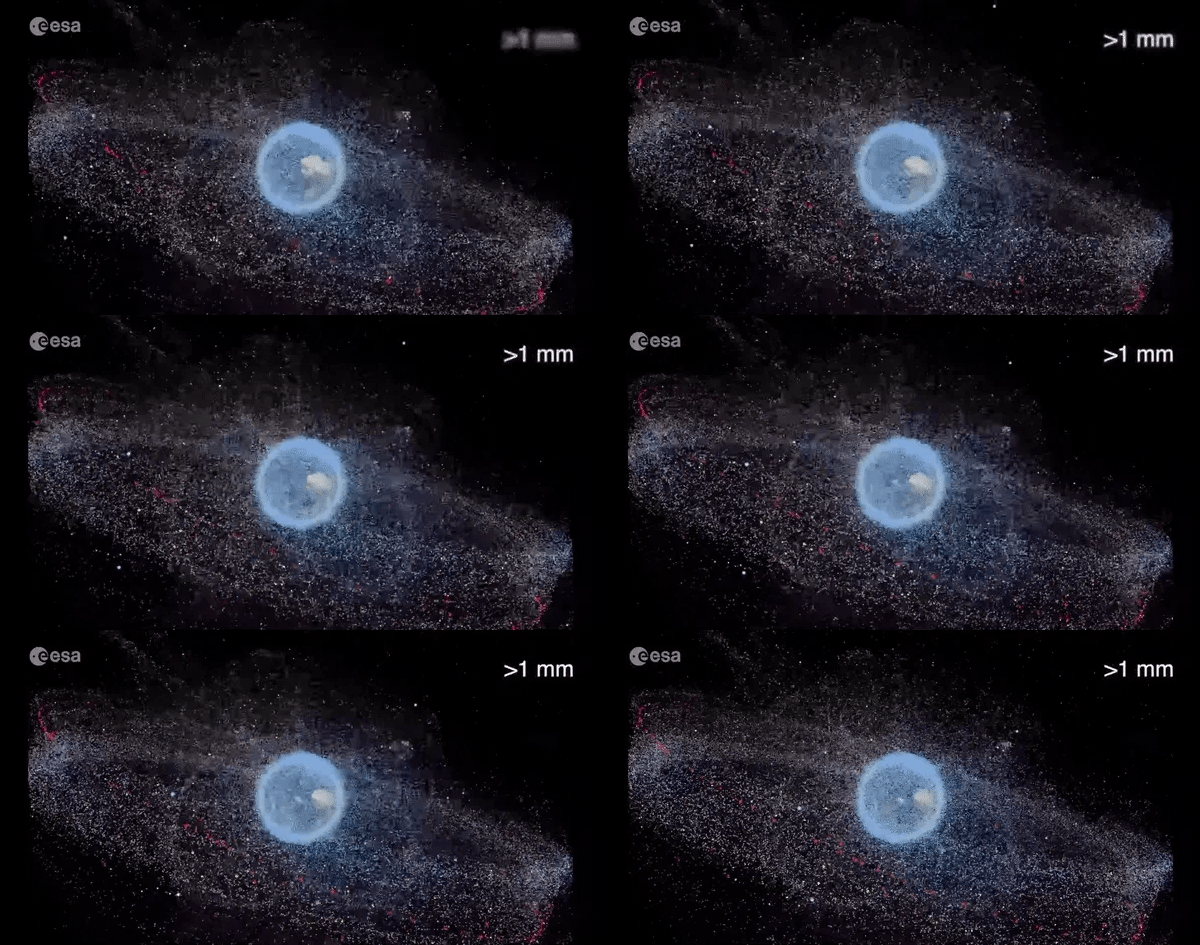
Just four incidents have created 8,000 large pieces of debris in less than 20 years. Three of them were Chinese, Russian, and Indian missile strikes on their own satellites. The fourth was an accidental collision between an American communications satellite and a Russian military satellite.
Each year, the risk of another collision is around 10%, with some orbits having already breached the threshold for Kessler Syndrome. It’s a slow-motion disaster that will play out over decades or centuries, mitigated as satellites get better at dodging danger.
Unless something highly unlikely happens — something as improbable as an eruption of an Icelandic volcano closing European airspace or a novel coronavirus locking down the world.
Space, you see, is now what’s known as an actively safe environment. You don’t launch a satellite and forget about it; you need software algorithms executing thousands of collision-avoidance maneuvers every day.
And if those algorithms fail, things go wrong. In a “gradually, then suddenly” sort of way.
It Won’t Happen
Here are three ways that could push SloMo Kessler onto fast forward.
Scenario one: An extreme solar storm throws satellites onto unpredictable trajectories, while severing radio communications with them. Chances: somewhere between 1% and 10% in a decade. Predicted time to the first collision: a couple of days.
Scenario two: A cyberattack on the U.S. Space Surveillance Network leaves satellites flying blind. Or a bad firmware update strips a privately-owned megaconstellation like Starlink of the systems it uses for collision avoidance. Put this one in a basket labeled “it won’t happen … until it does.”
Scenario three: An anti-satellite missile strike, or the use of “soft-kill” weapons that blind satellites to the dangers approaching them, occurs. This is comfortably within the capabilities of scores of states and, possibly, some non-state actors, too. Fortunately, though, we live in peaceful times.
These “improbable” scenarios would destroy trillions of dollars in hardware, collapse the space insurance market, and degrade GPS, global weather forecasting, and other terrestrial necessities.
Even without a sudden catastrophe, launch windows for deep-space missions to the moon or Mars may narrow. And, at its worst, humanity could find itself effectively shut out of space.
In other words, it would be safe enough to launch a rocket, too risky to put a human in it.
Rules in Space
In 1959, the Antarctic Treaty was signed by 12 nations, banning military bases and territorial claims over the continent. By dedicating Antarctica to science, it paved the way for the discovery of the ozone hole.
Space also got a Cold War treaty. It was agreed through the UN in 1967, as the superpowers — shaken by the Cuban Missile Crisis — decided the last thing they needed was an arms race above their heads.
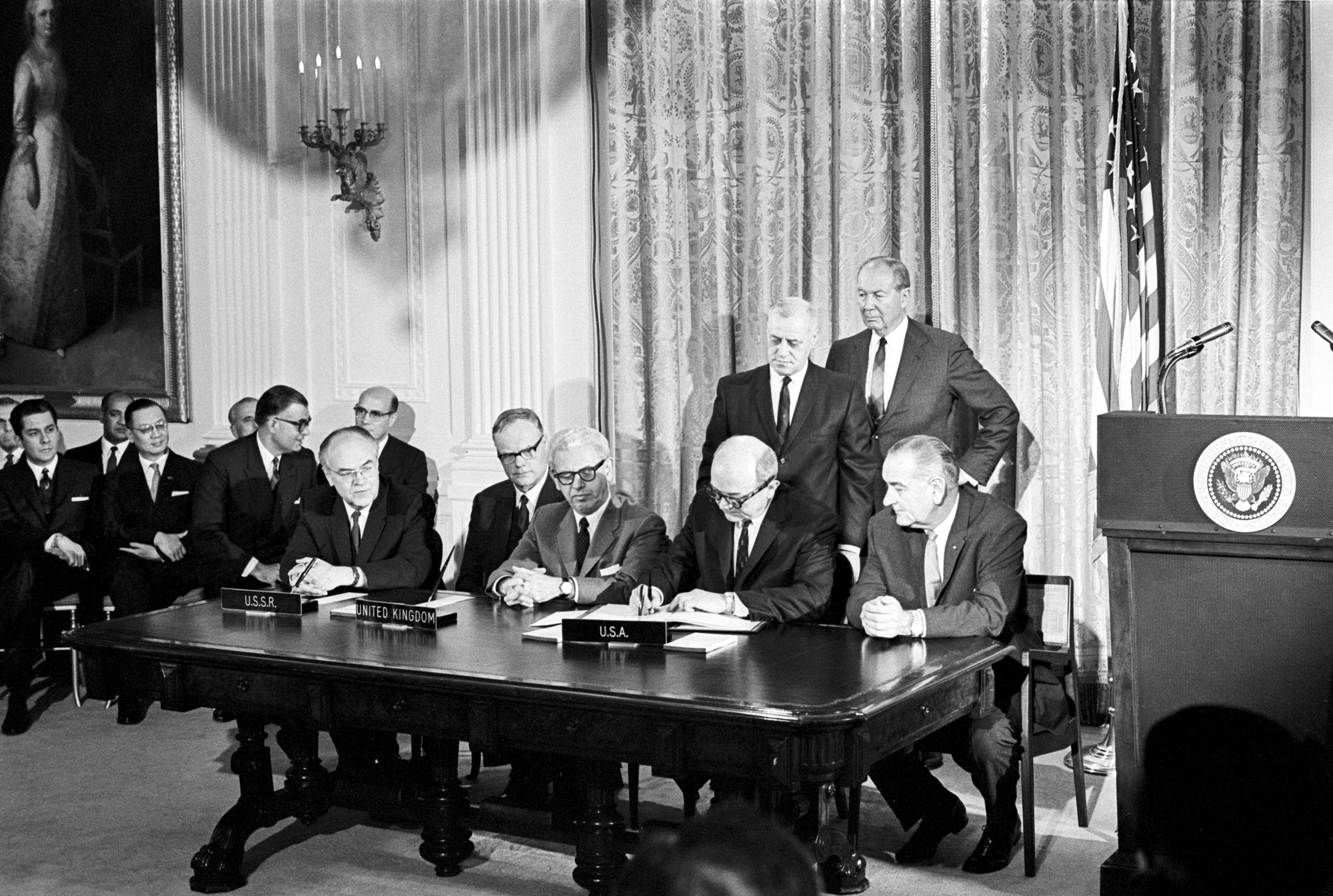
Some believe this treaty is moribund, elbowed aside by a teeming ecosystem of unilateral rulemaking and minilateral cooperation.
To control space debris, major spacefaring nations are dictating de facto global standards, such as mandates to deorbit satellites within five years of the end of their useful life. Informal coalitions are also on the rise, as decentralized networks pool research, agree on mitigation guidelines, and champion zero debris pledges.
But this scattered innovation needs a center of gravity, and geopolitical adversaries need a baseline for cooperation. Will the UN provide it? That may depend on whether it seizes the opportunity posed by the space summit, UNISPACE IV, which is proposed for July 2027 (Member States are still arguing about whether to let it happen).
Space debris would not be the only issue on the summit’s agenda, but it may be the most tractable. Major powers seem closer to a confrontation over space than at any time since the Outer Space Treaty was agreed sixty years ago. Meanwhile, the private sector is as assertive, and as lightly regulated, as chemical companies were in the 1970s.
But cleaning up space offers common ground. To seize it, the multilateral system won’t need to start from scratch. It just needs to update the ozone playbook, translating a messy patchwork into a governance architecture without crowding out efforts that private companies, national space agencies, and scientific networks are already making.
And if it works, tomorrow’s diplomats will be able to gaze up into safe skies, shake their heads, and say, “It was only space debris, wasn’t it?”