![[Re]Group](https://substackcdn.com/image/fetch/$s_!PUHU!,w_120,h_120,c_fill,f_webp,q_auto:good,fl_progressive:steep/https%3A%2F%2Fsubstack-post-media.s3.amazonaws.com%2Fpublic%2Fimages%2Ff2fb4256-d509-4e61-827b-2ee678efbba9_256x256.png)
![[Re]Group](https://substackcdn.com/image/fetch/$s_!OvcZ!,e_trim:10:white/e_trim:10:transparent/h_182,c_limit,f_auto,q_auto:good,fl_progressive:steep/https%3A%2F%2Fsubstack-post-media.s3.amazonaws.com%2Fpublic%2Fimages%2Fa2653539-a634-4ef5-9aab-bc4a7546ebc9_1344x500.png)
The Ultimate Cheat Sheet
Filling the World’s Toughest Job
![[Re]Group's avatar](https://substackcdn.com/image/fetch/$s_!w0DV!,w_108,h_108,c_fill,f_webp,q_auto:good,fl_progressive:steep/https%3A%2F%2Fsubstack-post-media.s3.amazonaws.com%2Fpublic%2Fimages%2F0517e9f8-af1c-41a5-b83c-2630660e4517_256x256.png)
Everything you need to know about the selection of the 10th UN Secretary-General (last updated: July 13)
Jump to:
AT A GLANCE • THE RACE • THE PROCESS • THE POLITICS • ADDITIONAL INFORMATION
What to Watch For
How are Member States, the media, and the broader public reacting to candidates’ performance in the public debates and appearances in various forums?
Will further nominations emerge as Security Council members’ begin the process of consideration of candidates presented thus far (informal straw polls) in late July?
What ideas and policy agendas will candidates champion going forward in the next stage of the selection process?
Milestones
Week of April 21: PGA-convened Interactive Dialogues (recordings)
May 28: UNA-UK Candidates debate in London, UK (recording)
June 9: GWL Voices and UN Foundation Candidates Debate in Geneva, Switzerland (recording)
June 15: PGA-convened Interactive Dialogues with María Fernanda Espinosa Garcés.
June 16 and 18: PGA-convened Interactive Dialogues (if new candidates emerge)
June 25: Candidates debate at the Jeju Forum for Peace and Prosperity in Jeju, South Korea.
July 23: PGA-convened townhall with civil society and candidates.
By July 30: UN Security Council begins straw polls
October: General Assembly appointment (based on last competitive cycle in 2015-2016)
January 1, 2027: 10th Secretary-General takes office

AT A GLANCE
Confirmed candidates: 6
Stage: Late nominations / post-interactive dialogues
THE RACE
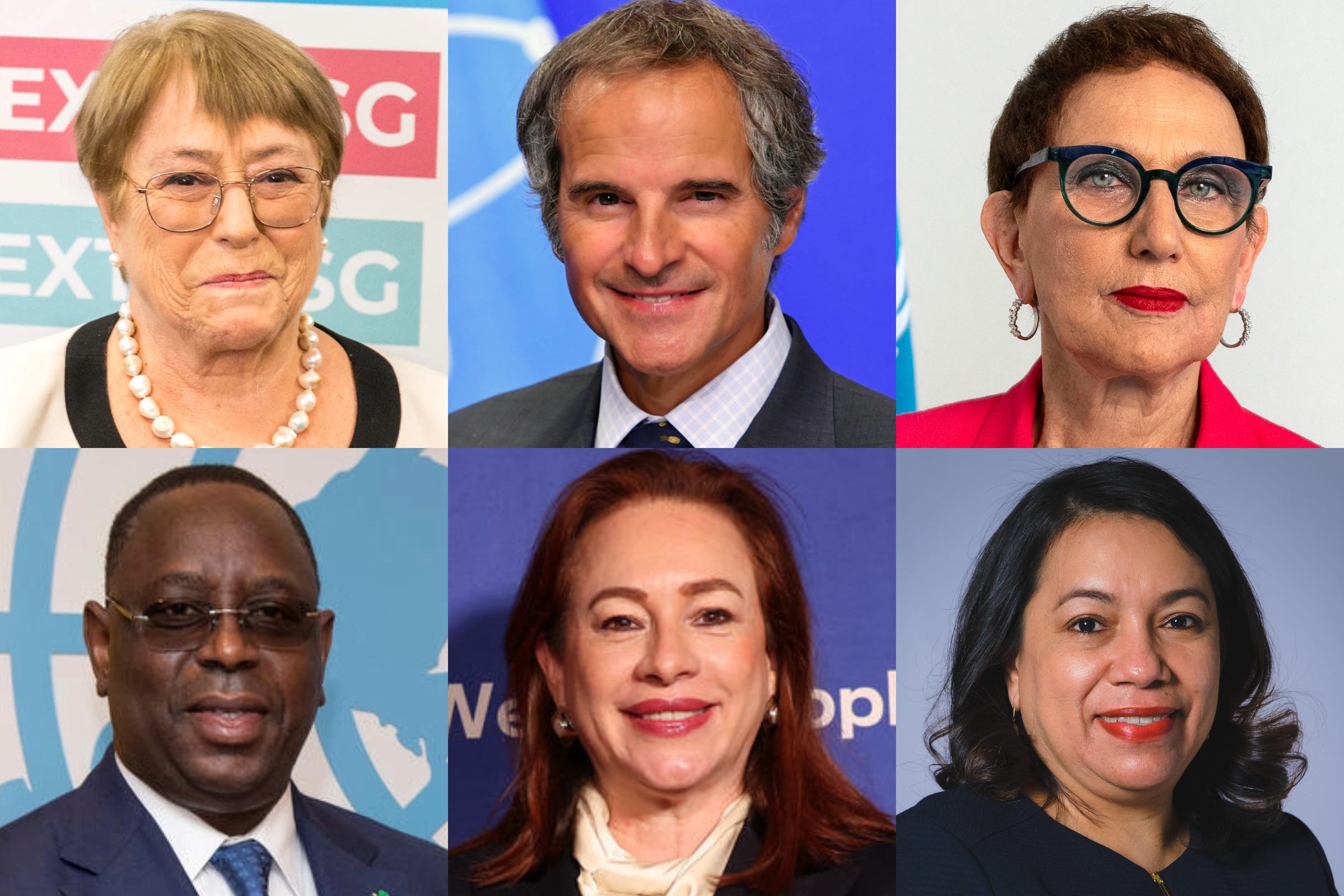
Who’s Running
Michelle Bachelet Jeria (Chile) — nominated by Chile, Brazil, Mexico (February 2, 2026); Chile withdrew nomination March 25, 2026, but she remains nominated by Brazil and Mexico
Rafael Grossi (Argentina) — nominated by Argentina (November 26, 2025)
Rebeca Grynspan Mayufis (Costa Rica) — nominated by Costa Rica (March 3, 2026)
Macky Sall (Senegal) — nominated by Burundi (March 2, 2026)
María Fernanda Espinosa Garcés (Ecuador) — nominated by Antigua and Barbuda (May 11, 2026)
Carolyn Rodrigues-Birkett (Guyana) — nominated by Guyana (June 13, 2026)
Withdrawals
Virginia Gamba (Argentina) — nominated by Maldives (March 11, 2026); withdrawn March 25, 2026
THE PROCESS
1. Nomination
Candidates can be nominated by any Member State, individually or jointly (no requirement to be nominated by their own country) at any point until the next Secretary-General is selected and appointed.
Member States can withdraw nominations; only one candidate at a time.
Requirements: CV, vision statement, campaign finance disclosure.
Candidates holding UN roles must suspend them or consider doing so.
Legal Basis: UN Charter Article 97 — “Appointed by the General Assembly upon the recommendation of the Security Council.”
Modalities: GA Resolution 79/327 (pp. 6–8, 2025) sets timelines, eligibility, withdrawal rules, and ethics for campaigning.
See useful guides from NYU Center on International Cooperation and 1 for 8 Billion.
2. Public Campaign & Dialogues
The President of the General Assembly convened interactive dialogues on April 21 and 22 (three hours per candidate): 10-minute presentation + questions from Member States and civil society. Additional interactive dialogues will be convened on June 15, 16, and 18, if needed.
Themes: leadership abilities and the UN’s three pillars (peace and security, development, and human rights).
Candidates are also expected to engage in public events run by think tanks and civil society.
UN Townhall: The Next Secretary-General
July 23 | 5p.m. – 6:30p.m. EDT
The PGA will convene a townhall with candidates and civil society ahead of the straw polls. It will be broadcast globally.
Catch Up on Past Dialogues
April 21
April 22
June 15
June 18
Candidates’ visibility does not equal success but shapes perception, can reveal unexpected strengths and vulnerabilities, and can shift campaign momentum for Member States and civil society alike.
A guide to three major debates worth watching:

3. Straw Polls (Security Council Selection)
Expected to begin by July 30.
Informal filtering mechanism to whittle down field, which includes official candidates meeting with the Security Council members and start of the informal straw poll.
Multiple rounds of secret ballots: Encourage / Discourage / No Opinion.
Candidates with too many Discourage ballots are encouraged to drop out.
In final rounds, ballots are color-coded: P5 red ballots; E10 white ballots.
A candidate must ultimately secure support from nine of 15 members, including the P5.
Results are confidential but often leak within minutes.
For news on results, follow UN watchers like Security Council Report and experts Gowan, Forti, Lynch.
4. Final Appointment
UNSC recommendation, typically by acclamation.
GA votes by secret ballot (Rule 141).
Term: Five years, renewable (some countries have proposed a single seven-year term).
5. Transition
Secretary-General–designate sworn in before GA.
First senior hires (Deputy Secretary-General, Chef de Cabinet, key Under-Secretary-General posts) reflect priorities, regional balance, and political commitments.
Transition window: Historically one to three months.
Day 1 in office: January 1, 2027.
THE POLITICS
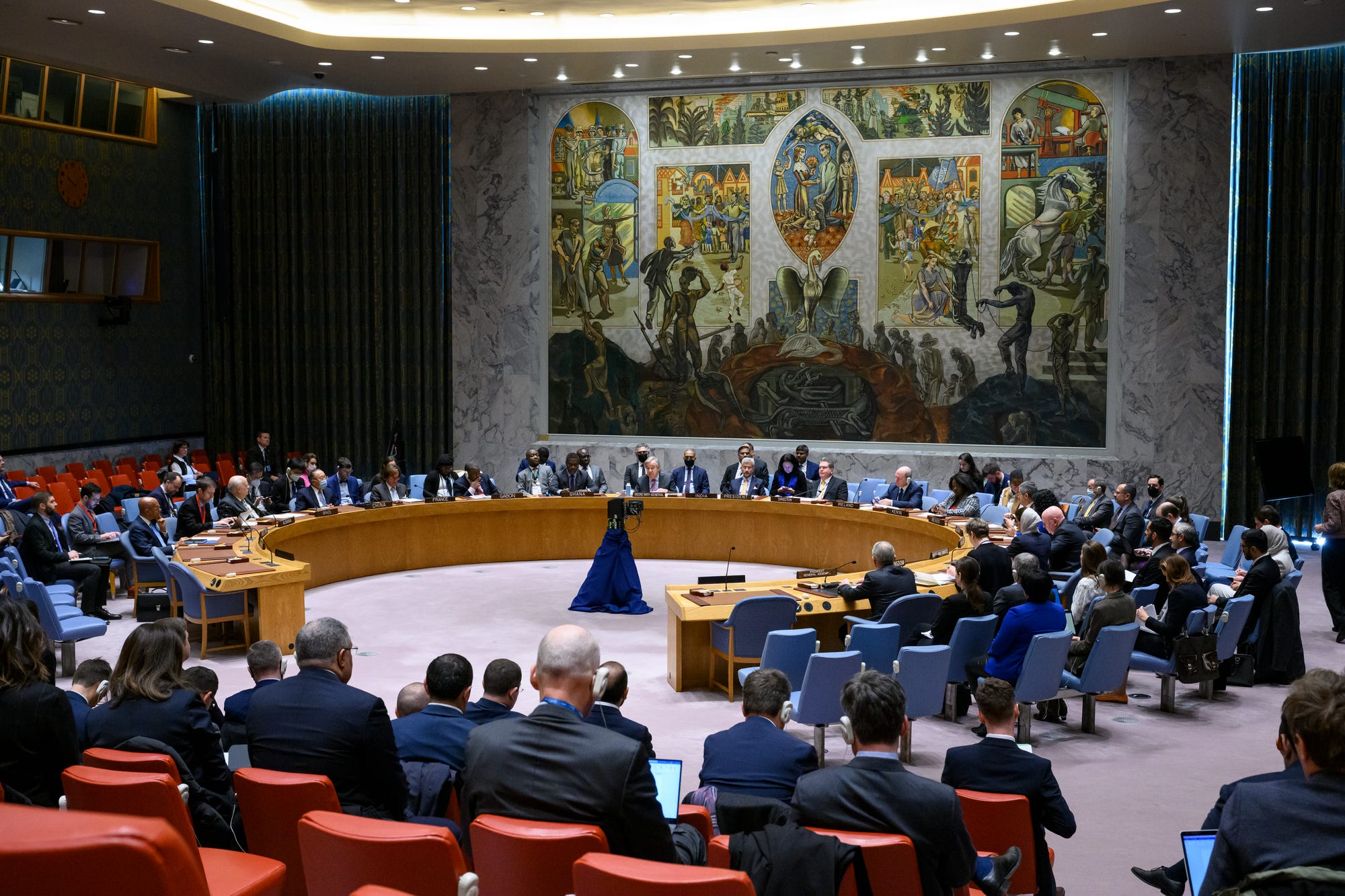
The Key Decision-makers
P5: Permanent members of the UN Security Council — China (UNSC President in May), France (September), Russia, United Kingdom, and the United States — vote and can veto.
E10: Ten elected members of the Security Council vote but cannot veto. Bahrain (UNSC President in April), Colombia (June), Democratic Republic of the Congo (July), Denmark (August), Greece (October), Latvia (November), Liberia (December), Pakistan, Panama, Somalia.
Security Council President: Monthly rotating chair; manages timing of straw polls (see P5 and E10 presidencies above). Judging from previous races, August (Denmark), September (France), and October (Greece) are likely to be most influential.
General Assembly (GA): 193 Member States can nominate and vote.
President of the General Assembly (PGA): Annalena Baerbock (steers process until mid-September 2026); next PGA from Asia-Pacific Group oversees final phase.
What Shapes the Field
Geography: Traditionally it’s Latin America and Caribbean’s turn, but that is not set in stone. Eastern Europe has never had a Secretary-General and was displeased at being passed over in the last cycle. See list of UN regional groups here.
Gender: No woman has held the office; Member States are officially encouraged to strongly consider women candidates.
Politics: A P5 veto is decisive; broad support across the E10 and regional groups is critical.
External Events to Watch
G7 Summit (June 15–17, France)
NATO Summit (July 7–8, Türkiye)
UNGA High-level Week (September 22–28, New York)
U.S. Midterm Elections (November 3)
COP 31 Climate Summit (November 9–20, Türkiye)
ADDITIONAL INFORMATION
Reading & Resources
UN Charter Articles 97-101 on the role of the Secretary-General and Secretariat
GA Resolution 79/327 on the selection process, paragraphs 38–46
Joint letter by the President of the General Assembly and President of the Security Council to PRs on the process, inviting nominations
Security Council Report’s report on the history of the selection process, December 2025
1 for 8 Billion Ultimate Guide
Proposals for process improvements from the Accountability, Coherence, and Transparency (ACT) Group (informal group of 27 Member States)
Tracker of UN Member State support for a woman to be Secretary-General by 1 for 8 Billion, Global Network of Women Peacebuilders, and NYU Center for Global Affairs.
Abbreviations
UNSG — UN Secretary-General
UNGA — UN General Assembly
UNSC — UN Security Council
PGA — President of the General Assembly
PSC — President of the Security Council
P5 — Permanent members
E10 — Elected members
MS — Member State
PR — Permanent Representative
GRULAC — Latin America & Caribbean (rotation turn)
EEG — Eastern European Group (has never had a Secretary-General)
APG — Asia-Pacific Group
WEOG — Western European & Others Group
G77 and China — Group of originally 77 and now 134 developing countries
