![[Re]Group: A Playbook for Turbulent Times](https://substackcdn.com/image/fetch/$s_!PUHU!,w_120,h_120,c_fill,f_webp,q_auto:good,fl_progressive:steep/https%3A%2F%2Fsubstack-post-media.s3.amazonaws.com%2Fpublic%2Fimages%2Ff2fb4256-d509-4e61-827b-2ee678efbba9_256x256.png)
![[Re]Group: A Playbook for Turbulent Times](https://substackcdn.com/image/fetch/$s_!OvcZ!,e_trim:10:white/e_trim:10:transparent/h_182,c_limit,f_auto,q_auto:good,fl_progressive:steep/https%3A%2F%2Fsubstack-post-media.s3.amazonaws.com%2Fpublic%2Fimages%2Fa2653539-a634-4ef5-9aab-bc4a7546ebc9_1344x500.png)
![[Re]Group's avatar](https://substackcdn.com/image/fetch/$s_!w0DV!,w_108,h_108,c_fill,f_webp,q_auto:good,fl_progressive:steep/https%3A%2F%2Fsubstack-post-media.s3.amazonaws.com%2Fpublic%2Fimages%2F0517e9f8-af1c-41a5-b83c-2630660e4517_256x256.png)
By Nendirmwa Noel and Harshani Dharmadasa

This article was first published in its original multimedia form on Our Future Agenda. To experience the full version with its original visual and interactive elements:
Imagine playing a game where the rules were written decades before you were born — and they’re stacked against you.
This is how many so-called young countries, where 50% to 80% of the population is under 30, experience today’s global financial system. The world’s financial architecture was largely designed in the last century by high-income countries, and they still hold most of the decision-making power. Meanwhile, countries with the youngest populations struggle to access affordable finance and are increasingly burdened by debt.
Below, we break down why the system is outdated, how it traps young nations in debt, real examples of the consequences, and what we can do about it.
Young countries – where the majority of the population is under the age of 30
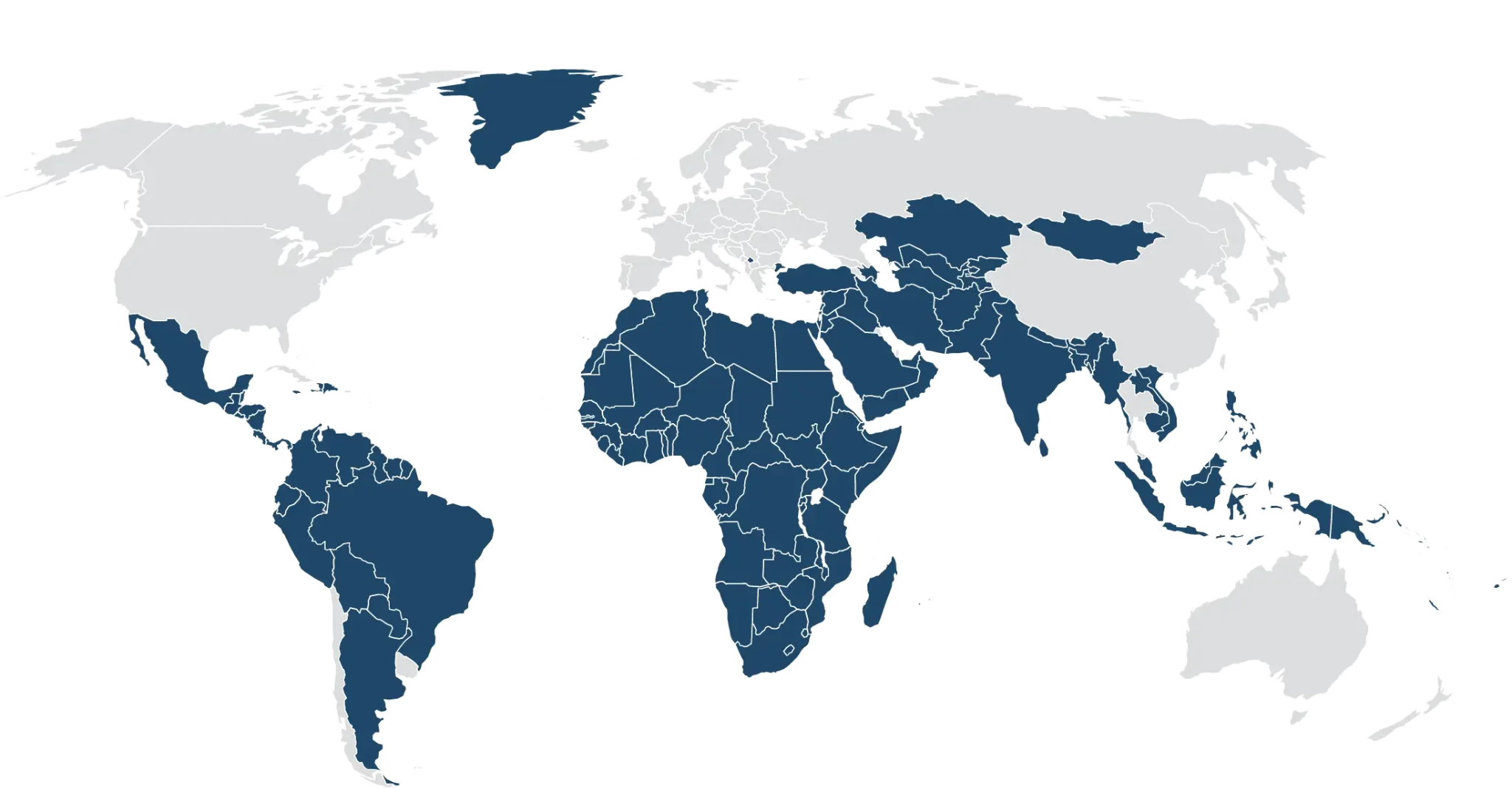
This map is based on 2024 UN Demographic Data, with a margin of error of 2–5% for countries with well-established civil registration systems and 5–10% for those with limited standards.
An Outdated Power Structure Dominated by Rich Countries
The international financial system, including institutions such as the International Monetary Fund (IMF) and the World Bank, is built on a post–World War II power structure.
Developed economies continue to hold a disproportionate share of voting power relative to their population. The G7 — Canada, France, Germany, Italy, Japan, the United Kingdom, and the United States — holds over 40% of IMF voting shares, giving it effective influence over major decisions, while 67 of the world’s most climate-vulnerable countries combined hold just 6.7% of voting shares. European economies also collectively retain enough votes to block reforms.
At the same time, Africa, Asia, Latin America, and other regions where most of the world’s young people live remain under-represented. Many countries in the Global South have pointed out that the existing structure is outdated and limits their ability to shape decisions on loans, debt relief, and economic policy.
The result is a system where policies on debt, aid, and finance often prioritize market stability and creditor repayment over investments in health, education, and jobs. For many young countries, the system does not feel designed for their realities.
Young Countries Struggle to Finance Their Future
Many countries in sub-Saharan Africa and parts of Asia have a median age under 30. These countries have significant potential, with large populations of young people entering the workforce, as well as having urgent needs. They must expand education systems, strengthen health care systems, build infrastructure, and create jobs at speed.
Accessing finance for these investments is costly. Global markets classify these countries as high risk, leading to much higher borrowing costs than those faced by developed economies. Average international borrowing costs are significantly higher for developing regions, with rates in Africa often approaching 10%. Kenya or Bangladesh may pay 8% to 10% interest on bonds, while developed countries borrow at far lower rates.
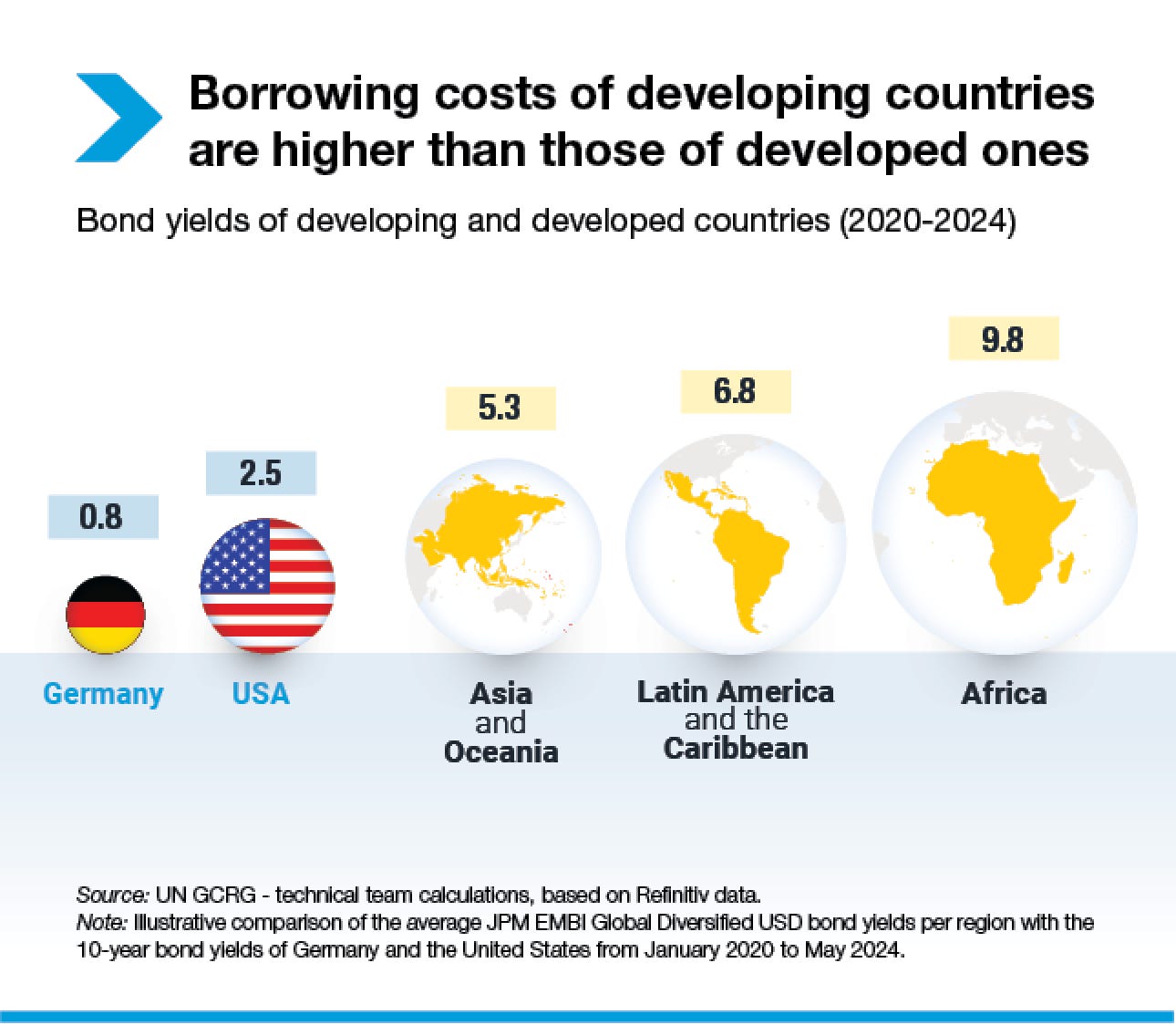
This gap reflects structural issues within the financial system. Credit rating agencies, largely based in the Global North, often assign lower ratings than economic fundamentals suggest. Investors then demand higher returns, reinforcing the cycle.
A UN study found that risk perception alone added an estimated $75 billion in borrowing costs for African countries. Some countries pay up to six percentage points more in interest than others with similar credit ratings. These costs have direct consequences. Governments allocate large portions of their budgets to debt repayment, reducing spending on essential services.
In 2023, 54 developing countries, home to 3.3 billion people, spent more than 10% of government revenue on interest payments. In many cases, debt servicing exceeded spending on education or health care. This creates a cycle where countries borrow to repay existing debt, while long-term investments are delayed. For many young countries, this limits progress and reduces opportunities for future generations. As UN Secretary-General António Guterres stated, financing is failing the developing world.
Debt and Distress: Country Examples
These dynamics are already shaping real outcomes across countries.
Lebanon: Lebanon experienced a major economic collapse after defaulting on its debt in 2020. The currency lost over 90% of its value, the banking system broke down, and youth unemployment rose sharply. Years later, Lebanon is still in economic freefall, illustrating the impact of default in the current global system on current and future generations.
Nigeria: Africa’s most populous country, with a median age of 18, is facing a severe debt burden. In 2022, 96% of government revenue was used to service debt. This left limited resources for public investment, placing pressure on services and future growth.
Pakistan: With over 240 million people and a median age of 22, Pakistan has faced repeated financial crises. In fiscal 2024, the country needed over $22 billion to repay external debt and interest. It has entered IMF programs 22 times in four decades. Each cycle brings currency devaluation and reduced public spending, with significant impacts on young people.
Tunisia: After the 2011 revolution, Tunisia borrowed to support economic recovery. A series of shocks led to fiscal stress, and in 2023 its credit rating was downgraded close to default. Caught between harsh austerity demands and lack of affordable credit, Tunisia is struggling to import basic medicines and food, exemplifying the no-win situation for young countries in debt distress.
What Needs to Change
The current system is not only about access to finance. It is also about who sets the rules, how risk is assessed, and whose priorities shape decisions.
Reform efforts such as the Fourth International Conference on Financing for Development (FfD4) present an opportunity to address these structural imbalances. This includes rethinking voting power, improving fairness in credit assessments, reducing the cost of capital, and ensuring that financing supports long-term development rather than short-term stability alone.
For young people, this is not a distant policy debate. It shapes access to education, jobs, and economic opportunity.
Get Informed and Take Part
Understanding how global finance works is a first step. The FfD4 Explainers series breaks down debt, tax systems, aid commitments, and other complex issues in accessible ways. These tools help young people engage with policy discussions and advocate for change.
Engagement can take many forms. This includes joining youth-led organizations, participating in discussions, or bringing these issues into classrooms and communities.
The system can change. The question is whether it will reflect the realities of the countries and generations it is meant to serve.
About Our Future Agenda
Our Future Agenda is a United Nations Foundation program dedicated to putting young people — especially from young countries in Africa, Asia, and Latin America — at the heart of global decision-making and solving the world’s biggest challenges.
Learn more: www.ourfutureagenda.org