![[Re]Group: A Playbook for Turbulent Times](https://substackcdn.com/image/fetch/$s_!PUHU!,w_120,h_120,c_fill,f_webp,q_auto:good,fl_progressive:steep/https%3A%2F%2Fsubstack-post-media.s3.amazonaws.com%2Fpublic%2Fimages%2Ff2fb4256-d509-4e61-827b-2ee678efbba9_256x256.png)
![[Re]Group: A Playbook for Turbulent Times](https://substackcdn.com/image/fetch/$s_!OvcZ!,e_trim:10:white/e_trim:10:transparent/h_182,c_limit,f_auto,q_auto:good,fl_progressive:steep/https%3A%2F%2Fsubstack-post-media.s3.amazonaws.com%2Fpublic%2Fimages%2Fa2653539-a634-4ef5-9aab-bc4a7546ebc9_1344x500.png)

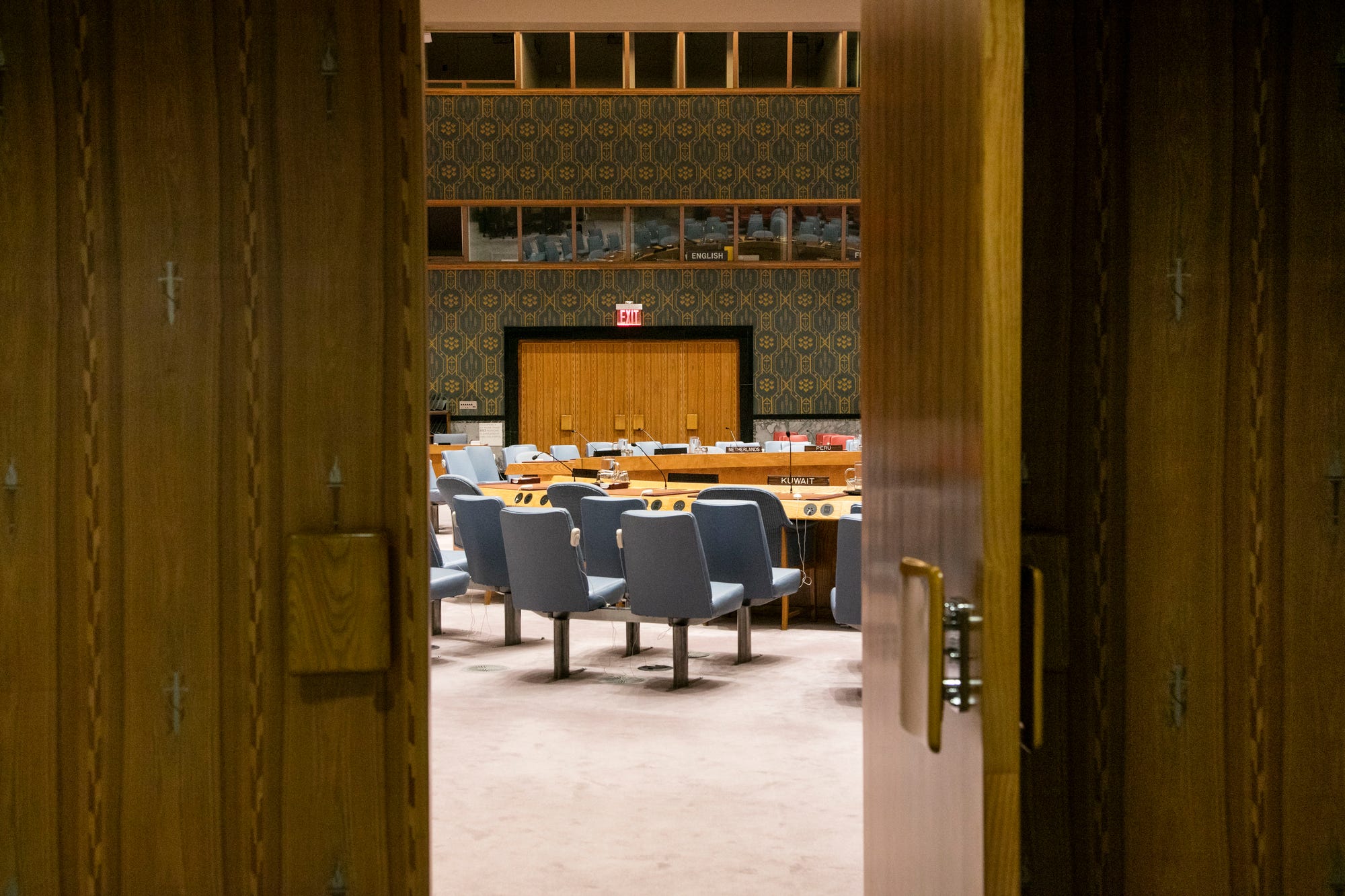
The Security Council held its third straw poll in three months to test the viability of eight candidates for United Nations Secretary-General. The result: we have two clear frontrunners.
Rebeca Grynspan, a Costa Rican economist, former vice president of Costa Rica and head of the United Nations Conference on Trade and Development, is leading the race. But she is followed very closely by Carolyn Rodrigues Birkett, Guyana’s Ambassador to the United Nations. These two have pulled away from a crowded field.
Today’s straw poll asked each of the 15 members of the Security Council to indicate whether they “encourage,” “discourage,” or have “no opinion” on each candidate.
In today’s poll, Grynspan received nine “encourage” votes, five “discourage” votes and one “no opinion.” Rodrigues Birkett received eight “encourage” votes, six “discourage” votes and one “no opinion.” In a distant third was Rafael Grossi, head of the International Atomic Energy Agency, with five “encourage” votes, eight “discourage” votes and two “no opinion” votes.
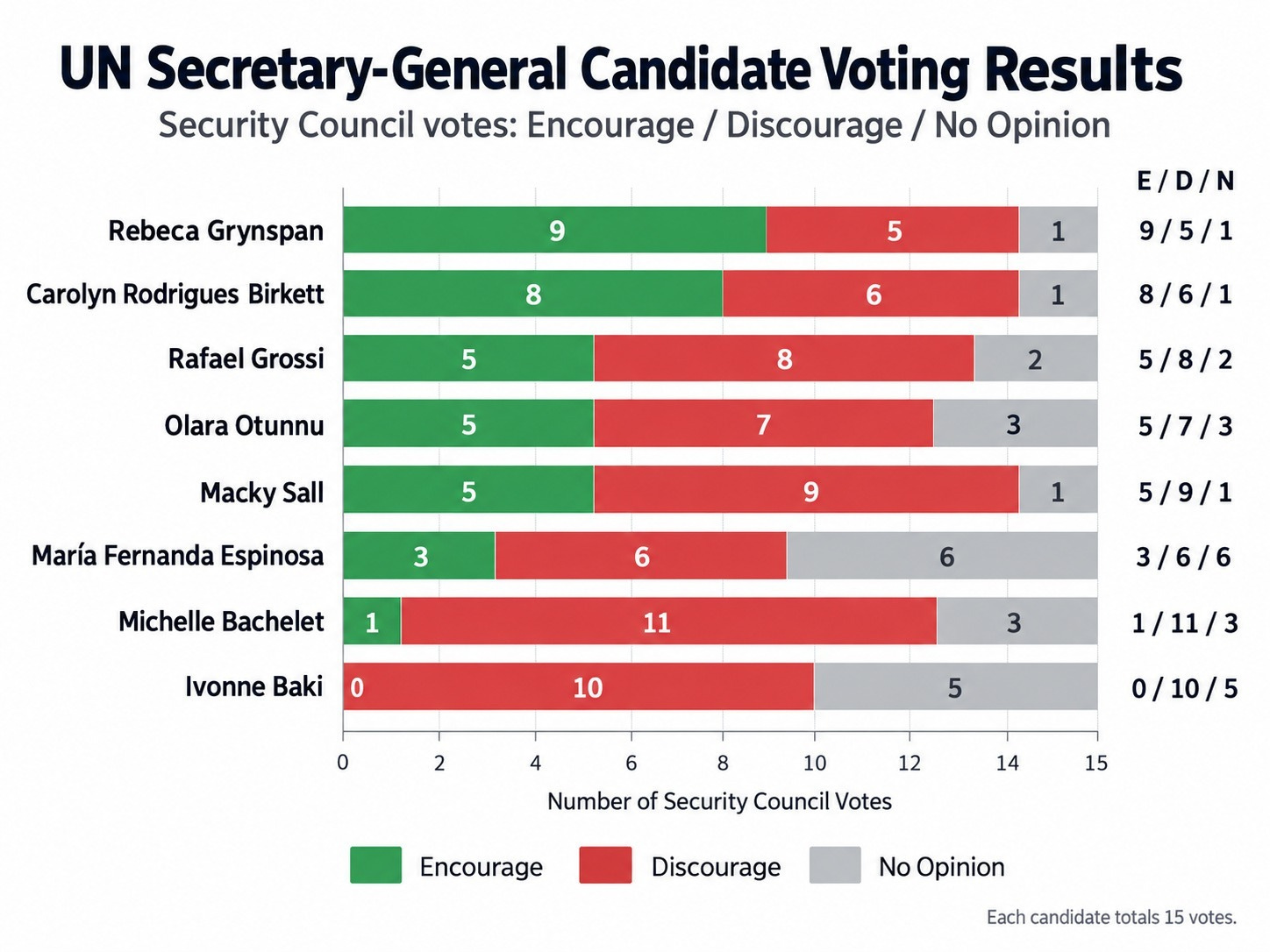
This is the third straw poll in a row in which Grynspan and Rodrigues Birkett have held the top positions. For now, this is a two-woman race. (However, I would not totally rule out María Fernanda Espinosa. While she received only three “encourage” votes, she also received only six “discourage” votes, suggesting that opposition to her candidacy has not fully consolidated.)
Why These Two?
The candidacies of Grynspan and Rodrigues Birkett have a lot going for them. Grynspan entered the race early, and she is a full-time candidate. Following guidance from the General Assembly that candidates who lead UN agencies take a leave of absence during the campaign, Grynspan has temporarily stepped down as head of UNCTAD.
Grynspan is also well known both around the UN and in capitals. Her profile grew substantially in the wake of Russia’s full-scale invasion of Ukraine, when she helped broker the Black Sea Grain Initiative, which enabled the export of Ukrainian food during the height of the fighting. In doing so, she demonstrated that she could work with Moscow and Western powers in pursuit of a goal — food security — that was broadly shared.
For her part, Rodrigues Birkett very recently served on the Security Council alongside many of the diplomats now casting votes. Guyana was an elected member of the Security Council in 2024 and 2025, and Rodrigues Birkett is well regarded among her colleagues and around the UN more broadly.
On the flip side, one candidate who now looks like a long shot is Rafael Grossi. Though once a frontrunner, his candidacy has faced headwinds in recent weeks. Statements from the Russian Foreign Ministry suggest Moscow has made no secret of its opposition to his candidacy. Just last week, the ministry released a statement blasting Grossi for refusing to endorse Moscow’s account of attacks at a major nuclear site in Ukraine in a recent IAEA report. (Perhaps, he should have followed Grynspan’s lead and taken the recommended leave of absence as head of the UN’s nuclear watchdog.)
But these results come with one giant asterisk. This straw poll used undifferentiated ballots, so we don’t know how the veto-wielding members of the Council voted compared with the other members. It could be that the candidates at the top face staunch opposition from one of the P5, which would doom a candidacy. Similarly, we don’t know whether those at the bottom of the list received any of their “discourage” votes from a veto-wielding member. (The exception is Michelle Bachelet: with 11 “discourage” votes, at least one of them must have come from the P5.)
We do know, however, that the greater the number of “discourage” votes a candidate receives, the more likely it is that at least one of those votes came from a veto-wielding member. That is why any candidate with seven or more “discourage” votes is probably a long shot at this point.
I would expect some candidates to drop out of the race in the near future, particularly Michelle Bachelet. It is well known that the former president of Chile and UN High Commissioner for Human Rights faces opposition from the United States. Earlier this year, a group of Republican members of Congress wrote to Secretary of State Marco Rubio, urging him to block her candidacy over issues related to her positions on reproductive rights.
The two African men in the race, Macky Sall and Olara Otunnu, also face significant opposition, in part due to a widely held view around the UN that the next secretary-general should come from Latin America — and be a woman.
What Comes Next?
The race for UN Secretary-General is still very much in flux.
The next straw poll is scheduled for the end of the month. This would be the first straw poll after UNGA. If past practice is any precedent, that means the Council will use differentiated ballots for the first time — those from the United States, United Kingdom, Russia, France and China will use one color, while ballots from the other 10 members will use a different color. This vote should give us a clearer indication of which candidates are truly viable and who we might expect to bow out. And it will flow directly from bilateral meetings and conversations that happen behind closed-doors.
At that point, if any one candidate emerges with no discourage votes from a P5-colored ballot, she or he would be considered the presumptive winner of the race for Secretary-General. The Council would subsequently take a formal vote and then pass its recommendation on to the General Assembly for final approval.
On the other hand, if all candidates receive at least one discourage vote from a P5-colored ballot, the race remains wide open. There is even the possibility — I’d say likelihood — that new candidates will emerge. This dark horse scenario becomes all the more likely the closer we get to the end of the year, when Guterres’ term expires. Who that person is, we do not know.
Bottom line: Today’s straw poll results tell us where we stand right now. But the winnowing of the field is still to come.
Mark Leon Goldberg is a veteran international affairs journalist and has covered the United Nations for 20 years. He writes the Global Dispatches Substack.
