![[Re]Group: A Playbook for Turbulent Times](https://substackcdn.com/image/fetch/$s_!PUHU!,w_120,h_120,c_fill,f_webp,q_auto:good,fl_progressive:steep/https%3A%2F%2Fsubstack-post-media.s3.amazonaws.com%2Fpublic%2Fimages%2Ff2fb4256-d509-4e61-827b-2ee678efbba9_256x256.png)
![[Re]Group: A Playbook for Turbulent Times](https://substackcdn.com/image/fetch/$s_!OvcZ!,e_trim:10:white/e_trim:10:transparent/h_182,c_limit,f_auto,q_auto:good,fl_progressive:steep/https%3A%2F%2Fsubstack-post-media.s3.amazonaws.com%2Fpublic%2Fimages%2Fa2653539-a634-4ef5-9aab-bc4a7546ebc9_1344x500.png)

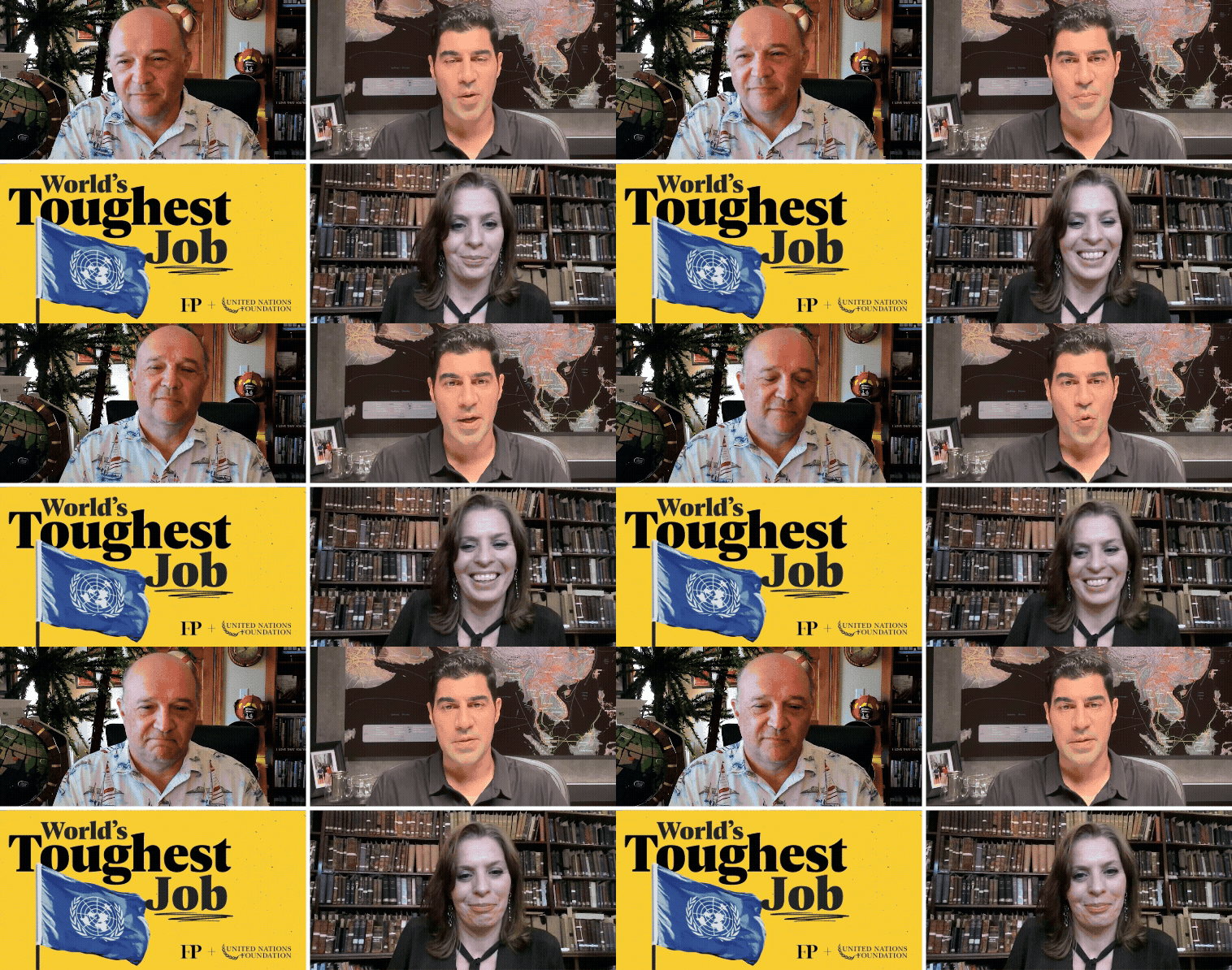
This week on World’s Toughest Job, a podcast co-produced by Foreign Policy and the United Nations Foundation, we ask: How can a new UN Secretary-General protect the infrastructure on which the world depends?
The episode opens with a look back at the early 2000s, when UN Secretary-General Kofi Annan recognized that the digital divide could lock the Global South out of the 21st-century economy. He used the UN to champion connectivity, helping create the conditions for the private sector to bridge the gap and give the African continent greater access to global networks. Read about that history here.

Today, the world is much more intensively connected, which has created new vulnerabilities. Over 95% of international data and trillions of dollars in daily financial transactions travel through a network of undersea deep-ocean cables. Maritime choke points such as the Strait of Hormuz and the Red Sea have been disrupted by attacks on shipping, while cyberattacks and the severing of deep-sea cables have demonstrated the potential for a digital breakdown.
In this episode, co-hosts Jasmin Bauomy and Mark Malloch-Brown are joined by an expert panel to discuss these vulnerabilities. Guests explore how states are reacting to these single points of failure, the limits of international maritime law when actors sever cables or block straits with impunity, and whether the UN could convene public and private actors to defend the networks on which global commerce and communication relies.

Here’s what Parag Khanna, the strategist, author, and founder and CEO of AlphaGeo; Salvatore Mercogliano, maritime historian and associate professor of history at Campbell University; and Elisabeth Braw, senior fellow at the Atlantic Council and author of the forthcoming Undersea War: The Battle to Control the Cables and Pipelines That Connect Our World, had to say.
1. The erosion of maritime law threatens the global commons.
The centuries-old doctrine of freedom of the seas is at risk as state and non-state actors flout maritime law. From illicit tolls and GPS spoofing to infrastructure sabotage, adversaries are shifting their attacks to the global commons — the ungoverned expanses of international waters and outer space.
The blockade of the Strait of Hormuz has shown that weaponizing choke points offers actors important leverage. This creates the risk of copycat blockades as states and non-state actors seek to replicate the disruption without the costs of a full declaration of war. Growing lawlessness challenges the legal bedrock provided by the 1982 UN Convention on the Law of the Sea (UNCLOS), which was designed to guarantee transit passage and protect subsea cables.
Elisabeth Braw pointed out the contagious nature of gray-zone aggression — hostile acts that fall below the threshold of formal war. “The more countries violate maritime rules, the less incentive other countries have to stick by the rules,” she said. Nations may conclude that adhering to international treaties places them at a strategic disadvantage. “It took the world centuries to get to a place where countries could sign a treaty, and now the reality is the world is slipping away from that, which is a massive loss,” Braw warned.
Salvadore Mercogliano emphasized that this regression involves actors across the globe. “We’re seeing countries like the United States with its attacks on shipping in the Caribbean. We see Iran. We see the Houthi. We see the Russians and Ukrainians in the Black Sea. We see the Chinese and the Philippines in the South China Sea,” he said. Left unchecked, Mercogliano argued, this trajectory points toward “a return of great power competition on the high seas,” which he said would be “a massive step backwards.”
2. A single point of failure can send shock waves through global networks.
As countries work to protect their critical national infrastructure, they are forced to confront sources of vulnerability that lie beyond their borders. Domestic energy grids, healthcare systems, and financial sectors all depend on borderless digital architectures. National systems are only as resilient as the global infrastructure on which they depend.
Parag Khanna noted that global trade relies on “an immovable geography” that allows an energy and food crisis to ripple through complex systems already under pressure from the aftereffects of the COVID-19 pandemic and the trade war triggered by the Trump Administration.
Mercogliano agreed that vulnerabilities overlap, with choke points for shipping doing the same thing for undersea cables. “Will those nodes become much more vulnerable to potential interdiction and attack?” he asked. When they are attacked, he said, disruption does not remain geographically contained. Digital sabotage threatens the systems ships use to navigate, he said, which can “lead to collisions … to groundings” in physical corridors.
Assessments of global risk highlight infrastructure vulnerability. In the World Economic Forum’s Global Risk Report 2026, geoeconomic competition is ranked as the leading threat, with experts across academia, business, government, international organizations, and civil society concerned by its impacts on critical infrastructure that is already prone to failures and accidents. Meanwhile, the Allianz Risk Barometer finds that just 3% of global businesses view their supply chains as very resilient, and risk managers rank global supply chain paralysis as the most plausible black swan scenario over the next five years.
As Mark Malloch-Brown warned, we may all have to learn to live with much higher levels of risk. “Which system is going to fail this week, year, or month?” he asked.
3. The privatization of risk creates disparities in global resilience.
Modern infrastructure is increasingly owned and operated by the private sector, with governments having less say on how it is protected. As a result, Malloch-Brown noted, “multinational corporations are now the de facto defenders of infrastructure we all depend on.”
Commercial repair schemes work well under normal conditions, but as Braw asked, “What would happen if the situation were to continue to deteriorate, where it’s not just commercial considerations and risks facing the cable owners and the repair crews, but geopolitical ones as well?” Mercogliano echoed this, questioning if companies will be able to insure themselves in dangerous waters.
Because resilience is a capital-intensive local good rather than a global public one, a geopolitical divide has emerged. Wealthy nations can afford to insulate themselves. Khanna pointed to Singapore as an example of a nation “hell-bent on redundancy.” In contrast, countries in the Global South lack capital for adaptation and remain exposed to sabotage and natural disasters. “Building redundancy costs money,” Mercogliano said, with poorer countries left to “get by with the minimum.”
According to the Global Infrastructure Risk Model and Resilience Index, the loss of infrastructure during disasters costs $732 billion annually, with low- and middle-income countries facing double the relative risk of high-income countries. This creates a vicious cycle where scarce capital is diverted from new development to repairing destroyed assets.
4. The next Secretary-General must assemble functional coalitions to defend global networks.
Protecting global infrastructure from attack is an extension of the UN’s mandate to maintain peace and security, but securing these networks requires engaging actors outside the realm of traditional foreign policy.
“You can’t solve critical infrastructure without the private sector at the table,” Malloch-Brown said. For the next Secretary-General, the lack of binding international law governing these spaces is a mandate to “move beyond the classic interstate formulas of the law and the UN of 1945 to convene these multi-stakeholder groups.”
The UN has a track record of evolving to protect the global commons, from the 1967 Outer Space Treaty to the 2015 Sendai Framework for Disaster Risk Reduction, while Mercogliano highlighted how the International Maritime Organization had been able to “qualitatively change shipping on the world’s oceans.” Building on this legacy, the International Telecommunication Union and other bodies are adapting to modern threats, with Nigeria co-chairing its International Advisory Board for Submarine Cable Resilience.
But Malloch-Brown noted the attacks that the IMO had faced for its work on shipping and climate change, demonstrating to the maritime industry the dangers of “major power wrath.” The United States “absolutely destroyed the political consensus,” he said, “threatening delegates that they would lose their right and visas to come to America, and that their countries would be punished in other ways if they voted for it.”
Khanna pointed out that as formal global governance fractures, new transregional alliances are emerging. “I’m not suggesting that fragmented governance would be a better way,” he said. “It’s obviously suboptimal.” But he praised the “functional” nature of coalitions on semiconductors, critical minerals, trade, and other priorities. Regional groups are also stepping in to create and protect standards.
By wielding convening authority, a new Secretary-General may find space to unite tech giants, maritime insurers, environmental nongovernmental organizations, and sovereign states. Braw highlighted the unprecedented nature of such alliances. “It must be the only situation in which, for example, Greenpeace could team up with Meta and the government of Nigeria,” she observed.
Quotations have been lightly edited for clarity.