![[Re]Group: A Playbook for Turbulent Times](https://substackcdn.com/image/fetch/$s_!PUHU!,w_120,h_120,c_fill,f_webp,q_auto:good,fl_progressive:steep/https%3A%2F%2Fsubstack-post-media.s3.amazonaws.com%2Fpublic%2Fimages%2Ff2fb4256-d509-4e61-827b-2ee678efbba9_256x256.png)
![[Re]Group: A Playbook for Turbulent Times](https://substackcdn.com/image/fetch/$s_!OvcZ!,e_trim:10:white/e_trim:10:transparent/h_182,c_limit,f_auto,q_auto:good,fl_progressive:steep/https%3A%2F%2Fsubstack-post-media.s3.amazonaws.com%2Fpublic%2Fimages%2Fa2653539-a634-4ef5-9aab-bc4a7546ebc9_1344x500.png)

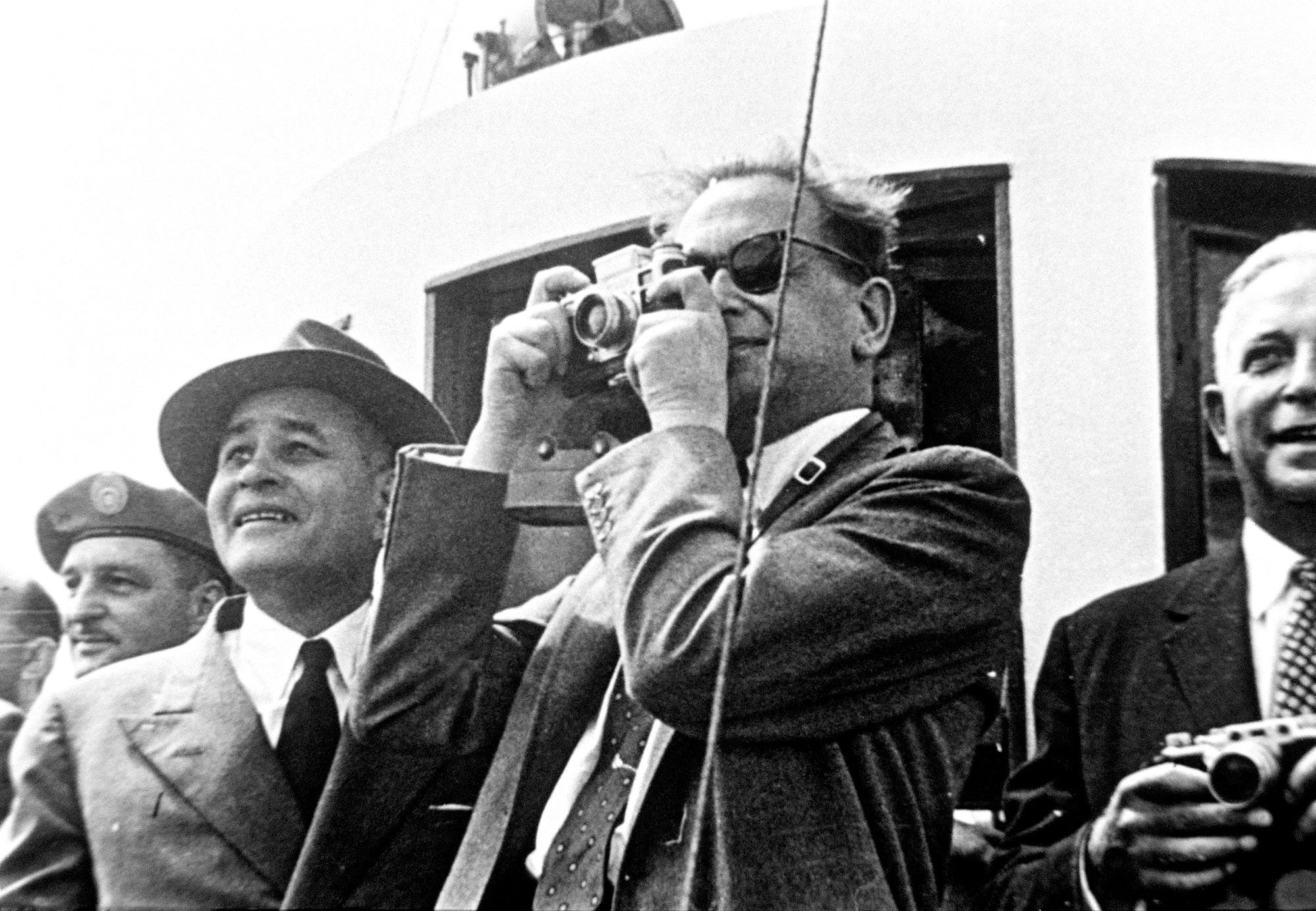
February 16, 1960, and a hall at Wellesley College — a liberal arts college for “women who will make a difference in the world” — is packed to overflowing, with hundreds watching on closed-circuit television in another building. The subject: the “well-nigh explosive rapidity with which the peoples of Africa in all sectors are emerging from colonialism.”
Those are the words of Ralph Bunche, UN Under-Secretary for Special Political Affairs under Dag Hammarskjöld, the UN’s second Secretary-General. Bunche, the first African American to receive the Nobel Peace Prize, was a keynote speaker at the symposium, alongside representatives of emerging African nations, diplomats, and scholars.
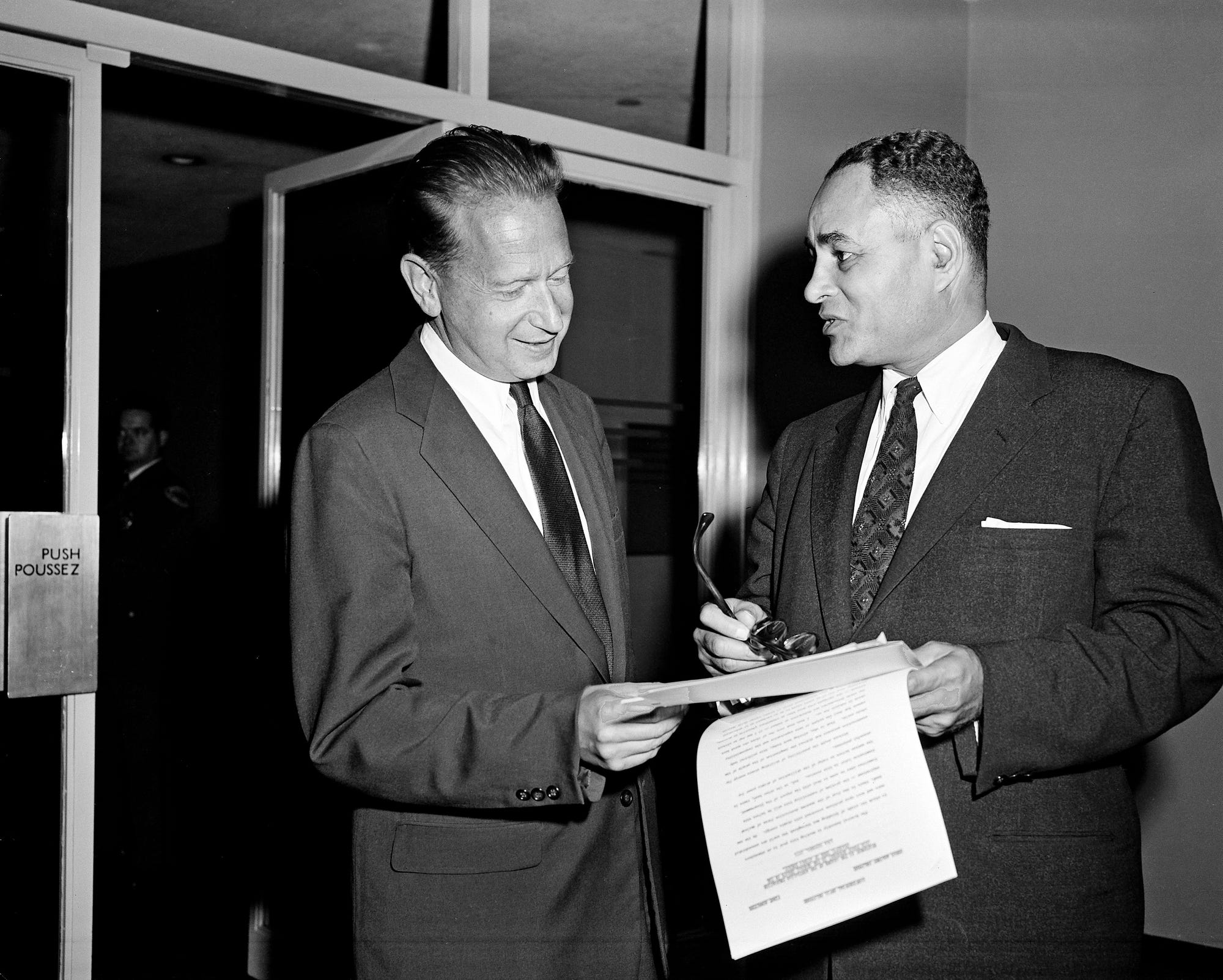
You can read about this event in a New York Times article by Paul Hofmann. Hofmann, an Austrian and ardent antifascist, had served as interpreter for the Nazi commanders of Rome while informing on them to the Italian resistance and the Allies. Now he was reporting on the death throes of colonialism from the Congo, as the Belgian imperial authorities tried — and failed — to slow momentum to independence.
The prevailing sentiment at the Wellesley symposium, Hofmann reported, was that “hostility to colonial powers and to what they stood for was bridging many of the existing differences among Africans.” Debate centered on “whether there were several ‘Africas’ or the continent was an entity, politically and economically.” Whatever the answer to this question, African independence was an increasingly resonant popular movement.
Belgian tactics were to divide and delay, but the Congolese delegates had formed a common front and were wearing down Belgian resistance. The Congolese had invited their musical icon, Joseph Kabasele — Le Grand Kallé — to form a supergroup and bring it to Brussels. The band premiered its wildfire hit, “Indépendance Cha Cha,” on Feb. 1 at a gala in the Hotel Plaza, just as the Belgians capitulated to Congolese demands. Kabasele’s chorus translates to “Independence, cha-cha, we’ve won it. Oh! The round table cha-cha, we’ve pulled it off.” It swept across borders to become Africa’s independence anthem.
Bunche told the Wellesley crowd that he believed Africa’s revolution would be largely peaceful. And that it would bring an influx of new members to the UN that would exert growing influence over international politics and the global economy. He made a prediction: 1960 would be the Year of Africa, and it would provide the UN with as many as eight new Member States.
The name — the Year of Africa — was catchy, and it caught on. But Bunche’s prediction was wide of the mark. In 1945, just four African countries signed the UN Charter. In 1960, 17 nations gained independence and all but one of them was admitted to the UN General Assembly (Mauritania’s membership was delayed until 1961 because of a Soviet veto).
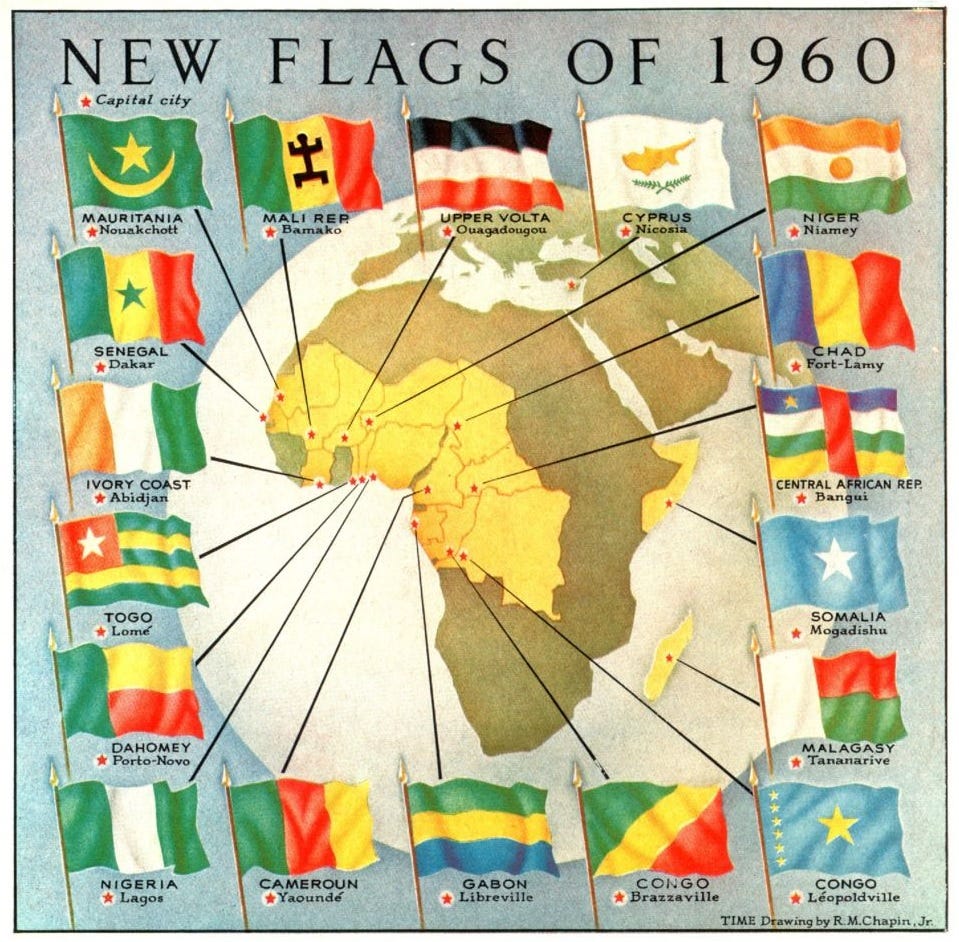
This is the story that introduces the third episode of World’s Toughest Job. We start with it for three reasons. First, for what the UN did to support the independence of these new countries. Second, for how a surge of new Member States gave the UN renewed purpose despite the gridlock of the Cold War. And, for why this episode resonates as the UN is forced once again to reassess its role as a development actor.

The UN is often criticized as a talk shop, but Bunche was a doer. As Kal Raustiala, author of The Absolutely Indispensable Man, explains in the podcast, the collapse of empires was Bunche’s life work. “The process of decolonization was something that he had studied as a graduate student and as a professor at Howard,” Raustiala argues. “When he [Bunche] joins the UN, Africa continues to be something he’s very interested in, especially as a Black man, that’s a particular kind of personal interest, but it was his real academic expertise.”
Long before the Year of Africa made headlines, Bunche was maneuvering behind the scenes, leveraging the UN’s heft to advise emerging African leaders. To get the system fully behind independence, he needed the support of his boss, who spent his days consumed by Cold War crises and knew very little about Africa. But that had now changed. As he sat on the Wellesley platform, Bunche had just returned from a grueling six-week, 21-country tour of the continent, with Hammarskjöld leading the delegation.
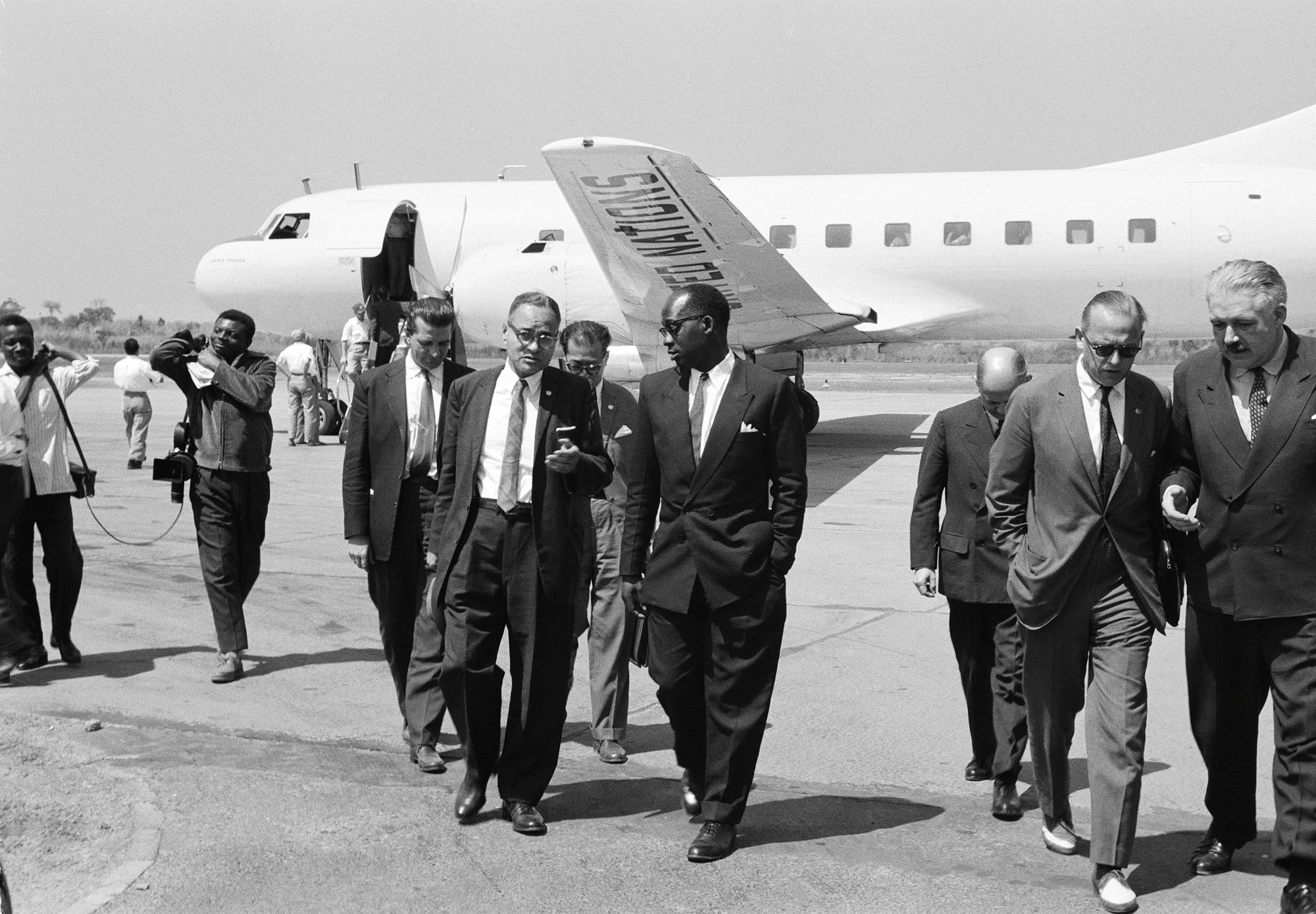
The Secretary-General and his entourage traveled in a specially outfitted aircraft that served as a diplomatic command center. On World’s Toughest Job, Raustiala talks about the monkey, Greenback, that Hammarskjöld brought back from the trip, but the detail that sticks with me is the Swedish Christmas tree he strapped inside the plane’s cabin to remind him of home. The Secretary-General had designed the itinerary to bypass colonial intermediaries and communicate directly with African leaders and UN personnel on the ground. His message: How can we help?
It was the right question. The UN team saw firsthand the damage caused by departing colonial powers, as they stripped away the administrative, economic, and institutional scaffolding necessary to run a modern state. When Guinea voted for independence in 1958, France withdrew all colonial administrators, doctors, and as much capital as it could. Two years later in the Congo, fleeing Belgian administrators took the architectural blueprints and legal codes with them. According to Raustiala, “there were only 17 college graduates in the entire country,” whose population at the time was around 15 million.
Bunche had long believed that “peace must be paced by human progress” and that to have meaning “it must be translated into bread or rice, shelter, health, and education, as well as freedom and human dignity — a steadily better life.” Hammarskjöld returned from Africa in full agreement. The UN needed to become an active institutional ally to newly independent states, he concluded, channeling economic support multilaterally rather than bilaterally (as he believed the superpowers were using their money primarily to secure proxy states). “The billions put up would be better billions in terms of peace and world progress if they were put up in a form which was more adjusted to the real political needs of the receiving countries,” Hammarskjöld said.
That also meant providing more than money. Against the opposition of European colonial powers, Hammarskjöld and Bunche had fought to create the UN Economic Commission for Africa, as a center for economic sovereignty and a platform for developing the statistical machinery required for planning. The UN also created a program known as OPEX that deployed central bankers, economic planners, infrastructure coordinators, and other international experts to states that wanted them. These were not aid workers but seconded public servants who took orders from their host governments. The UN sent an executive economist to the Government of Libya, an air traffic controller to manage the skies over Tunisia, and broadcasting directors to Sudan. This program went far beyond Africa. More than 60 countries eventually signed up for this kind of help.
But Africa shaped the UN even more than the UN changed Africa. The opening of the 15th session of the UN General Assembly in the autumn of 1960 was a shock to the old world order. The General Assembly Hall was designed for 70 delegations, but, as Raustiala reminds us in the podcast, membership was now breaking through the 100-country mark with Africa the largest regional bloc. Western powers, which were suddenly losing votes in the General Assembly, felt threatened, and every country sent its heavyweights to New York to jostle for influence. U.S. President Dwight D. Eisenhower, Soviet Premier Nikita Khrushchev, Cuba’s Fidel Castro, Yugoslavia’s Josip Broz (Tito), India’s Jawaharlal Nehru, and Egypt’s Gamal Abdel Nasser were all in the same building. Castro attended in military fatigues and delivered what remains the longest speech (269 minutes) in UN General Assembly history.
Khrushchev was at the heart of the backlash from the UN’s traditional powers, repeatedly interrupting speakers and pounding his fists on his desk. When a delegate from the Philippines accused the Soviet Union of imperialism, Khrushchev exploded, calling the delegate a “jerk, a stooge, and a lackey of imperialism.” According to legend, when his microphone was cut, Khrushchev took off a shoe and banged it furiously on the desk to drown out the speaker.
Africa’s leaders, who had come with a message of non-alignment and anti-colonialism, were appalled. Guinea’s young President, Ahmed Sékou Touré, canceled his flight home to return to the UN and demand the floor to scold both the communist bloc and the West. He reminded the room that the UN was located near a famous monument: “The Statue of Liberty ... represents not American liberty alone, but liberty for all peoples and all men.” The entire Assembly rose in ovation.
Amid the hubbub, the shift in the balance of power was palpable. According to Raustiala, African nations “didn’t have a lot of economic power, but they had political power, particularly in the General Assembly, where it was one nation, one vote.” By December, the regional bloc had successfully pushed through the Declaration on the Granting of Independence to Colonial Countries and Peoples. The subjugation of peoples by colonial powers was formally declared a violation of fundamental human rights. The African bloc also supported the launch of the first UN Development Decade, the expansion of OPEX, and then, in 1965, its absorption into the newly created UN Development Programme (UNDP).
So what does this history lesson mean for today? In the podcast, panelists ask what the UN can do to support today’s great development challenge: creating opportunities for the largest generation of young people in history and helping young countries build power in the global economy.
While researching this history, a further question occurred to me. When Hammarskjöld and Bunche scrambled to build the development system in the 1960s, they put the international system in the service of governments that were fighting to keep their heads above water. But doesn’t that describe the predicament of almost every country today, as states are outthought and even outspent by private actors, and as a wave of shocks from across borders leaves citizens enraged by each new failure to exert national control?
If the global order of the 20th century was built by strong states, maybe the UN in the 21st century needs to act as a mutual defense pact for besieged states. And, if that is true, maybe a new form of intergovernmentalism is needed. And just as happened in 1960, perhaps a new Secretary-General will need to think very differently about the services governments want the UN — and the broader international system — to provide.
A year after the Wellesley College symposium, and after the conclusion of the Year of Africa, Dag Hammarskjöld returned to the Congo, with Paul Hofmann reporting on his hope that unity would prevail over factionalism. He was killed later in the year when his plane crashed in mysterious circumstances as he once again tried to fly into the country. He gave his life trying to prove that the international system could stand as the last line of defense for a besieged government. In a fractured world, and for a fractious UN, maybe that is again the only mandate that matters